
Picking between Bybit and Bitget feels a bit like choosing between two gyms that both promise the same six-pack. The marketing pages look identical, the bonuses look identical, and somehow you still have to decide before your coffee gets cold.
This guide skips the sales pitch. It looks at what each exchange actually charges, who actually regulates them, and what happens when things go wrong — because in crypto, something eventually goes wrong.
Quick Verdict — Bybit vs Bitget at a Glance
| Category | Bybit | Bitget |
|---|---|---|
| Founded | 2018, Dubai HQ | 2018, Seychelles-linked HQ |
| CEO | Ben Zhou | Gracy Chen |
| Users | Roughly 60 million | Roughly 120 million |
| EU license | Full MiCA license (Austria) | National VASP registrations only |
| Spot fee (base) | 0.10% | 0.10% |
| Futures taker fee | 0.055% | 0.06% |
| Native token discount | MNT, up to 25% | BGB, up to 20% |
| Major hack | $1.5B, February 2025 | $1M (BitKeep wallet), 2022 |
| Best for | Derivatives traders, EU users | Copy traders, altcoin hunters |
Neither exchange is “bad.” They’re built for slightly different traders, and that difference matters more than any single fee.
1. Company Background & Trust Factor
Both exchanges launched in 2018, which makes them roughly the same age in an industry where three years can feel like a decade.
Bybit is led by co-founder and CEO Ben Zhou and now runs out of Dubai, after relocating its headquarters in 2022. It has grown into one of the largest exchanges globally by trading volume, and it recently opened a European headquarters in Vienna to support its EU license.
Bitget operates under CEO Gracy Chen, who took the role in 2024, and the company reports serving over 120 million registered users across roughly 150 countries. Bitget doesn’t publish a single clear headquarters location the way Bybit does, which is a minor transparency gap worth noting.

Trust in crypto isn’t built on a logo. It’s built on licenses, audits, and how an exchange behaves the day something breaks. Both companies now publish Proof of Reserves reports, which is table stakes in 2026, not a bonus feature.
2. Supported Countries & Regulatory Restrictions
Neither exchange serves the United States. That’s the first filter for a lot of readers, and it rules both platforms out instantly if you’re a US resident.
Bybit’s regulatory footprint currently looks stronger on paper. Austria’s Financial Market Authority granted Bybit EU a full MiCA license in May 2025, giving it passporting rights across all 29 EEA countries. Bybit also holds a Dubai VARA license and operates under Hong Kong’s VATP framework.
Bitget’s approach is broader but shallower. It holds licenses or registrations in El Salvador (DASP and BSP), Australia (AUSTRAC), Italy, Poland, Lithuania, and a handful of other jurisdictions, but it hasn’t secured a full MiCA CASP license yet, which puts it a step behind Bybit, Kraken, and OKX in Europe.
Both exchanges restrict a similar list of countries, including mainland China, Singapore’s retail market, and various sanctioned states. If you’re outside those restricted zones, access isn’t the deciding factor — compliance depth is.
For a country-specific breakdown, our UAE exchange guide and Singapore exchange guide cover local access rules in more detail.
3. Account Setup & KYC Process
Signing up takes about the same five minutes on both platforms: email, password, and a selfie with your ID.
Bybit eliminated its no-KYC tier. Standard Verification — a government ID plus a live selfie — is now mandatory before you can trade, withdraw, or use derivatives. This happened gradually after regulators worldwide pushed exchanges to close identity gaps.
Bitget made the same move. Government ID and facial verification have been required for deposits, trading, and withdrawals since January 2024, closing the older workaround that let people trade unverified.
Translation: the “quick account, verify later” era is over on both exchanges. Budget 10–15 minutes if your document photo doesn’t upload cleanly on the first try, because it never does.
4. Trading Fees Breakdown
This is where most comparisons get lazy and just copy a fee page. Let’s actually do the math.
Spot trading is a near-perfect tie. Both charge a base rate of 0.10% maker and 0.10% taker. Bybit’s native token, MNT, cuts that by up to 25%, landing around 0.075%. Bitget’s BGB token discount is 20%, landing around 0.08%. The gap is roughly half a basis point — not enough to change your life.
Futures trading is where Bybit pulls slightly ahead. Bybit charges 0.02% maker and 0.055% taker at the base tier. Bitget charges the same 0.02% maker but 0.06% taker. On a $100,000 taker order, that’s $55 on Bybit versus $60 on Bitget.
The gap narrows — and sometimes reverses — at higher volume. Bitget’s VIP ladder rewards active traders faster in some tiers, meaning a high-frequency trader might actually pay less on Bitget once BGB discounts stack with VIP status.
Bottom line: casual traders won’t notice the difference. Active futures traders should run their own numbers using each platform’s live fee calculator before committing serious volume, since VIP thresholds shift.
5. Product Range & Trading Tools
Bybit leans into derivatives depth. It supports over 1,300 tradable assets, offers TradeGPT (an AI trading assistant), copy trading, crypto loans, and — as of 2026 — TradFi perpetuals that let users trade tokenized US stocks and commodities like gold and crude oil as USDT-quoted contracts.
Bitget’s strength is copy trading. It runs one of the largest copy-trading networks in the industry, letting beginners mirror verified traders automatically. It also lists over 650 tokens, giving it a wider spot catalogue for altcoin hunters, plus futures, launchpool events, and its own non-custodial Bitget Wallet ecosystem.
If you want to build your own strategy with heavier tools, Bybit fits better. If you’d rather copy someone who already knows what they’re doing, Bitget’s copy-trading infrastructure is more mature.
6. Security Track Record
Neither exchange has a spotless past, and pretending otherwise would defeat the point of this article.
Bybit suffered the largest crypto theft in history on February 21, 2025, when North Korea’s Lazarus Group (also tracked as TraderTraitor by the FBI) stole roughly $1.5 billion in Ethereum. The attackers compromised the Safe{Wallet} multisig interface Bybit used for cold-to-warm wallet transfers, injecting malicious code that made a fraudulent transaction look legitimate. Bybit restored full withdrawal service within about 12 hours and reported that 99.99% of withdrawal requests processed normally during the incident, according to its own published timeline.
Bitget’s history is smaller in scale but not spotless either. Its BitKeep wallet (now Bitget Wallet) suffered two incidents in 2022 — a swap-feature exploit costing roughly $1 million and a counterfeit-app hack later that year — and the company committed to reimbursing affected users. In April 2025, Bitget also dealt with a VOXEL token market-manipulation incident that reportedly caused around $20 million in losses.
Since the 2025 hack, Bybit has rebuilt reserves and expanded regulatory oversight. Bitget currently maintains a Protection Fund exceeding $300 million and holds an “AA” transparency rating on CER.live. Both now publish monthly Merkle-tree Proof of Reserves reports that users can verify against their own account hash.
Neither incident should be the sole reason to avoid a platform in 2026 — both companies responded and rebuilt — but both are facts worth knowing before you park significant funds anywhere.
7. User Experience: App & Interface
Bybit’s interface is powerful but dense. Beginners often describe it as “everything, all at once,” which is accurate for a platform built around derivatives traders who want charts, order books, and funding rates visible simultaneously.
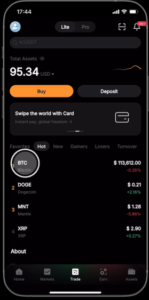
Bitget’s layout feels friendlier to newcomers. The copy-trading tab is front and center, onboarding tooltips are more frequent, and the overall visual hierarchy assumes you might be trading for the first time.
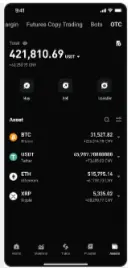
Neither interface is objectively “better.” A day trader running multiple charts will likely prefer Bybit’s density. Someone who wants to follow a strategy without building one from scratch will probably feel more at home on Bitget.
8. Withdrawal Fee Comparison Table
Withdrawal costs are network fees, not platform fees, and they shift with blockchain congestion. Here’s the structural comparison rather than a snapshot that goes stale next week:
| Factor | Bybit | Bitget |
|---|---|---|
| Deposit fees | Free | Free |
| Withdrawal fee model | Network-dependent | Network-dependent, some chains subsidized |
| Cheapest stablecoin route | TRC20 (USDT) | TRC20 (USDT) |
| P2P withdrawal fee | None (spread applies) | None (spread applies) |
| Fee transparency | Shown before confirmation | Shown before confirmation |
Both exchanges are functionally tied here. Always check the live withdrawal screen before confirming — network fees move independently of the exchange and can spike during busy periods.
9. Mobile App Comparison
Both apps mirror their desktop personalities closely.
The Bybit app packs in advanced charting, TradingView integration, and full derivatives functionality, which makes it genuinely usable for serious trading on the go — but it can overwhelm a first-time crypto buyer.
The Bitget app puts copy trading and the Earn section within one or two taps of the home screen, and its simplified order interface makes market and limit orders easier to execute without digging through menus.
App store ratings for both platforms fluctuate with market volatility (angry reviews spike during price crashes on every exchange, not just these two), so treat star ratings as a mood indicator more than a security metric.
10. Fiat On-Ramp & Payment Method Comparison
Both exchanges support card purchases, bank transfers in select regions, and active P2P marketplaces where users trade directly using local payment methods like bank apps, PayPal-style services, or regional transfer networks.
Bybit’s P2P desk is deep and multi-currency, useful for traders in regions with limited direct banking rails. Bitget runs a comparable P2P system plus GroupCoin, a bulk-buy feature that lets users pool orders for better pricing on certain tokens.
Neither platform charges a platform-side fee for P2P trades; the cost sits in the spread the seller sets. If your local currency has a strong P2P community on one platform over the other, that alone might decide your winner.
11. Liquidity & Order Execution
Bybit consistently ranks among the top two or three exchanges globally by trading volume, and that volume translates into tighter spreads and less slippage on major pairs like BTC/USDT and ETH/USDT, especially in derivatives markets.
Bitget’s liquidity is strong on its most popular futures pairs and altcoins tied to its copy-trading ecosystem, but it can thin out faster on lower-cap tokens compared to Bybit’s order books.
For large market orders on major coins, Bybit generally offers better execution. For niche altcoins that Bitget lists but Bybit doesn’t, liquidity comparisons become irrelevant — availability wins by default.
12. Staking & Earn APY Comparison
Both exchanges run “Earn” hubs with flexible and fixed-term products, and both use tiered rates that make headline APY numbers misleading if you don’t read the fine print.
Bybit’s Easy Earn often advertises eye-catching APRs on USDT, but those rates typically apply only to the first small tranche of a deposit (for example, the first 200 USDT), after which the blended rate drops sharply. Bybit also offers On-Chain Earn, fixed-term deposits, and liquid staking for assets like ETH.
Bitget’s Simple Earn works similarly, with flexible and fixed products, APR boosts, and campaign-based promotions layered on top of a base rate.
The honest takeaway: neither platform’s advertised APY is the number you’ll actually earn on a meaningful balance. Always check the tiered breakdown before assuming the top-line rate applies to your entire deposit.
13. Customer Support Reality Check
Both exchanges offer 24/7 live chat and a searchable help center, and both lean heavily on AI chatbots for tier-one questions before routing you to a human.
Bybit’s support tends to move faster on account-verification issues, likely a byproduct of scaling up compliance staff after its 2025 hack and EU expansion. Bitget’s support handles copy-trading and Earn-product questions well, since those are its flagship features.
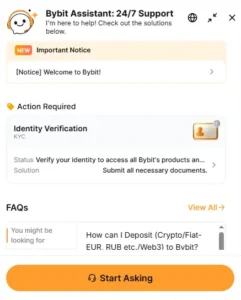
Neither platform offers phone support, which is standard across the crypto exchange industry, not a red flag unique to either company. If you need urgent help during a market crash, expect chat queues on both platforms — everyone else is messaging support at the same time you are.
14. Unique Differentiators — What Sets Each Exchange Apart
Bybit’s edge: a full MiCA license, TradFi perpetuals on stocks and commodities, TradeGPT’s AI assistant, and one of the deepest derivatives order books in the industry.
Bitget’s edge: the largest and most mature copy-trading network among major exchanges, a wider spot listing catalogue, GroupCoin bulk buying, and a genuinely beginner-friendly app layout.
If you had to describe the split in one line: Bybit built a serious trading terminal, and Bitget built a social trading platform that also happens to have a serious trading terminal underneath it.
15. Pros and Cons
Bybit
- Full MiCA license across 29 EEA countries
- Slightly lower futures taker fees
- Deep liquidity on major pairs
- Recovering from the largest crypto hack on record (2025)
- Interface can overwhelm true beginners
Bitget
- Massive copy-trading network, ideal for passive strategy followers
- Wider altcoin selection (650+ tokens)
- $300M+ Protection Fund and AA transparency rating
- No full MiCA license yet
- Headquarters transparency is weaker than Bybit’s
16. Verdict by User Type
Beginners: Bitget’s guided interface and copy-trading tools lower the learning curve significantly.
Active derivatives traders: Bybit’s lower taker fees and deeper liquidity matter more once volume scales up.
EU-based users: Bybit’s MiCA license gives it a clearer regulatory edge right now.
Altcoin hunters: Bitget’s broader token catalogue wins outright.
Security-cautious users: Both have visible histories; review each exchange’s Proof of Reserves and licensing pages yourself rather than taking either brand’s word for it.
17. Which Exchange Is Better? (Final Verdict)
There isn’t a universal winner here, and any comparison claiming otherwise is oversimplifying to sell you something.
Bybit is the stronger pick for active traders who want regulatory clarity in Europe, tighter derivatives fees, and deep liquidity on major pairs. Bitget is the stronger pick for beginners who want to learn by copying experienced traders, and for anyone chasing a wider selection of altcoins.
Judge them on what you’ll actually use — fee schedule, licensing footprint, and product fit — not on which one has the louder marketing budget this quarter. For a deeper look at how Bybit stacks up against other major platforms, see our full Bybit review and Bybit vs MEXC comparison.
18. Frequently Asked Questions
Is Bybit or Bitget better for beginners? Bitget generally suits beginners better because of its copy-trading tools and simpler app layout. Bybit’s feature depth can feel overwhelming for a first-time trader.
Which exchange has lower fees? Spot fees are essentially tied. Bybit has a small edge on futures taker fees, while Bitget can pull ahead for high-volume traders once BGB and VIP discounts stack.
Is Bybit safe after the 2025 hack? Bybit restored withdrawals within about 12 hours of the February 2025 incident and has since expanded its regulatory licensing, including a full MiCA license in the EU. Past security incidents don’t disappear, but they don’t automatically disqualify a platform that has since strengthened its controls.
Is Bitget regulated? Bitget holds licenses and registrations in several jurisdictions, including El Salvador, Australia, and parts of the EU, but it does not yet hold a full MiCA CASP license, unlike Bybit.
Can US residents use Bybit or Bitget? No. Both exchanges restrict US residents under their current terms of service.
Which exchange has better liquidity? Bybit generally offers deeper liquidity on major pairs like BTC and ETH, which benefits large market orders and reduces slippage.
Do Bybit and Bitget require KYC? Yes. Both exchanges made identity verification mandatory for trading and withdrawals, closing earlier no-KYC options.
This article is for informational purposes only and does not constitute financial advice. Fees, licenses, and product terms change; always verify current details directly on each exchange’s official website before trading.
