
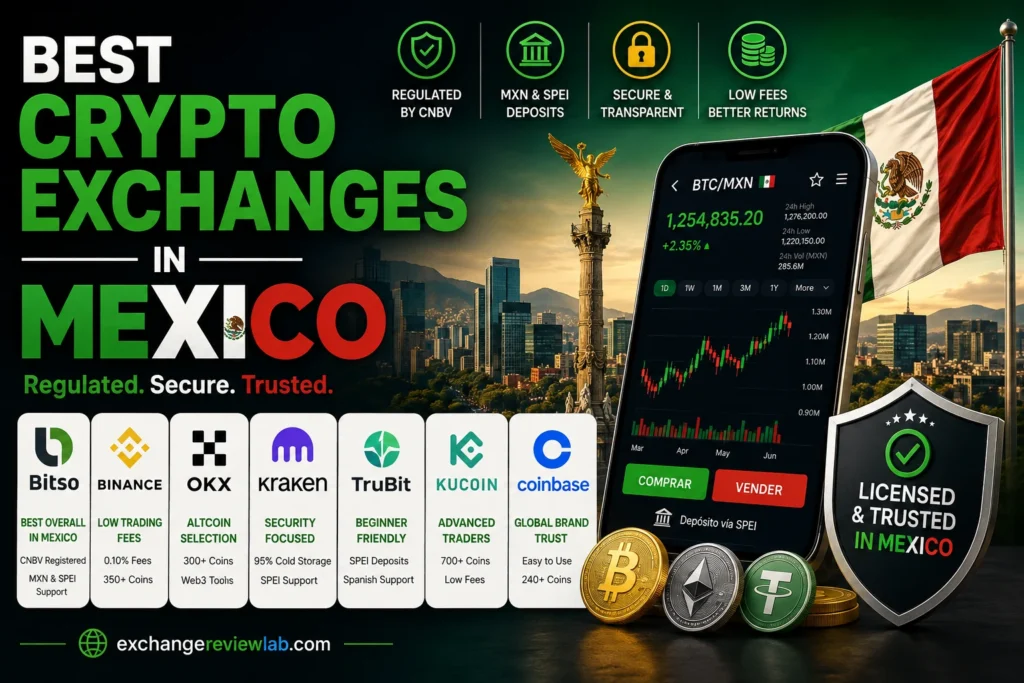
Mexico has one of the most unusual crypto rulebooks in the Western Hemisphere. Buying and holding digital assets is completely legal for individuals, yet the country’s own banks are barred from touching crypto for their customers. That gap is exactly why exchanges — not banks — have become the default gateway for millions of Mexican users.
If you have ever tried to pick an exchange by opening ten browser tabs and comparing screenshots, you already know how messy this decision gets. This guide cuts through that. We compare the platforms that actually matter for someone funding an account in pesos, moving money through SPEI, and eventually reporting gains to the SAT.
How We Ranked the Best Crypto Exchanges for Mexico
We did not just copy a global “top exchanges” list and swap the flag icon. Ranking exchanges for Mexico specifically means weighing things that a US or European ranking would ignore entirely.
Here is what carried the most weight:
- MXN and SPEI support. An exchange that forces you to convert pesos to dollars before you can deposit is a worse fit than one with a native peso rail, even if its trading fee is marginally lower.
- Regulatory standing under Mexico’s Fintech Law. We checked whether each platform is registered with, or actively supervised by, Mexico’s National Banking and Securities Commission (CNBV), and how it has responded to Banxico’s restrictions on financial institutions offering crypto.
- Trading and withdrawal fees. Listed maker/taker rates plus what it actually costs to move pesos in and crypto out, since spread-based pricing can quietly cost more than a stated “zero fee” deposit suggests.
- Security track record. Cold storage ratios, proof-of-reserves practices, audit history, and whether the exchange has suffered a material breach.
- Coin selection and trading tools. Whether the platform covers the basics (BTC, ETH, major stablecoins) or goes deep into altcoins, derivatives, and Web3 tools for more advanced traders.
- Customer support quality, including Spanish-language coverage, since English-only support is a real friction point for a large share of Mexican users.
We relied on each exchange’s published fee schedules, licensing pages, and security disclosures, cross-checked against independent reviews, rather than assuming marketing copy is accurate. Where sources disagreed on a fee figure, we noted the range rather than picking whichever number looked best.
Quick Comparison: Best Crypto Exchanges for Mexico
| Exchange | Best For | Mexico Regulatory Status | Spot Trading Fee | MXN Deposit Fee | Withdrawal Fee | Min. Deposit | Coins Supported | Cold Storage | Support |
|---|---|---|---|---|---|---|---|---|---|
| Bitso | Best Overall in Mexico | CNBV-registered (ITF), also licensed in Brazil, Argentina, and Gibraltar (GFSC) | ~0.04%–0.05% (USD market), up to 0.60% on MXN pairs | Free via SPEI on standard transfers | Varies by coin, network fee passed through | No fixed minimum for SPEI transfers | 100+ | Multi-signature cold storage | 24/7, strong Spanish support |
| Binance | Low Trading Fees | Operates in Mexico without a CNBV exchange license; access and features can change | 0.10% maker/taker, lower with BNB discounts | P2P/card-based, no direct SPEI integration | Network-dependent, varies by coin | Low, card/P2P dependent | 350+ | SAFU insurance fund, majority in cold storage | 24/7 live chat, Spanish supported |
| OKX | Altcoin Selection & Web3 Tools | Partially regulated for Mexico; MXN funding limited to P2P and cards | 0.08% maker / 0.10% taker | No direct SPEI, P2P/card fees apply | Network fee only, no extra OKX charge | Low, P2P dependent | 300+ | Majority in cold storage, monthly Proof of Reserves | 24/7 chat, limited Spanish depth |
| Kraken | Security-Focused Traders | Not CNBV-licensed; MXN handled via conversion, not held as balance | 0.12%–0.26% (Pro tier) | 0.5% fee, minimum 150 MXN via SPEI | Standard network withdrawal fees | 150 MXN equivalent | 200+ | ~95% cold storage, ISO 27001 and SOC 2 certified | Email/chat, limited Spanish hours |
| Coinbase | Beginners Wanting a Global Brand | Not CNBV-licensed; no direct SPEI support | ~1.49% plus spread (higher than most on this list) | Not SPEI-native, card fees apply | Varies, generally higher than peers | Card/bank dependent | 240+ | Majority in cold storage, publicly traded and audited | Standard support tiers, app-based help |
| TruBit | Stablecoin & App-First Users | Operates under Mexico’s IFPE/Fintech Law framework | Competitive spot fees, varies by pair | SPEI supported | Network fee dependent | Low | Moderate range, stablecoin-focused | Cold storage held, smaller audit footprint than global majors | Spanish-first support |
| KuCoin | Advanced/Pro Traders | Not CNBV-licensed; no dedicated MXN rail | Around 0.10%, reduced with KCS holdings | No SPEI, third-party on-ramps only | Network-dependent | Low, on-ramp dependent | 700+ | Cold storage plus insurance fund | 24/7 chat, limited Spanish depth |
Fees and coin counts change often, so treat the table as a snapshot rather than a permanent number. Always confirm current fees directly on the exchange’s official fee schedule before funding an account.
Bitso – Best Overall Crypto Exchange in Mexico

Bitso was founded in Mexico City in 2014, which already sets it apart from every global competitor on this list. It has grown into Latin America’s largest exchange, and it plays a real role in the region’s economy: the platform has processed billions of dollars in remittances between the US and Mexico, not just speculative trading volume. That is a meaningfully different use case from “buy Bitcoin and hope.”
Bitso is registered under Mexico’s Fintech Law with the CNBV, and it also holds licenses in Brazil, Argentina, and Gibraltar. For a Mexican user, that regulatory footprint matters more than a slightly lower fee on a competing platform, because it directly answers the question “what happens if something goes wrong.”
Pros
- Native MXN and SPEI integration, including free standard bank transfers
- CNBV registration plus additional regional licenses
- Local, responsive Spanish-language customer support
- Yield products and stablecoin (“Digital Dollars”) options for hedging peso volatility
Cons
- Coin selection is smaller than global giants like Binance or KuCoin
- Fees on the basic MXN trading interface can be higher than on its Pro platform
- Less useful if your main interest is derivatives or advanced altcoin trading
Binance – Best for Low Trading Fees
Binance remains the largest exchange in the world by trading volume, and its 0.10% baseline trading fee is hard to beat once you strip away spreads and hidden markups. Fee discounts for holding or paying with BNB push that even lower for active traders.
The catch for Mexican users is funding. Binance does not offer direct SPEI integration, so deposits typically run through P2P transfers or card payments, both of which add friction and cost compared to Bitso’s native peso rail.
Pros
- Among the lowest headline trading fees of any major exchange
- Massive coin selection, from blue-chip assets to smaller altcoins
- Advanced tools: futures, margin, bots, and a full derivatives suite
- Spanish-language interface and support
Cons
- No direct SPEI deposit, meaning slower and sometimes costlier funding
- Regulatory footprint in Mexico is less formalized than Bitso’s
- Feature-heavy interface can overwhelm first-time users
TruBit – Best for Beginners
TruBit operates under Mexico’s Fintech Law framework and leans into simplicity: SPEI support, a stablecoin-friendly product line, and a Spanish-first interface designed for people who are not already crypto-native. If your main goal is buying, holding, and occasionally converting to a stablecoin without wading through futures menus, it is a comfortable starting point.
Pros
- SPEI-supported peso deposits
- Simple app interface aimed at first-time users
- Operates within Mexico’s fintech regulatory framework
Cons
- Smaller coin selection than global exchanges
- Less independent security auditing history than the largest platforms
- Liquidity on less common pairs can be thinner
Kraken – Best for Security

Kraken has operated since 2011 without a major security breach, which is a genuinely rare claim in this industry. It was also the first exchange to complete a public Proof of Reserves audit, holds roughly 95% of assets in cold storage, and carries ISO/IEC 27001:2022 and SOC 2 certifications.
For Mexican users, Kraken does support MXN deposits and withdrawals through SPEI, but pesos are automatically converted to USD on arrival — the platform does not hold an MXN balance — and there is a 0.5% fee with a 150 MXN minimum.
Pros
- Long, clean security track record and third-party audits
- Strong regulatory and compliance certifications
- SPEI deposit and withdrawal support
Cons
- SPEI fee and minimum are higher than Bitso’s free transfers
- Interface and support lean English-first
- Trading fees (0.12%–0.26% on Pro) sit above Binance’s baseline rate
OKX – Best for Altcoin Selection
OKX covers more than 300 cryptocurrencies with maker/taker fees around 0.08%/0.10%, and it layers in DeFi and Web3 tools that experienced traders actually use — a built-in Web3 wallet, launchpad access, and a broad derivatives suite. It also publishes monthly Proof of Reserves reports using Merkle tree verification, which lets users independently check that their balance is included.
Regulatory status for Mexico specifically is thinner than Bitso’s or Kraken’s, and MXN funding runs through P2P transfers or card payments rather than SPEI. It is also worth knowing that OKX settled with US authorities over anti-money-laundering violations for more than $500 million, which is a compliance data point worth weighing alongside its technical strengths.
Pros
- Deep altcoin and token selection, plus DeFi/Web3 integration
- Competitive, transparent fee structure
- Monthly, self-verifiable Proof of Reserves
Cons
- No direct SPEI integration for Mexican pesos
- Regulatory standing in Mexico is less formalized than local competitors
- Past AML settlement is a legitimate diligence point
KuCoin – Best for Advanced/Pro Traders

KuCoin‘s headline feature is scale: over 700 supported coins, which is the deepest altcoin catalog on this list by a wide margin. Trading fees sit around 0.10%, with further discounts for holding KCS. Security includes cold storage plus a dedicated insurance fund.
There is no dedicated MXN rail, so Mexican users typically rely on third-party on-ramps to fund an account, and KuCoin does not hold a CNBV registration. This is a platform built for traders who already know exactly which obscure token they want, not for someone opening their first account.
Pros
- Largest coin selection among major exchanges
- Competitive fees, reducible further with native token holdings
- Insurance fund layered on top of cold storage
Cons
- No native MXN or SPEI support
- Not CNBV-registered
- Overkill for beginners who just want BTC or ETH
Read more:
Coinbase – Runner-Up for Global Brand Recognition

Coinbase is publicly traded on Nasdaq, has strong global brand recognition, and offers one of the cleanest, most beginner-friendly apps in the industry, backed by solid educational content. For Mexican users specifically, though, it is one of the least practical choices on this list: its effective fees run near 1.49% plus spread — the highest of any exchange compared here — and there is no direct SPEI support, which makes funding both slower and more expensive.
Pros
- Publicly audited, Nasdaq-listed company
- Very beginner-friendly interface and educational resources
- Strong global brand trust
Cons
- Highest effective fees on this list
- No native MXN or SPEI integration
- Less competitive for anyone trading more than occasionally
Read more:
Deposit and Withdrawal Speed Comparison
Speed matters differently depending on how you fund your account:
SPEI transfers (Bitso, Kraken, TruBit): Typically settle same-day, often within minutes during business hours, since SPEI is Mexico’s real-time interbank transfer system.
P2P and card-based funding (Binance, OKX, KuCoin): Timing depends on the counterparty or card processor, and can range from minutes to longer holds, especially on first-time verifications.
Crypto withdrawals: Speed is mostly a function of the blockchain network you choose, not the exchange itself — a USDT withdrawal on a congested network will always be slower than the same withdrawal on a faster chain, regardless of which exchange you use.
Bank withdrawals back to MXN: Exchanges with native SPEI support tend to be faster and cheaper here too, since a conversion step (crypto to USD to MXN) adds both time and cost on platforms without direct peso rails.
If speed and low friction on both ends of a transaction matter most to you, an SPEI-native exchange like Bitso has a structural advantage that a lower headline trading fee elsewhere cannot fully offset.
Is Crypto Trading Legal in Mexico?
Yes — cryptocurrency is legal for individuals and most businesses in Mexico, but it exists in what is genuinely one of the more unusual regulatory setups in Latin America. The 2018 Fintech Law and Banxico rules created a split system: open market access, restricted for financial institutions. Crypto exchanges operate legally under strict AML/KYC rules, filling the gap left by banks.
In plain terms: you personally can buy, sell, and hold crypto without breaking any law. What you will not find is your regular bank offering to do it for you, because financial institutions are restricted from using crypto as a means of payment or settlement, while licensed exchanges can operate as long as they comply with strict anti-money laundering and know-your-customer regulations enforced by Mexico’s Financial Intelligence Unit.
Three government bodies share oversight of this space. Banxico handles oversight of how financial institutions interact with virtual assets, the CNBV manages licensing, and the Ministry of Finance oversees tax policy and anti-money-laundering enforcement. Mexico’s fintech industry has also been pushing regulators for an update to the original framework, with industry groups jointly seeking a clearer framework for crypto assets and open finance under a “Fintech Law 2.0.”
So the short version: trading is legal, exchanges are legal if they follow AML/KYC rules, and banks are the one piece of the system that stays firmly on the sidelines.
Factors to Consider When Choosing a Crypto Exchange in Mexico
Before you pick a platform, run through this checklist:
Peso funding method. Does the exchange support SPEI directly, or will you be routed through card payments and P2P transfers with extra steps and fees?
Regulatory status. Is the exchange registered under Mexico’s Fintech Law with the CNBV, or operating in a regulatory gray zone that could shift with future policy changes?
Real cost of trading. Look past the headline maker/taker rate. Spread-based pricing on “beginner” interfaces can quietly cost more than the advertised percentage suggests.
Security posture. Cold storage percentage, proof-of-reserves practices, and whether the exchange has a documented history of breaches.
Coin and product range. Match this to what you actually plan to do — a beginner buying BTC and ETH needs far less than an active trader running derivatives strategies.
Support quality in Spanish. English-only support is a real barrier for many users if something goes wrong with a withdrawal or a locked account.
Tax record-keeping tools. Since Mexico requires you to track and report gains, an exchange with clean exportable transaction history saves real time at filing season.
Centralized vs. Decentralized Exchanges: Which Is Right for You?
Centralized exchanges (CEXs) — Bitso, Binance, Kraken, OKX, Coinbase, KuCoin, TruBit — hold your funds on your behalf, handle KYC verification, and offer customer support if something goes wrong. For most Mexican users funding accounts in pesos, a CEX is the practical starting point: it is where fiat on-ramps, SPEI integration, and beginner-friendly interfaces actually exist.
Decentralized exchanges (DEXs) let you trade directly from a self-custodied wallet without handing funds to a third party. You keep control of your private keys, and there is no company that can freeze your account. The trade-off is real: no customer support line if you make a mistake, no fiat on-ramp from pesos, and a genuine learning curve around wallets, gas fees, and network selection.
A practical approach many users take: use a regulated CEX with MXN support for funding and day-to-day trading, then move longer-term holdings to a self-custodied wallet if you want to reduce counterparty risk. This is not financial advice — it is simply how the trade-off between convenience and control tends to get resolved in practice.
How to Start Trading Crypto in Mexico (Step-by-Step Guide)
Choose an exchange that matches your priorities. If MXN funding and regulatory footprint matter most, Bitso is the straightforward choice. If low fees and altcoin range matter more, Binance or KuCoin fit better.
Complete identity verification (KYC). You will typically need a government-issued ID (INE or passport) and proof of address. This step is required across every regulated exchange on this list.
Fund your account. Use SPEI where available for the fastest, cheapest peso deposit, or a card/P2P method where SPEI is not supported.
Place your first trade. Start with a well-established asset like Bitcoin or Ethereum before exploring smaller altcoins, and get comfortable with the order types (market vs. limit) before using leverage or derivatives.
Move to secure storage if holding long-term. Consider transferring larger amounts to a hardware or self-custodied wallet rather than leaving everything on an exchange indefinitely.
Keep records of every transaction. Save dates, amounts, and MXN values at the time of each trade — this becomes essential at tax time under SAT rules.
Withdraw or convert back to pesos as needed, factoring in network fees and, on non-SPEI exchanges, the extra conversion step back to MXN.
Crypto Tax Rules in Mexico
This is the part most beginners skip, and it is also the part where mistakes get expensive. Here is what applies as of current SAT guidance:
Crypto is not legal tender. Mexico’s tax authority applies its progressive Income Tax scale (ISR – Impuesto Sobre la Renta) to net crypto gains, and this rate varies according to total income bracket, ranging from roughly 1.92% for the lowest incomes up to 35% for the highest brackets.
Buying and holding is not taxable. You are only taxed when you sell, trade, or spend your cryptocurrency — merely buying and holding it does not trigger a tax liability.
Crypto-to-crypto swaps count as a taxable event. The SAT treats trading one virtual asset for another as a form of disposal, so you are treated as having sold the first crypto at its fair market value in pesos and immediately used the proceeds to buy the second.
There is no special crypto tax rate. Gains on crypto sales are simply added to total annual income and taxed at the individual’s marginal ISR bracket, with no preferential long-term rate and no crypto-specific regime.
Reporting requirements are tightening. From April 2026, the SAT gained real-time access to transaction data on digital platforms, and the OECD’s crypto reporting framework requires platforms to report user transactions to the SAT starting in 2026–2027.
Filing deadline. Annual returns covering crypto gains are generally filed the following April, alongside other income, and unreported crypto income carries the same penalties as unreported income from any other source.
Given how many gray areas remain in this framework, it is worth treating exchange-exported transaction history as a starting point and confirming your specific filing situation with a licensed Mexican contador público — not something to guess at from a blog post, including this one.
Frequently Asked Questions (FAQs)
Is it safe to trade crypto in Mexico? Trading itself is legal and, on a regulated exchange with strong security practices, reasonably safe from a platform-risk perspective. The bigger risks are the same ones that apply everywhere: market volatility, phishing scams, and poor personal security habits like reused passwords or skipped two-factor authentication.
Which exchange has the lowest fees for Mexican users? On headline trading fees alone, Binance and OKX are typically the cheapest, both sitting around 0.08%–0.10%. Once you factor in MXN funding costs, though, Bitso’s free SPEI transfers can make it cheaper overall for peso-based trading.
Do I need a Mexican bank account to use these exchanges? Not strictly, but it makes funding far easier. SPEI-supported exchanges like Bitso work directly with Mexican bank accounts, while card-based or P2P funding on platforms like Binance and KuCoin can work without one, at the cost of extra friction.
Can I use Binance or OKX legally in Mexico? Yes, individuals in Mexico can legally use these platforms. Their regulatory relationship with Mexican authorities is simply less formalized than Bitso’s CNBV registration, which is a distinction worth understanding rather than a legal barrier to using them.
Do I have to pay taxes on crypto I have not sold? No. Under current SAT guidance, holding crypto without selling, swapping, or spending it does not create a taxable event.
Is Bitso better than Binance for Mexican users? It depends on your priority. Bitso wins on MXN/SPEI integration, local regulatory standing, and Spanish-language support. Binance wins on headline trading fees and coin selection. Many active users end up using both for different purposes.
Final Verdict: Which Crypto Exchange Should You Choose?
If you want one straightforward answer: Bitso is the strongest overall choice for most people trading crypto in Mexico. It combines native SPEI integration, CNBV registration, and genuinely useful Spanish-language support — the three things that matter most once you move past the “which exchange has the lowest fee” question.
That said, this is not a one-size-fits-all decision:
Choose Binance if minimizing trading fees and accessing the widest range of coins and trading tools matters more to you than native peso banking.
Choose Kraken if a long, clean security track record is your top priority and you are comfortable with a slightly higher SPEI fee.
Choose OKX or KuCoin if you are an experienced trader chasing altcoin depth or DeFi/Web3 features.
Choose TruBit if you are brand new to crypto and want the simplest possible on-ramp in Spanish.
Whichever platform you pick, treat regulatory status, SPEI support, and documented security practices as non-negotiable filters — and keep clean records from day one, since Mexico’s tax reporting environment is only getting stricter. For deeper platform-by-platform breakdowns, including fee audits from real accounts, our KuCoin fees review, Binance vs OKX comparison, and Binance vs KuCoin comparison go into more detail than a single country guide can cover, and our beginner’s guide to crypto exchanges is a solid next stop if you are still getting comfortable with the basics.
This article is for educational purposes only and does not constitute financial, investment, or tax advice. Cryptocurrency trading carries significant risk, including the risk of loss. Fees, licensing status, and regulations referenced here can change; always verify current terms directly with the exchange and consult a licensed Mexican tax professional before filing.
