
Picking a crypto exchange in 2026 feels a bit like picking a bank that also lets you gamble, invest, and occasionally survive a nine-figure hack. Binance and Bybit sit at the top of that list, and traders ask the same question every year: which one is actually worth trusting with real funds?
This guide breaks down Binance vs Bybit across fees, security, regulation, products, and usability. No guesswork, no recycled marketing lines — just verified facts from regulators, court filings, and the exchanges’ own disclosures.
Quick Verdict — Binance vs Bybit at a Glance
Binance wins on scale. It runs the deepest liquidity on major pairs, the largest asset list, and a fee discount system through BNB that active traders genuinely use. If you want one account that does almost everything crypto-related, Binance is still the default choice for most people.
Bybit wins on focus. It built its entire platform around derivatives traders, and it shows. The interface stays clean, the maker fees on futures undercut Binance, and copy trading feels like a first-class feature instead of a bolted-on afterthought.
Neither exchange is a “set it and forget it” place to park your life savings. Both are centralized, both have paid heavily for past mistakes, and both expect you to understand that self-custody exists for a reason. Keep that in mind as you read the rest of this comparison.
| Feature | Binance | Bybit |
|---|---|---|
| Founded | 2017, by Changpeng Zhao (CZ) | 2018, by Ben Zhou |
| Headquarters | No fixed global HQ (regionally licensed) | Dubai, UAE |
| Registered users | 260M+ | 80M+ |
| Spot maker/taker fee | 0.10% / 0.10% (down to 0.075% with BNB) | 0.10% / 0.10% (down to ~0.09% with MNT) |
| Futures maker/taker fee | ~0.02% / ~0.05% | ~0.01–0.02% / ~0.055–0.06% |
| Max leverage | Up to 125x | Up to 100x |
| Tradable assets | ~400 coins | 1,600+ coins |
| KYC | Mandatory for full access | Mandatory for most products |
| US access | Blocked (Binance.US only, limited) | Fully blocked |
| EU status (2026) | Restricting services after missing MiCA approval | MiCA-licensed via Bybit EU (Austria FMA) |
| UAE license | VARA (Dubai) | VARA + full SCA licence (UAE-wide) |
| Major security incident | 2019 hack (~$40M, covered by SAFU) | Feb 2025 hack (~$1.5B, fully reimbursed in 72 hrs) |
| Insurance/reserve fund | SAFU, $1B+ | Monthly Proof-of-Reserves (Hacken-audited) |
| Standout strength | Liquidity, ecosystem breadth, altcoin selection | Derivatives tools, copy trading, cleaner UI |
| Best for | High-volume traders, altcoin hunters, all-in-one ecosystem users | Derivatives traders, EU users, copy-trading fans |
Company Background & Trust Factor
Binance launched in 2017, founded by Changpeng Zhao, known across the industry simply as CZ. Within a year, it became the largest crypto exchange in the world by trading volume, and it has mostly held that position since. Today the platform serves well over 260 million registered users globally.
That growth came with a serious asterisk. In November 2023, Binance pleaded guilty to violating US anti-money laundering laws and sanctions rules, agreeing to a settlement package worth roughly $4.3 billion with the Department of Justice, FinCEN, OFAC, and the CFTC. CZ personally pleaded guilty to a single Bank Secrecy Act violation, served four months in a US federal facility, and was released in September 2024. He remains a shareholder but has no operational role at the company anymore.
Bybit tells a different story. Ben Zhou co-founded the exchange in Singapore in 2018, and the company later moved its global headquarters to Dubai in 2022. Early backers reportedly included venture investor Peter Thiel, which gave the platform an unusual amount of credibility for a relatively young exchange.
Bybit’s defining moment arrived on February 21, 2025. Hackers linked to North Korea’s Lazarus Group breached a cold wallet during a routine transfer and stole roughly 400,000 ETH, worth about $1.5 billion at the time — the single largest crypto theft on record.
What happened next matters more than the hack itself. Bybit secured emergency ETH funding from partners like Galaxy Digital and Wintermute, restored full reserves within 72 hours, and processed nearly all customer withdrawals without delay. A subsequent proof-of-reserves audit by Hacken confirmed the exchange held over 100% collateralization across major assets.
So here’s the honest trust comparison. Binance survived a regulatory reckoning and came out the other side with a heavily monitored compliance program. Bybit survived a catastrophic hack and came out the other side solvent and transparent. Both stories end reasonably well. Neither should make you complacent.
Supported Countries & Regulatory Restrictions
Availability changes constantly in this industry, so treat any “supported country” list as a snapshot rather than gospel.
Binance blocks US residents from the main Binance.com platform entirely; Americans can only use Binance.US, a separate, more limited entity that also excludes several states outright.
Binance fully exited Canada in 2023 after new provincial securities rules landed, and it can no longer onboard new UK retail clients under FCA restrictions. The Netherlands and Russia saw full exits in 2023 as well.
In June 2026, Binance announced it would suspend services across additional EU countries after failing to secure a MiCA license in time, a significant setback in a region it had spent years courting. Its strongest current licenses sit in the UAE (VARA) and across parts of Asia and the Middle East.
Bybit restricts a similar list: the US, Canada, mainland China, Hong Kong, and Singapore among them, alongside standard sanctions-based blocks like Iran and North Korea. But its regulatory trajectory has moved in the opposite direction from Binance’s recent EU troubles.
Bybit EU GmbH secured a MiCA license from Austria’s FMA in May 2025, passporting regulated services across the European Economic Area.
The exchange also holds a full Virtual Asset Platform Operator License from the UAE’s Securities and Commodities Authority, registration with India’s Financial Intelligence Unit, and — as of December 2025 — renewed UK access through a partnership with FCA-authorised Archax.
Bottom line: if you live in the EU right now, Bybit’s regulatory position looks noticeably steadier than Binance’s in 2026. If you live in the Middle East or most of Asia, both platforms operate with real licenses rather than a “we’ll figure it out later” approach.
Account Setup & KYC Process
Signing up on either exchange takes a few minutes: email, password, a phone number, and you’re browsing the market within the hour.
Binance requires full identity verification for essentially all functional use. That means a government ID, a selfie check, and sometimes proof of address before you can deposit meaningful amounts or trade freely.
Bybit historically allowed a lighter entry point, letting new users explore basic features before completing full verification. That flexibility has narrowed over time. Full KYC is now required for most products, including derivatives and higher withdrawal limits, so the practical gap between the two platforms has mostly closed.
Neither exchange lets serious traders skip verification anymore. Global regulators simply don’t allow it, and both companies have already paid enormous fines for cutting corners on compliance.
Trading Fees Breakdown
Fees look nearly identical on paper and diverge once you read the fine print.
For spot trading, both exchanges start at 0.1% for makers and 0.1% for takers on standard accounts. Binance cuts that by 25% if you pay fees in BNB, bringing the effective rate down to 0.075%. Bybit offers a comparable discount, around 10%, when you hold its native token, MNT.
Futures fees show a small but real gap. Binance typically charges a 0.02% maker fee and roughly 0.05% for takers on USDⓈ-M contracts. Bybit runs slightly cheaper on the maker side, often between 0.01% and 0.02%, while its taker fee tends to land between 0.055% and 0.06%.
Translate that into plain English: if you place a lot of limit orders and act as a market maker, Bybit usually costs less. If you’re a high-frequency taker who also holds BNB for the discount, Binance often wins on total cost. Neither advantage is dramatic on its own — it only adds up if you trade often and at real volume.
Both platforms charge zero fees for crypto deposits and apply variable, network-dependent fees for withdrawals. Neither exchange hides fees behind vague language, which is more than you can say for some smaller platforms still operating in 2026.
Product Range & Trading Tools
Binance built an entire financial ecosystem, not just a trading screen. Spot trading, margin, futures up to 125x leverage, options, an NFT marketplace, staking and Earn products, a P2P desk, and a Launchpad for new token listings all live under one login. The sheer number of features is genuinely impressive — and, if we’re being honest, occasionally overwhelming for a first-time user trying to find the “buy Bitcoin” button.
Bybit took the opposite design philosophy: fewer distractions, sharper focus on derivatives. It still covers a lot of ground, though — spot, perpetuals, options, copy trading, an Earn suite, its own payment tool (Bybit Pay), tokenized stock trading through xStocks, and an AI-assisted research tool called TradeGPT. Bybit’s asset list has also grown aggressively, now covering well over a thousand tradable tokens, edging past Binance’s roughly 400-coin catalog in raw quantity.
If variety and a mature ecosystem matter most, Binance still leads. If you specifically trade derivatives and want tools built for that purpose from day one, Bybit’s toolkit feels more purpose-built.
Security Track Record
Binance maintains the Secure Asset Fund for Users (SAFU), an insurance reserve worth over $1 billion, funded by a portion of trading fees and set aside specifically to cover user losses in a worst-case breach. The exchange suffered a hack in 2019 that cost roughly 7,000 BTC, an incident it fully covered through SAFU without user losses. That history is now more than half a decade old.
Bybit’s incident record is fresher and far larger in dollar terms — the February 2025 hack remains the biggest crypto theft ever recorded. What keeps it from being a disqualifying red flag is the response: full reserve replenishment within days, verified proof-of-reserves audits, and zero user losses. It’s not the incident-free record any exchange would prefer, but it is arguably one of the clearer case studies in crisis management the industry has seen.
Neither platform is a cold-storage hardware wallet, and neither should be treated like one for long-term holdings. Trade on them, don’t retire on them.
Read:
- Bybit Review After 7 Days of Use
- Is Bybit Safe or a Scam? (2026)
- Bybit Fees Review: Spot, Futures, Hidden Costs & How to Pay Less
User Experience: App & Interface
Binance’s app and web platform pack in dozens of tools, charts, and menus. Power users appreciate the depth. Newcomers sometimes feel like they’ve opened a cockpit instead of a trading app.
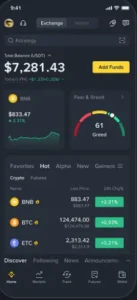
Bybit leans cleaner. Charts, order books, and futures tools sit closer to the surface, and the learning curve feels gentler, especially for anyone coming specifically to trade derivatives rather than explore an entire product suite.
Neither app is objectively “better” in a vacuum — it depends on whether you want a Swiss Army knife or a scalpel.
Liquidity & Order Execution
Liquidity is where Binance still separates itself from almost everyone else in the industry. Its daily trading volume regularly reaches tens of billions of dollars, and that depth translates into tighter spreads and less slippage on major pairs like BTC/USDT and ETH/USDT.
Bybit isn’t a minor player either. It ranks among the top five exchanges globally by volume, with daily trading activity reported in the multiple billions of dollars, and its post-hack recovery actually pushed user numbers and volume higher through the rest of 2025.
For massive orders on blue-chip pairs, Binance’s liquidity advantage still matters. For most retail-sized trades, both platforms execute cleanly enough that the difference won’t move your bottom line.
Customer Support Reality Check
Both exchanges offer 24/7 live chat and extensive help centers, and both handle enormous support volumes given their user bases run into the tens of millions.

The honest reality, common across every large centralized exchange rather than unique to either platform, is that response speed drops during high-volatility periods — exactly when people need help the fastest. Account verification delays and withdrawal holds are the most frequent complaints for both Binance and Bybit, usually tied to standard anti-fraud checks rather than platform failure.
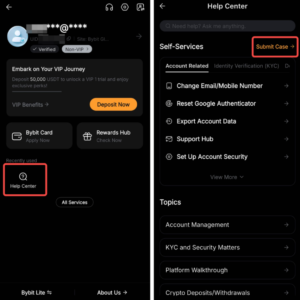
If support quality is a dealbreaker for you, check recent user reviews on independent platforms like Trustpilot before committing serious funds, since response times shift with market conditions faster than any comparison article can track in real time.
Unique Differentiators — What Sets Each Exchange Apart
Binance’s biggest edge is its ecosystem gravity. BNB fee discounts, the BNB Chain, a long track record of Launchpad listings, and unmatched liquidity all reinforce each other. Once you’re inside the Binance ecosystem, there’s a real incentive to stay.
Bybit’s biggest edge is specialization plus a trust story it earned the hard way. Its derivatives-first design, competitive maker fees, copy trading community, tokenized stock access through xStocks, and transparent crisis response after the 2025 hack all point toward a platform that knows exactly who it’s building for.
Pros and Cons
Binance
Pros: deepest liquidity in the industry, largest ecosystem of products, strong BNB fee discounts, long operating history, robust SAFU insurance fund.
Cons: shrinking regulatory footprint in parts of Europe, a criminal settlement history that still shapes public perception, an interface that can overwhelm beginners.
Bybit
Pros: lower maker fees on derivatives, cleaner interface, strong recent regulatory progress in the EU and UK, transparent hack recovery, fast-growing asset list.
Cons: the largest crypto hack on record sits in its history, narrower product range than Binance in areas like NFTs, US access remains fully blocked.
Verdict by User Type
Beginners who want one simple, guided experience will likely find Bybit’s interface friendlier to start with, though Binance’s educational resources through Binance Academy remain excellent once you’re ready to dig deeper.
Active derivatives traders chasing lower maker fees and a focused futures workspace should lean toward Bybit.
Altcoin hunters who want the widest possible selection and deepest liquidity should stick with Binance.
Copy trading and social trading fans will find Bybit’s tools more mature and easier to use out of the box.
EU-based traders navigating MiCA rules in 2026 currently have a smoother regulatory path with Bybit EU than with Binance’s shrinking European presence.
Security-conscious users focused purely on incident history will note Binance’s last major hack sits further in the past, though Bybit’s post-hack transparency and reserve verification earned back significant trust.
Which Exchange Is Better? (Final Verdict)
There’s no universal winner here, and anyone claiming otherwise is probably trying to sell you a referral link.
Binance remains the stronger choice for traders seeking maximum liquidity, the widest asset selection, and a comprehensive financial ecosystem in a single account. Bybit remains the stronger choice for derivatives-focused traders who want lower maker fees, a cleaner interface, and a regulatory posture that currently looks more stable in Europe.
Plenty of experienced traders use both — Binance for spot liquidity and altcoin access, Bybit for futures and copy trading. That split isn’t a cop-out; it’s genuinely how many active traders manage risk and costs across exchanges in 2026.
Frequently Asked Questions
Is Binance or Bybit safer in 2026? Both operate under real regulatory licenses today, and both have survived major incidents — Binance a 2023 legal settlement, Bybit a 2025 hack. Neither incident is disqualifying on its own, but neither exchange should hold funds you can’t afford to lose.
Which exchange has lower fees? It depends on your trading style. Binance often costs less for takers who hold BNB, while Bybit tends to offer lower maker fees on futures contracts.
Can US residents use Binance or Bybit? No, not the main global platforms. US residents can only access the separate, more limited Binance.US and Bybit, which block US access entirely.
Which exchange is better for beginners? Bybit’s simpler interface tends to suit first-time traders better, while Binance offers a deeper product range once you’re comfortable navigating more tools.
Does Bybit still work in the EU after the 2025 hack? Yes. Bybit EU GmbH holds a MiCA license issued by Austria’s FMA, allowing it to serve users across the European Economic Area legally.
Which exchange has more cryptocurrencies listed? Bybit currently lists more assets overall, while Binance still holds the edge in daily trading liquidity on major pairs.
This article reflects publicly available regulatory filings, exchange disclosures, and reporting current as of mid-2026. Crypto exchange fees, licenses, and country availability change frequently — always verify current terms directly on Binance’s and Bybit’s official websites before trading.
