
When you lose money on a trade, you blame the market. Fair enough. But when you lose money before the trade even moves, you should blame the fees. That is where a proper Bybit fees review saves you real dollars.
Bybit has grown into one of the largest crypto derivatives and spot exchanges in the world. Millions of traders use it daily. But almost nobody sits down and actually reads the fee structure until they notice their balance quietly shrinking with every transaction.
This guide covers everything. Spot fees. Futures fees. Withdrawal charges. Hidden costs nobody talks about. How to reduce what you pay. And a straight answer on whether Bybit is worth it at all.
No filler. No fluff. Just the numbers and what they mean for you.
Bybit Trading Fees Overview
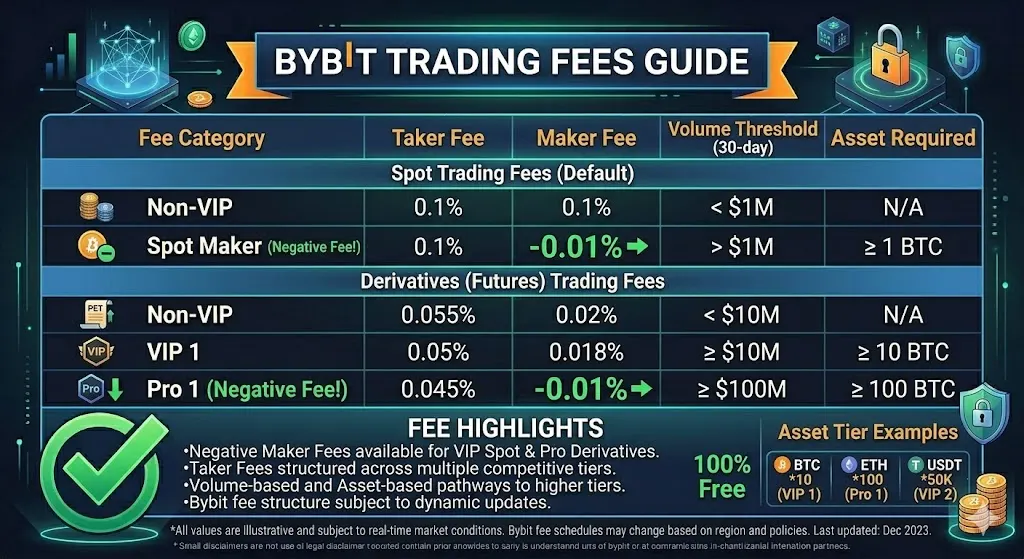
Bybit uses a maker-taker fee model. This is standard across most major exchanges, so understanding it is step one.
A maker adds liquidity to the order book. If you place a limit order that does not fill immediately, you are a maker. A taker removes liquidity. If you place a market order or a limit order that fills right away, you are a taker.
Makers get rewarded with lower fees. Takers pay slightly more because they demand instant execution.
Bybit also uses a VIP tier system. The more volume you trade over a 30-day rolling window, the lower your fees drop. New users start at the standard rate. High-volume traders climb the ladder.
Here is the starting-point overview before we break each category down:
| Fee Type | Standard Rate |
| Spot Maker | 0.10% |
| Spot Taker | 0.10% |
| USDT Perpetual Maker | 0.02% |
| USDT Perpetual Taker | 0.055% |
| Inverse Perpetual Maker | 0.01% |
| Inverse Perpetual Taker | 0.06% |
| Crypto Deposit | Free |
| Crypto Withdrawal | Varies by asset |
These figures are for standard (non-VIP) accounts. Always verify current rates directly on Bybit’s official fee schedule, as they can change.
Spot Trading Fees
Bybit charges 0.10% for both makers and takers on spot trading at the standard tier. That puts it on par with Binance’s standard rate and cheaper than most Western exchanges.
To put that in plain terms: trade $1,000 worth of BTC, and you pay $1 in fees. Not devastating. But if you trade $10,000 a day five days a week, that adds up to $50 a week, $200 a month, and $2,400 a year, just in spot fees alone.
Bybit also offers fee discounts when you hold or use BIT (Bybit’s native token) to pay fees. The discount structure varies, so checking your account dashboard for current promotions is worth doing before each large trade.
Spot fees apply to all trading pairs, including BTC/USDT, ETH/USDT, and hundreds of altcoin pairs. There is no separate fee structure for different pairs; the percentage stays the same across the board for standard users.
Futures Trading Fees
This is where Bybit actually shines. Futures fees are significantly lower than spot fees, which makes sense since Bybit built its reputation primarily as a derivatives exchange.
USDT-Margined Perpetual Contracts
These are the most popular contracts on Bybit. You trade with USDT as collateral.
- Maker: 0.02%
- Taker: 0.055%
Inverse Perpetual Contracts (Coin-Margined)
These use the base cryptocurrency (like BTC) as collateral instead of USDT.
- Maker: 0.01%
- Taker: 0.06%
Options Fees
- Maker: 0.02%
- Taker: 0.05%
The maker fee on inverse contracts at 0.01% is one of the lowest in the industry. If you are a limit-order trader who consistently acts as a maker, futures trading on Bybit is genuinely competitive.
One important note: funding rates apply to perpetual contracts. These are periodic payments between long and short holders to keep the contract price anchored to the spot price. Funding rates are not set by Bybit; they fluctuate based on market conditions. You might pay for funding or receive it, depending on your position and timing. Always factor this into your cost calculation for held positions.
Deposit Fees
Good news here. Bybit charges zero fees for crypto deposits. Send Bitcoin, Ethereum, USDT, or any supported asset to your Bybit wallet, and the platform takes nothing.
However, the blockchain itself charges a network fee. That cost comes from your wallet before the funds even reach Bybit. Bybit does not control this and cannot waive it.
For fiat deposits through third-party payment processors (like credit cards or bank transfers), fees may apply depending on the provider and your region. Bybit connects you to third-party services for fiat on-ramps, and those services charge their own rates, typically 1% to 3%.
Always deposit using crypto directly if you want to avoid these extra charges.
Withdrawal Fees
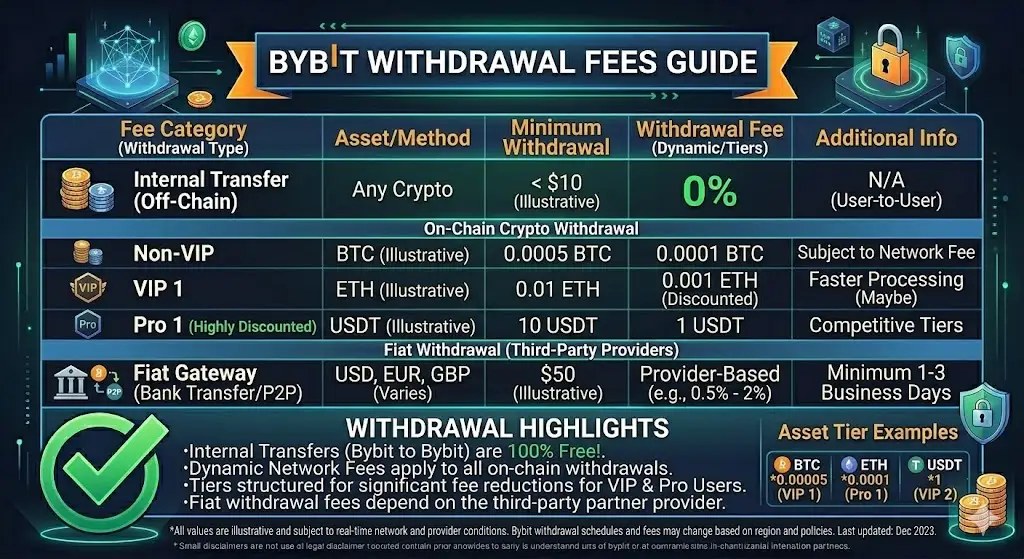
Withdrawal fees on Bybit vary by asset and by the blockchain network you choose. This is standard across all exchanges; sending ETH on the Ethereum mainnet costs more than sending it over a layer-2 network.
Here are some approximate withdrawal fees for major assets as a reference point. These figures fluctuate with network conditions, and Bybit adjusts them periodically, so always check the live withdrawal fee page before you transact:
| Asset | Network | Approx. Withdrawal Fee |
| BTC | Bitcoin | ~0.0001 BTC |
| ETH | ERC-20 | ~0.0008 ETH |
| USDT | TRC-20 | ~1 USDT |
| USDT | ERC-20 | Higher (varies) |
The TRC-20 network (Tron) consistently offers the cheapest USDT withdrawal fees across most exchanges, including Bybit. If you are moving stablecoins and do not need the Ethereum network specifically, TRC-20 will save you money every time.
Bybit also enforces minimum withdrawal amounts for each asset. Try to withdraw below the minimum, and the transaction will not go through. Check the minimum before you attempt a transfer.
Hidden Charges Explained
Calling them “hidden” is a bit generous to the exchange; they are disclosed in the fine print. But they catch traders off guard constantly.
Funding Rates on Perpetual Contracts
Already mentioned above, but worth repeating. If you hold a perpetual futures position overnight (or for multiple funding intervals), you either pay or receive a funding fee every 8 hours. In highly trending markets, funding rates can spike dramatically. Holding a highly leveraged long during a Bitcoin bull run can cost you 0.1% to 0.3% per 8 hours in funding alone.
Spread on Instant Conversions
When you use Bybit’s “Convert” feature to swap one asset for another instantly, you get a quoted price that already includes a spread. It is convenient. It is also more expensive than placing a standard spot limit order. The spread is not always visible unless you compare it directly to the order book price.
Liquidation Fees
If your position gets liquidated, Bybit charges a liquidation fee. The exact amount depends on the contract and position size. This is on top of the actual loss from the liquidation itself. Leverage is a sharp tool; respect it, or it will cost you twice.
Withdrawal Network Fees
Choosing the wrong network when withdrawing can cost you more than the withdrawal minimum. For example, withdrawing USDT over ERC-20 instead of TRC-20 can be five to ten times more expensive. Always compare network options before confirming.
How to Reduce Bybit Fees
Here is the practical playbook. You do not need a finance degree, just a few habits.
1. Trade as a Maker Whenever Possible
Place limit orders instead of market orders. When your order sits on the book and waits for a match, you are a maker. On futures, that drops your fee from 0.055% to 0.02%. Over thousands of trades, that gap is meaningful.
2. Climb the VIP Tiers
Bybit’s VIP program rewards volume. Higher tiers bring lower fees across both spot and derivatives. If you already trade frequently, make sure your 30-day volume is being tracked under one account to maximize your tier.
3. Use BIT for Fee Payments
Bybit’s native token,, BIT, can be used to pay trading fees at a discount. The discount rate changes based on promotions and your account tier, so check the current rate in your account settings.
4. Choose Cheap Withdrawal Networks
For stablecoins, TRC-20 is almost always cheaper than ERC-20. For smaller altcoin withdrawals, compare network options before confirming. Ten seconds of comparison can save you several dollars per transfer.
5. Avoid the Instant Convert Feature for Large Amounts
For amounts above a few hundred dollars, use the spot order book instead of the Convert feature. The spread on Convert is convenient but not free.
6. Time Your Entries to Avoid High Funding
For futures traders, check the funding rate before opening a position. If the rate is unusually high because everyone is leaning the same way you are, consider entering after the next funding interval resets.
Bybit Fees vs Other Exchanges
You cannot judge a fee structure in isolation. Context matters. Here is how Bybit compares to a few major competitors at standard tier rates:
| Exchange | Spot Maker | Spot Taker | Futures Maker | Futures Taker |
| Bybit | 0.10% | 0.10% | 0.02% | 0.055% |
| Binance | 0.10% | 0.10% | 0.02% | 0.05% |
| OKX | 0.08% | 0.10% | 0.02% | 0.05% |
| Kraken | 0.16% | 0.26% | 0.02% | 0.05% |
| Coinbase Advanced | 0.40% | 0.60% | N/A | N/A |
Note: These rates are for standard non-VIP accounts. All exchanges have tier systems that reduce fees with volume. Always check the official fee page for each platform before comparing.
Bybit sits in a competitive middle ground. Its spot fees match Binance exactly at the standard tier. Its futures fees are very close to industry leaders like OKX. Compared to Coinbase or Kraken, Bybit is considerably cheaper for both spot and derivatives.
The real differentiation is not always the headline number; it is how quickly you can reduce fees through VIP tiers and what tools the platform gives you to do so.
Advanced Tips to Reduce Your Bybit Fees Further
You already know the basics. Here is what experienced traders do that most beginners skip.
Referral Programs
Bybit runs a referral program. When someone signs up through your referral link, both you and the referred user can receive fee rebates. If you bring even a few active traders to the platform, the accumulated rebate can offset a noticeable portion of your own fees.
Bybit Earn and Staking
Bybit offers yield products. While these do not directly reduce trading fees, they help you grow idle capital that would otherwise sit static. The compounded earnings from staking can effectively offset some of the fee burden over time.
Institutional and Affiliate Accounts
If you trade at professional volume, we are talking millions in monthly volume. Bybit offers dedicated account managers and custom fee negotiations for institutional clients. If you are at that level and still paying standard rates, that is worth a conversation with their business development team.
API Trading with Limit Orders
Algorithmic traders who use Bybit’s API can build strategies specifically designed to capture maker fees rather than paying taker fees. This requires technical knowledge but can shift your fee structure meaningfully for high-frequency strategies.
Are Bybit Fees Worth It?
Short answer: yes, for most active traders.
Long answer: It depends on what you trade.
For futures and derivatives traders, Bybit is genuinely one of the better-priced platforms globally. A 0.02% maker fee on perpetuals is difficult to beat at any tier. The depth of the order book is strong, execution is fast, and the fee structure rewards consistent limit-order traders.
For spot traders, Bybit is competitive but not a standout. You get the same 0.10% that Binance charges, with a smaller spot market and marginally less liquidity on altcoin pairs. If spot trading is your primary activity, Bybit still works fine, but it does not offer a price advantage over Binance at standard tiers.
For occasional traders who move money infrequently, the withdrawal fees matter more than trading fees. Use cheap networks, withdraw in batches rather than small frequent amounts, and the platform is perfectly reasonable.
The platform’s overall fee load is fair. No major exchange in the top tier charges zero. What separates a good fee structure from a bad one is transparency, competitive rates, and genuine paths to reduce costs over time. Bybit delivers on all three.
Read More :
Bybit Review 2026 : Best Crypto Exchange for Beginners?
Is Bybit Safe or a Scam? (2026) – Read before star trading
Bybit Review After 7 Days of Use (2026) – Fees, Safety & Real Experience
Can You Start trading in bybit with Just $20?
Pros and Cons
- Futures maker fee of 0.02% — industry low
- Spot fees match industry standard at 0.10%
- Zero fees for all crypto deposits
- Multiple cheap withdrawal networks available
- Clear VIP tier system with accessible entry points
- BIT token reduces fees further
- Strong liquidity on major derivatives pairs
- Transparent fee schedule published openly
- Less spot liquidity than Binance on small altcoins
- Withdrawal fees require manual comparison each time
- Fiat on-ramp fees depend on third-party processors
- Funding rates add unexpected cost on held positions
- Instant Convert includes a hidden spread
- High volume thresholds needed for big VIP discounts
Frequently Asked Questions (FAQ)
Q: What is the standard trading fee on Bybit for spot trading?
A: Bybit charges 0.10% for both makers and takers on spot trades at the standard (non-VIP) account level. This matches the rate Binance charges at the same tier.
Q: Does Bybit charge fees for crypto deposits?
A: No. Bybit does not charge platform fees for crypto deposits. You only pay the blockchain network fee, which is charged by the underlying network, not Bybit.
Q: How do I reduce my Bybit trading fees?
A: The most effective methods are trading with limit orders to qualify as a maker, climbing the VIP volume tiers, using BIT (Bybit’s native token) to pay fees at a discount, and using low-cost withdrawal networks like TRC-20 for USDT transfers.
Q: What are funding rates, and how do they affect my cost?
A: Funding rates are periodic payments exchanged between long and short position holders on perpetual futures contracts. They occur every 8 hours and keep perpetual prices aligned with spot prices. Depending on market conditions, you either pay or receive funding. During strong trends, funding rates can be high for holders.
Q: Is Bybit cheaper than Binance?
A: For spot trading, both charge the same standard rate of 0.10%. For futures, they are nearly identical; Binance charges 0.05% taker while Bybit charges 0.055%. Bybit has a slight edge on maker fees for some contract types. Neither has a decisive overall advantage at standard tiers.
Q: Does Bybit have hidden fees?
A: The fees are disclosed but easy to overlook. The main ones to watch are funding rates on perpetual futures, the spread built into the Instant Convert feature, and the variation in withdrawal fees across different blockchain networks. None are hidden per se, but they require active attention.
Q: What is the cheapest way to withdraw USDT from Bybit?
A: Use the TRC-20 (Tron) network. It consistently offers the lowest withdrawal fees for USDT across most major exchanges, including Bybit. The ERC-20 network is substantially more expensive.
Q: Does Bybit offer fee discounts for high-volume traders?
A: Yes. Bybit has a VIP tier system that reduces both spot and futures fees based on your 30-day trading volume. Higher tiers unlock progressively lower rates. Institutional clients can also negotiate custom fee arrangements directly with Bybit’s team.
Q: Are Bybit’s withdrawal fees fixed?
A: No. Withdrawal fees on Bybit are not fixed. They adjust based on network congestion and blockchain conditions. Bybit publishes a live withdrawal fee page that reflects current rates. Always check before you withdraw.
Q: Is Bybit regulated?
A: Bybit’s regulatory status varies by jurisdiction. It holds licenses in certain regions and operates under varying regulatory frameworks in others. Always check the current regulatory status relevant to your country before using the platform. Bybit publishes compliance information on its official website.
Final Verdict
Bybit runs a fee structure that is honest, competitive, and well-designed for active traders.
The futures fees are a genuine strength. A 0.02% maker fee on USDT perpetuals is difficult to beat, and the platform’s liquidity on major derivatives pairs ensures those rates translate into real execution quality.
The spot fees are solid but not spectacular , they match the standard rather than beat it. If spot trading is your main activity, Bybit is a reasonable choice, but not necessarily the cheapest one available.
The hidden costs , funding rates, conversion spreads, and withdrawal network variations ,are manageable once you understand them. They are not traps. They are just features of how derivatives and blockchain transactions work across every major platform.
For derivatives traders, Bybit earns a strong recommendation. For spot-focused traders, it is a fair platform that competes adequately with the best.
The fees do not tell the whole story of any exchange. Platform reliability, security, customer support, and product range all matter. But if fees are your deciding factor, Bybit gives you a competitive deal , and several clear paths to make it even better.
Disclaimer
This article is written for informational and educational purposes only. It does not constitute financial advice, investment advice, or a recommendation to use any particular exchange or financial product.
Cryptocurrency trading involves substantial risk of loss. Fee structures, VIP tiers, and withdrawal rates mentioned in this article are based on information publicly available at the time of writing. These figures change regularly. Always verify current fees directly on Bybit’s official website before making any trading or financial decision.
The author and publisher are not responsible for any financial losses resulting from the use of this information.
