
If you’ve ever stared at a crypto exchange fee page and felt like you were reading a legal contract written in Klingon, you’re not alone. Gate.io’s fee structure isn’t exactly straightforward at first glance. But once you break it down, it’s actually one of the more competitive setups in the industry.
This Gate.io fees review covers everything: spot trading fees, futures fees, withdrawal costs, hidden charges, and how to cut your costs using GT tokens and VIP tiers. By the end, you’ll know exactly what you’re paying, why, and whether it’s worth it.
Let’s get into it.
Table of Contents
Gate.io Trading Fees Overview
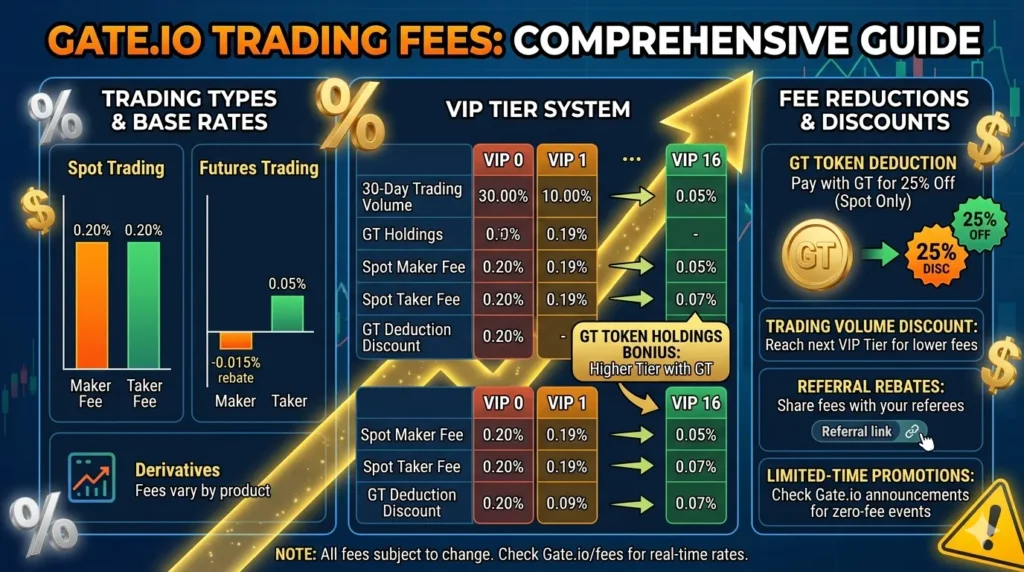
Gate.io operates on a maker-taker fee model, a standard structure across major crypto exchanges. The basic idea: if you add liquidity to the order book (maker), you pay less. If you remove liquidity (taker), you pay a bit more.
Here’s the quick snapshot for standard users:
| Fee Type | Rate |
| Spot Trading (base) | 0.1% maker / 0.1% taker |
| Futures Trading (base) | 0.02% maker / 0.05% taker |
| Deposit Fee | Free |
| Withdrawal Fee | Varies by asset |
| Card Purchase Fee | ~2.9% |
Gate.io uses a 16-tier VIP system, and your tier is determined by your 30-day trading volume and GT token holdings. The higher your tier, the lower your fees, reaching as low as 0% maker fees at the top levels.
Spot Trading Fees
For most regular traders, spot trading is where the bulk of their activity happens. Gate.io’s base spot trading fee sits at 0.1% for both makers and takers, right in line with what Binance charges for standard users.
A few important things to know:
GT Token Discount: If you hold Gate.io’s native GateToken (GT) and use it to pay fees, you get a meaningful discount on spot trading costs. This can bring your effective rate noticeably lower, which adds up fast if you’re trading frequently.
VIP Tiers: The platform runs a 16-tier VIP structure. As your 30-day volume grows, your fees drop progressively. The top tiers reach 0% maker and 0.02% taker, which is near-zero cost territory for spot trading.
Zero-Fee Pairs: Gate.io also offers zero trading fees on select spot trading pairs. These rotate, so it’s worth checking the current list in your account dashboard.
One thing worth noting: some older review sites still cite 0.2% as the base spot rate. That was the older structure. The current base is 0.1%, which is more competitive. Always check Gate.io’s official fee page for the most current numbers, as these are updated periodically.
Futures Trading Fees
Gate.io’s futures market is where things get genuinely interesting, especially for active traders.
The base futures fee structure starts at:
- Maker fee: 0.02%
- Taker fee: 0.05%
These apply to USDT-margined perpetual contracts, which are the most commonly traded on the platform. Gate.io supports over 415 futures contracts, with leverage up to 200x on selected pairs.
Now here’s a feature that stands out: Gate.io offers a maker rebate on futures at higher VIP levels. That means instead of paying a fee when you place limit orders, the exchange actually pays you. This is a meaningful advantage for high-frequency traders and market makers.
At the top VIP tiers, futures fees drop to 0% maker and 0.016% taker. Combined with GT token discounts, serious traders can get their effective futures costs extremely low.
Gate.io also supports inverse contracts (BTC-margined) alongside USDT-margined contracts, giving traders flexibility in how they manage margin and settlement.
Funding Rates: Like all perpetual contract platforms, Gate.io charges funding rates, periodic payments between long and short traders that keep the perpetual price anchored to the spot price. These aren’t technically exchange fees, but they’re a real trading cost. Funding rates fluctuate with market conditions and can work for or against your position.
Deposit Fees
This is the easiest section in this entire article: Gate.io charges zero fees for cryptocurrency deposits.
Most blockchains confirm within seconds for major networks, and BTC/LTC typically settle within 15 minutes. You only pay the underlying blockchain network fee, which the exchange has no control over.
For fiat on-ramps, the picture is different. Card purchases (Visa, Mastercard, Apple Pay) carry approximately 2.9% via third-party processors, which is on the higher end. This isn’t unique to Gate.io; it’s the standard across most exchanges using card processors. But if you’re regularly buying large amounts, this fee bites.
The better approach? Deposit crypto directly from a wallet or another exchange to avoid that 2.9% entirely.
Withdrawal Fees
Here’s where many users feel surprised, and it’s also where Gate.io actually performs better than many assume.
Withdrawal fees on Gate.io are network-dependent and vary by token and blockchain. They’re set by the exchange and updated based on network conditions.
Some concrete numbers (subject to change):
- BTC withdrawal: approximately 0.0001 BTC (some sources cite 0.0005 BTC depending on network conditions at the time)
- ETH (ERC-20) withdrawal: approximately 0.002 ETH
For context, industry averages for BTC withdrawals sit around 0.0008 BTC, which means Gate.io’s BTC withdrawal fee is well below average, often around 40% lower than the industry norm, according to data from Cryptowisser.
Choosing the right network matters a lot. Many tokens can be withdrawn on multiple blockchains, such as ERC-20, BEP-20, Arbitrum, Polygon, etc. The fee differences between networks for the same token can be dramatic. Polygon and Arbitrum withdrawals are often a fraction of the cost of ERC-20 withdrawals for tokens that support them.
Always verify the withdrawal fee for your specific token before initiating a transaction, particularly for smaller altcoins where fees can be disproportionately high relative to the value transferred.
Hidden Charges Explained
“Hidden fees” is the phrase that keeps traders up at night. Let’s be direct about what Gate.io does and doesn’t hide.
What Gate.io is transparent about:
- Spot and futures fees are clearly listed in the fee schedule
- Withdrawal fees are shown before you confirm any transaction
- VIP tier requirements and discount structures are publicly documented
What can catch traders off guard:
Spread on instant buy/sell: When you use the “Buy Crypto” quick-purchase option rather than the spot trading terminal, you’re often paying a wider spread. The convenience costs you.
Funding rates on perpetuals: As mentioned above, funding rates aren’t a Gate.io fee per se, but they’re a real cost of holding perpetual positions. In volatile markets, these can be significant.
Conversion fees: If you use Gate.io’s internal conversion tools to swap between assets, there may be a spread built into the conversion rate.
Margin interest: Non-VIP users on margin trading pay around 18% annually on borrowed funds. VIP users receive discounts of up to 70% on loan interest. If you’re running leveraged positions for extended periods, this cost accumulates.
Card purchase surcharge: The ~2.9% card fee is disclosed, but many users scan past it. On a $1,000 purchase, that’s $29 straight to the processor before a single trade is placed.
None of these is technically hidden; they’re disclosed in Gate.io’s documentation. But they don’t advertise them prominently either, which is why understanding the full picture matters.
How to Reduce Gate.io Fees
Here’s where this review actually saves you money. There are several legitimate strategies to lower what you pay on Gate.io.
1. Hold GT Tokens
GateToken (GT) is Gate.io’s native exchange token. Holding GT grants fee discounts across spot and futures trading. The more GT you hold, the greater the discount, and this stacks with VIP tier benefits.
GT’s total supply is capped at 300 million, with over 211 million burned through the platform’s buyback-and-burn program, making it deflationary by design.
2. Use Limit Orders (Maker Orders)
Maker orders, limit orders that sit in the order book and wait for a match, qualify for the lower maker fee. Taker orders (market orders that execute immediately) remove liquidity and cost more. Get into the habit of using limit orders when timing isn’t urgent.
3. Climb the VIP Tiers
Your 30-day trading volume determines your VIP tier. The more you trade, the lower your fees. This is a virtuous cycle for active traders; more volume means lower effective costs on each trade.
4. Choose Low-Cost Withdrawal Networks
Before withdrawing any token, check which supported blockchain offers the lowest fee. For tokens available on Arbitrum, Polygon, or BSC, you can save significantly versus ERC-20 network fees.
5. Avoid Card Purchases for Large Amounts
The 2.9% card fee is avoidable entirely by depositing crypto from another wallet or exchange. Set up a direct crypto transfer workflow and save the card option for small, urgent purchases only.
6. Use the Point System
Gate.io has a points system where 1 point equals 1 USDT in fee reduction. Points accumulate through platform activity and can be applied directly against trading fees. Check your available points regularly in your account dashboard.
7. Time Withdrawals Strategically
Network congestion affects gas fees on blockchains like Ethereum. Withdrawing during off-peak hours, typically late night and early morning UTC, can result in lower actual network costs, though Gate.io’s withdrawal fees are fixed amounts, not gas-variable.
Gate.io Fees vs Other Exchanges
Context makes all the difference when evaluating fees. Here’s how Gate.io stacks up against its main competitors.
| Exchange | Spot Maker | Spot Taker | Futures Maker | Futures Taker |
| Gate.io (base) | 0.1% | 0.1% | 0.02% | 0.05% |
| Binance (base) | 0.1% | 0.1% | 0.02% | 0.04% |
| Coinbase Advanced | 0.4% | 0.6% | — | — |
| Bybit (base) | 0.1% | 0.1% | 0.02% | 0.055% |
| MEXC | 0.1% | 0.1% | 0% | 0.02% |
A few observations:
Spot trading: Gate.io matches Binance at the base level (0.1% each). Coinbase is significantly more expensive at the standard tier. Gate.io is well within the competitive range for spot traders.
Futures trading: Gate.io’s base futures taker fee of 0.05% is competitive with Binance’s 0.04%. MEXC is lower on futures, but Gate.io’s VIP structure and GT discounts can narrow that gap for active users.
Token selection: This isn’t a fee category, but it’s a relevant context. Gate.io lists over 3,500 cryptocurrencies, more than Binance (1,500+), Kraken (700+), and Coinbase (250+) combined. Access to early-stage altcoins and smaller tokens is a core part of Gate.io’s value proposition.
Withdrawal fees: Gate.io performs well here. Its BTC withdrawal fee is approximately 40% below the industry average, according to Cryptowisser’s analysis.
The honest summary: for most active traders, Gate.io’s fees are competitive, not the cheapest available, but not far off. The GT discount system and VIP program give serious traders a clear path to institutional-level pricing.
Are Gate.io Fees Worth It?
This is the right question, and the answer depends entirely on what you’re using the platform for.
For spot traders who want access to a wide altcoin selection, including early-stage and newly listed tokens, Gate.io’s 0.1% base rate is fair. No premium over Binance for the same base access.
For futures traders, the base 0.02% maker / 0.05% taker is solid. The maker rebate feature at higher VIP levels is a genuine differentiator for high-volume users. If you primarily trade on futures and trade frequently, Gate.io’s fee trajectory with GT tokens and VIP tiers is genuinely attractive.
For casual traders who buy occasionally and don’t hold GT tokens, the fees are reasonable but not outstanding. Avoid card purchases, use limit orders, and pick efficient withdrawal networks, and your costs stay manageable.
For US-based users: This point is moot. Gate.io doesn’t serve US residents due to regulatory restrictions. The platform operates across 130+ countries, with notable restrictions also in India, China, and Canada.
The broader question of “worth it” also involves what you get beyond fees: access to 3,500+ tokens, a functioning VIP program, proof of reserves publication, cold storage security, and a mature platform founded in 2013. These factors matter alongside the raw fee numbers.
Pros and Cons
Pros
- Competitive 0.1% base spot fee matching Binance
- Zero deposit fees for all crypto transfers
- BTC withdrawal fee is approximately 40% below the industry average
- 16-tier VIP system with significant fee reduction potential
- GT token discounts stack with VIP benefits
- Futures maker rebate available at higher VIP tiers
- Over 3,500 cryptocurrencies, the largest selection among major centralised exchanges
- Transparent fee schedule and proof of reserves reporting
Cons
- Withdrawal fees on smaller altcoins can be disproportionately high
- Futures taker fee (0.05%) is higher than MEXC (0.02%)
- Not available to US, Indian, Canadian, or Chinese residents
- Interface complexity can make fee navigation confusing for beginners
- Funding rates on perpetuals add to the real cost of futures positions
FAQ Section
What is the base spot trading fee on Gate.io? The standard spot trading fee is 0.1% for both makers and takers. This can be reduced through GT token holdings and VIP tier status.
Does Gate.io charge deposit fees? No. Crypto deposits are free. You only pay the underlying blockchain network fee, which Gate.io does not control. Card purchases carry approximately 2.9%.
How much does it cost to withdraw Bitcoin from Gate.io? BTC withdrawal fees vary with network conditions but are generally around 0.0001–0.0005 BTC, which is significantly below the industry average.
What is the GT token, and how does it reduce fees? GT is Gate.io’s native GateToken. Holding GT qualifies you for trading fee discounts on spot and futures. The discount level scales with your GT holdings and stacks with your VIP tier benefits.
How do VIP tiers work on Gate.io? Gate.io has 16 VIP tiers determined by your 30-day trading volume and GT holdings. Higher tiers receive progressively lower maker and taker fees, reaching 0% maker and 0.02% taker at the highest levels.
Are there hidden fees on Gate.io? There are no hidden fees in the traditional sense, but traders should be aware of the card purchase surcharge (~2.9%), spread on instant buy/sell, funding rates on perpetual contracts, and margin interest for leveraged positions.
How do Gate.io’s fees compare to Binance’s? Both exchanges charge 0.1% maker/taker as their base spot fee. Binance has a slightly lower base futures taker fee (0.04% vs Gate.io’s 0.05%), but Gate.io’s VIP and GT discount structure can close that gap for active users.
Can I reduce withdrawal fees by choosing a different network? Yes, significantly. Tokens available on multiple blockchains (e.g., Arbitrum, Polygon, BEP-20) often have much lower withdrawal fees than ERC-20. Always compare available network options before withdrawing.
Final Verdict
Gate.io’s fee structure is competitive, transparent, and genuinely rewarding for active traders who engage with its VIP and GT token systems.
For the average user trading spot markets, 0.1% is fair and matches industry leaders. Zero deposit fees and below-average withdrawal costs for major assets like BTC add real value. The main watch-out is the card purchase fee (2.9%) and the cost variation on altcoin withdrawals, both of which are manageable with a bit of awareness.
For higher-volume traders, the GT + VIP combination unlocks near-institutional pricing. The maker rebate on futures at top tiers is a feature you won’t find on every major exchange, and it’s worth considering if futures trading is your primary activity.
Overall rating on fees: Solid. Not the cheapest exchange in every category, but well-structured, fair, and increasingly competitive as your trading activity grows.
If fee optimisation matters to you, and it should, hold some GT, use limit orders, deposit crypto directly, and pick the most efficient withdrawal network for each token. Do those four things, and Gate.io becomes one of the more cost-effective platforms available to active crypto traders globally.
