
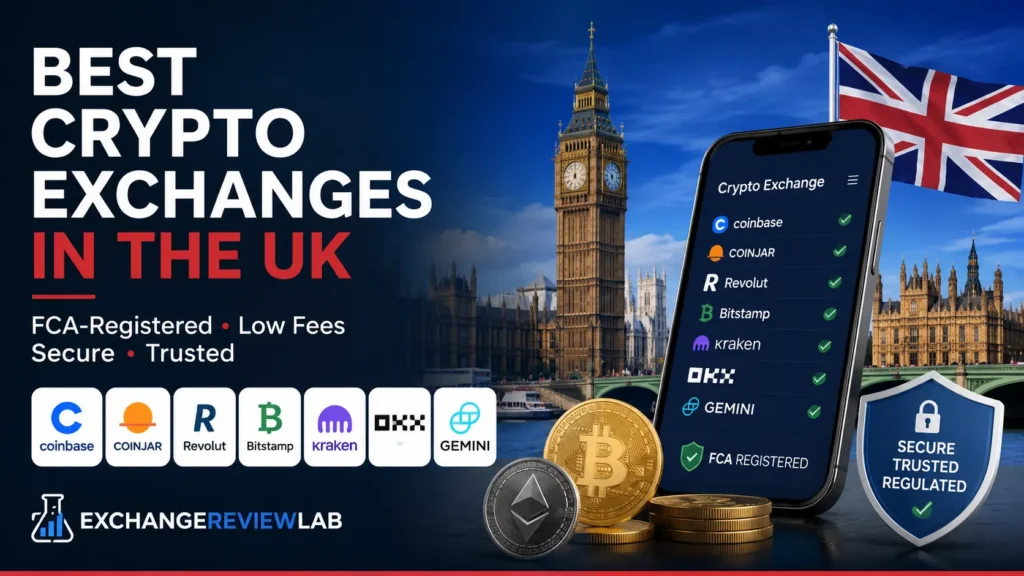
Picking a crypto exchange in the UK sounds simple until you actually try it. Type “best crypto exchange UK” into Google and you get fifty different “top picks,” half of them sponsored, most of them copy-pasting the same three sentences about Bitcoin. Somewhere in that mess is a real answer, and it depends on facts most articles skip: who is actually FCA-registered, who charges what, and who has a track record you can check yourself.
This guide cuts through that noise. Every exchange below is checked against the FCA’s cryptoasset register, real fee schedules, and publicly available security history. No invented numbers, no vague “trusted by millions” claims.
How We Ranked the Best Crypto Exchanges in the UK
We didn’t rank these exchanges by vibes. Each one was measured against a short list of things that actually matter to a UK trader.
FCA registration status. Every platform on this list is registered on the Financial Conduct Authority’s cryptoasset register under the Money Laundering Regulations 2017. That’s the current legal baseline for operating in the UK, and it’s non-negotiable.
Fee transparency. We looked at what each exchange actually charges for GBP deposits, spot trading, and withdrawals — not just the headline number on the homepage.
Security history. Past breaches, custody structure, and insurance arrangements were checked against public records, not marketing copy.
Usability for UK residents. GBP pairs, Faster Payments support, and whether the app was built for British users or bolted on as an afterthought.
This is the same approach we use across our reviews at Exchange Review Lab — open a real account, test the fees, check the paperwork, and publish what we find.
Quick Comparison: Best Crypto Exchanges in the UK
| Exchange | Best For | FCA Status | GBP Support |
|---|---|---|---|
| Coinbase | Best Overall | Registered (CB Payments Ltd) | Yes, Faster Payments |
| CoinJar | Low Trading Fees | Registered (CoinJar UK Ltd) | Yes, free via Faster Payments |
| Revolut | Beginners | Authorised (e-money institution) | Yes, native GBP account |
| Bitstamp | GBP Deposits & Withdrawals | Registered (Bitstamp UK Ltd) | Yes, Faster Payments |
| Kraken | Altcoin Selection | Registered (Payward Ltd) | Yes |
| OKX | Advanced/Pro Traders | Registered | Yes |
| Gemini | Security | Registered | Yes |
Now let’s break down why each one earned its spot.
1. Coinbase – Best Overall Crypto Exchange UK

Coinbase remains the default answer for a reason. It’s simple enough for a first-time buyer, established enough to trust with real money, and it operates in the UK through CB Payments Ltd, a legal entity registered separately from Coinbase’s global operations.
The catch is the standard interface. Buying crypto through Coinbase’s simple app can be genuinely expensive — a live test on a small BTC purchase using the basic buy flow showed costs running well above what you’d pay through the Advanced trading screen. If you use Coinbase, use Coinbase Advanced. It’s the difference between paying a fair spread and paying a “convenience tax.”
Coinbase Advanced runs on a standard maker-taker model, with fees starting around 0.40% for makers and 0.60% for takers at the entry tier, dropping as your monthly volume increases. GBP deposits through Faster Payments are free on both interfaces.
Read More:
Coinbase Review for Beginners 2026
Coinbase Fees 2026: Hidden Costs & How to Save
Is Coinbase Safe or a Scam? (2026 Honest Review)
2. CoinJar – Best for Low Trading Fees
CoinJar doesn’t get the attention Coinbase and Kraken do, which is a shame, because its fee structure is one of the tightest available to UK residents. Founded in Australia in 2013, CoinJar built a long-standing UK presence through CoinJar UK Ltd and was among the first firms admitted to the FCA cryptoasset register.
On the numbers: GBP deposits via Faster Payments cost nothing, and the CoinJar Exchange charges a flat 0.10% on GBP trading pairs — noticeably lower than most mainstream competitors’ entry-tier rates. Its Instant Buy feature costs more, similar to every “one-tap purchase” option across the industry, so stick to the Exchange order book if fees matter to you.
Coin selection is smaller than the giants — around 60 or more assets — but for a UK trader who mostly wants Bitcoin, Ethereum, and the major alts without paying a premium, that’s plenty.
3. Revolut – Best for Beginners

Revolut earns its spot here for one simple reason: most UK adults already have the app on their phone for banking. Adding crypto to an account you already trust and understand removes a huge chunk of the friction that scares off first-time buyers.
Revolut isn’t just registered under anti-money-laundering rules — it holds full authorisation as an e-money institution, which puts it in a different regulatory category from most pure-play crypto exchanges. That doesn’t mean your crypto holdings get FSCS protection (nothing crypto-related does), but it does mean the company itself sits under tighter oversight.
The trade-off is depth. Revolut’s crypto features are simpler than a dedicated exchange, coin selection is narrower, and you can’t run limit orders the way you can on Kraken or OKX. For a beginner buying their first £50 of Bitcoin, none of that matters. Our guide to the best exchanges for beginners covers a few more options if you outgrow it.
4. Bitstamp – Best for GBP Deposits & Withdrawals

Bitstamp has been running since 2011, which in crypto terms makes it practically ancient — and that longevity is worth something. It now operates as part of Robinhood following a 2025 acquisition, with UK services delivered through Bitstamp UK Ltd.
What makes Bitstamp stand out for GBP users specifically is how boring its fiat rails are, in the best possible sense. Faster Payments deposits and withdrawals just work, without the delays or minimum-amount headaches that trip up traders on smaller platforms. If you move money in and out of crypto regularly, that reliability compounds over a year of trading.
Its coin list is curated rather than sprawling. That’s a deliberate choice — fewer listings, more vetting — and it suits investors who’d rather not scroll past a hundred obscure tokens to find Bitcoin.
5. Kraken – Best for Altcoin Selection

Kraken’s reputation for breadth is well earned. It operates in the UK through Payward Ltd, a legal entity you’ll need to search for on the FCA register rather than the “Kraken” brand name itself — a quirk worth knowing before you go hunting for it.
On fees, Kraken Pro’s order-book pricing starts around 0.25% for makers and 0.40% for takers at the base tier, which sits below Coinbase Advanced’s entry rates and drops further as volume climbs. Kraken’s simple “instant buy” screen costs more; same story as every exchange’s beginner interface, so serious traders route through Kraken Pro instead.
Where Kraken really separates itself is asset variety — a genuinely wide spread of altcoins, staking options, and even forex pairs on the same platform. If your portfolio goes beyond the top ten coins, Kraken is usually where you’ll find what you’re after.
6. OKX – Best for Advanced/Pro Traders
OKX shows up on the FCA’s list of UK-serving platforms alongside Coinbase, Kraken, and Bitstamp, and it’s built for a different kind of user than the exchanges above. Its order types, charting tools, and derivatives access are aimed squarely at traders who already know what a limit order and a stop-loss do.
The interface has a learning curve. This isn’t the exchange you hand to your mum for her first Bitcoin purchase — it’s the one you migrate to once Coinbase’s simple buy screen starts feeling too basic. API access and algorithmic trading support add to that pro-trader appeal.
Read More: OKX Review 2026: Honest Pros, Cons & Guide for Beginners
7. Gemini – Best for Security

Gemini built its reputation on being the “boring bank” of crypto exchanges, and in this industry, boring is a compliment. It appears on the FCA’s cryptoasset register alongside the other major UK-facing platforms, and its public security posture — regular audits, insurance arrangements for custodial holdings, and a conservative approach to new listings — reflects that same cautious streak.
None of this means your funds are risk-free. FCA registration, as covered below, is about anti-money-laundering compliance, not a guarantee that your crypto is protected the way a bank deposit is. But among UK-accessible exchanges, Gemini’s security-first reputation is one of the more consistently documented ones.
Is Crypto Trading Legal in the UK?
Yes, buying, selling, and holding crypto is legal in the UK. What’s regulated is how exchanges are allowed to operate, not whether you’re allowed to own Bitcoin.
Here’s the part most articles get muddled: the UK is not part of the EU’s Markets in Crypto-Assets Regulation. Britain sits outside MiCA and is building its own regulatory framework instead. Right now, the standard that matters is registration under the Money Laundering Regulations 2017 — every legitimate exchange serving UK customers needs to appear on the FCA’s cryptoasset register.
That’s changing, slowly. A broader regime under the Financial Services and Markets Act brings crypto activities properly into the FCA’s regulatory perimeter, with the authorisation gateway for firms opening later this year and the full regime expected to go live in October 2027. Until that transition completes, MLR registration remains the bar to check.
One distinction worth remembering: “FCA registered” and “FCA authorised” are not the same thing. Most crypto exchanges hold registration, which covers anti-money-laundering compliance. A smaller number, like eToro and Revolut, hold full authorisation as investment firms or e-money institutions, which comes with additional capital and conduct requirements. Neither status means your crypto balance is covered by the Financial Services Compensation Scheme — FCA registration does not provide FSCS deposit protection for exchange balances.
Before funding any account, run the exchange’s legal entity name through the FCA’s Financial Services Register yourself. It takes two minutes, and it’s the single best fraud-prevention habit you can build.
Factors to Consider When Choosing a Crypto Exchange in the UK
Regulatory status first. Confirm FCA registration before anything else. Operating in the UK without it is illegal, and the FCA has shut down unregistered firms and issued regular public warnings about them. Check the entity name carefully — exchanges often register under a subsidiary rather than their consumer-facing brand.
Fee structure, not just the headline rate. A 0% “no fee” claim usually hides a wider spread baked into the price. Compare like-for-like: maker/taker percentages, card purchase fees, and withdrawal costs.
GBP rails. Faster Payments support for deposits and withdrawals saves you the currency conversion fees that come with funding an account in USD or EUR.
Custody and security disclosures. Look for cold storage percentages, insurance arrangements, and a public incident history. An exchange that’s never had a breach and one that’s never disclosed anything are not the same thing — check for actual transparency.
Coin range versus your actual needs. More listings isn’t automatically better. A beginner buying Bitcoin doesn’t need 500 altcoins; an active trader chasing new listings does.
Customer support quality. Crypto moves fast, and a stuck withdrawal at 2 am is not the moment to discover your exchange has no live chat.
Centralized vs. Decentralized Exchanges: Which Is Right for You?
Every exchange in this guide is centralized — meaning a company holds custody of funds, runs KYC checks, and sits under FCA registration. That’s the model most UK beginners should start with, and it’s the only model that puts you under any form of UK regulatory oversight.
Decentralized exchanges (DEXs) work differently. There’s no company custodying your funds — trades execute directly between wallets through smart contracts, and you keep control of your private keys throughout. Platforms like Uniswap fall into this category.
The trade-offs run in opposite directions. Centralized exchanges offer GBP on-ramps, customer support, and a regulatory body you can complain to if something goes wrong — but you’re trusting a third party with custody until you withdraw. DEXs remove that custody risk but replace it with different ones: no support line if you send funds to the wrong address, no KYC-based fraud protections, and a genuine learning curve around wallets, gas fees, and seed phrases.
For most UK readers starting, a centralized, FCA-registered exchange is the sensible entry point. DEXs make more sense once you’re comfortable managing your own wallet and understand the extra responsibility that comes with full self-custody.
How to Start Trading Crypto in the UK (Step-by-Step Guide)
Step 1: Pick a registered exchange. Cross-check your chosen platform against the FCA’s cryptoasset register before signing up. This single step filters out the vast majority of scam platforms.
Step 2: Verify your identity. Every legitimate UK exchange requires KYC — a photo ID and proof of address. If a platform skips this step entirely, that’s a red flag, not a convenience.
Step 3: Fund your account in GBP. Use Faster Payments where available. It’s typically free and settles same-day, unlike card funding, which often carries a processing fee on top of the trading spread.
Step 4: Place your first trade. Start with a small amount. Use a limit order through an exchange’s “Pro” or “Advanced” interface where possible — it almost always costs less than the one-tap “instant buy” button.
Step 5: Decide on storage. Leaving crypto on an exchange is convenient but means you’re trusting that platform’s custody. For larger holdings, consider moving funds to a hardware wallet you control.
Step 6: Keep records from day one. Every trade, swap, and disposal is a potential tax event in the UK. Log the date, amount, GBP value, and fees for every transaction — future-you will be grateful during tax season.
Crypto Tax Rules in the UK
HMRC doesn’t treat crypto as currency. Cryptoassets are treated as property-like assets for tax purposes, and that classification drives almost everything about how they’re taxed.
Capital Gains Tax applies on disposal. Selling crypto, swapping one asset for another, spending coins, or gifting holdings to anyone other than a spouse or civil partner can all trigger a Capital Gains Tax event. Trading Bitcoin for Ethereum counts as a disposal, even though no GBP ever touched your bank account.
The annual exempt amount is £3,000. This tax-free allowance applies to your total capital gains across all asset types combined, not crypto alone — it shares the same pot as gains from shares, funds, or property.
Rates depend on your income band. For the current tax year, gains above the exempt amount are generally taxed at 18% for basic-rate taxpayers and 24% for higher or additional-rate taxpayers.
Some crypto income falls under Income Tax instead. Mining rewards, staking income, airdrops, employment payments in crypto, and referral rewards may be taxed as income rather than as a capital gain, depending on the specific facts.
Reporting happens through Self Assessment. Even if your total gains sit below the £3,000 exempt amount, you may still need to report if your total disposal proceeds for the year exceed £50,000.
Record-keeping is non-negotiable. Keep the purchase price, disposal price, transaction date, fees, and wallet transfer history for everything. HMRC expects you to reconstruct your full trading history if asked, and reduced allowances in recent years mean far more traders now owe something.
None of this is personalised tax advice — HMRC’s own guidance in the Cryptoassets Manual on GOV.UK is the authoritative source, and a qualified accountant is worth the fee if your trading history is complicated.
Frequently Asked Questions (FAQs)
Is Coinbase legal in the UK? Yes. Coinbase operates in the UK through CB Payments Ltd, registered on the FCA’s cryptoasset register.
Do I pay tax if I just hold crypto without selling? No. Simply holding crypto isn’t a taxable event. Tax applies when you dispose of it — selling, swapping, spending, or gifting to someone other than a spouse.
Is FCA registration the same as investor protection? No. FCA registration covers anti-money-laundering compliance. It doesn’t mean your crypto is protected by the Financial Services Compensation Scheme, and it doesn’t guarantee the exchange’s financial health.
Which UK exchange has the lowest fees? Among the exchanges in this guide, CoinJar’s flat 0.10% GBP trading fee and Kraken Pro’s entry-tier maker/taker rates are among the more competitive options — but always check your specific trade size and order type, since instant-buy screens cost far more than order-book trading on every platform.
Can I use a decentralized exchange in the UK? Yes, DEXs are accessible to UK residents, but they sit outside FCA oversight and require you to manage your own wallet security.
Do I need to report crypto losses to HMRC? Reporting losses is optional in the sense that you’re not required to, but it’s usually worth doing — losses can offset gains and reduce your tax bill in future years if properly recorded.
Final Verdict: Which Crypto Exchange Should You Choose?
There’s no single “best” exchange — there’s a best exchange for what you’re actually trying to do.
If you want one account that just works, Coinbase remains the safest default, provided you use the Advanced interface rather than the pricier simple buy screen. If fees are your main concern, CoinJar’s flat-rate GBP pricing is hard to beat. Complete beginners will find Revolut’s familiarity removes most of the friction, while Bitstamp earns its keep through dependable GBP banking rails. Traders chasing altcoins should look at Kraken; pro traders will feel more at home on OKX; and anyone prioritising a security-first reputation should put Gemini on the shortlist.
Whichever platform you pick, do the two-minute check first: confirm the exchange’s legal entity on the FCA register, understand exactly what fees you’ll pay, and keep a record of every trade from day one. That’s the difference between a good crypto experience and a costly lesson.
For deeper dives into individual platforms, browse the full set of independent exchange reviews or check the methodology behind how every score on this site gets calculated.
