
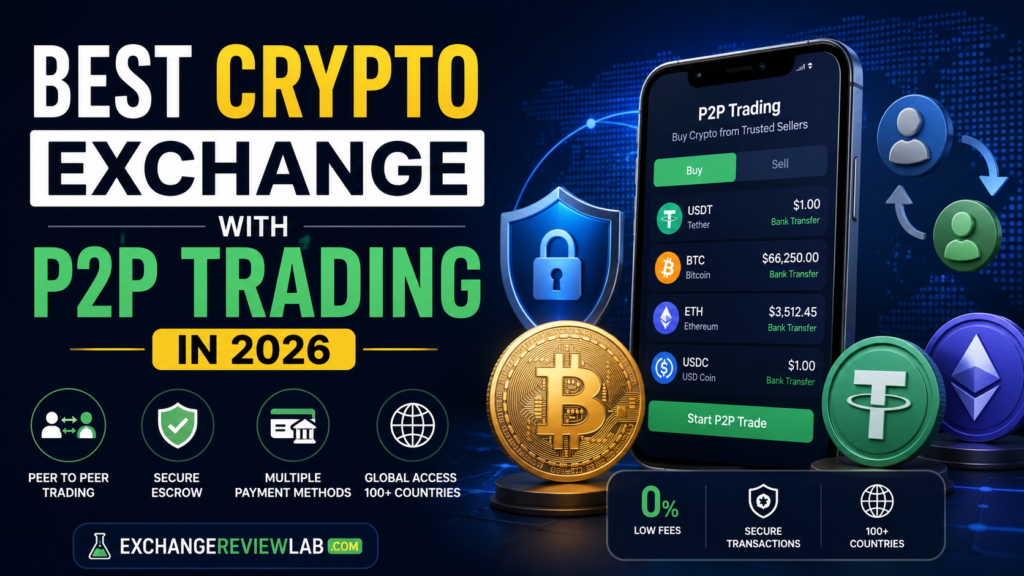
Buying crypto with a bank transfer sounds simple until your bank flags the transaction, freezes your account, and asks you to explain yourself. Peer-to-peer (P2P) trading skips that headache. You trade directly with another person, the exchange holds the coins in escrow, and nobody’s card gets declined at the worst possible moment.
But not every P2P platform treats you the same way. Some charge zero fees and settle trades in minutes. Others bury you in payment restrictions or slow-walk disputes when a trade goes sideways. This guide breaks down which exchanges actually deliver on P2P trading in 2026, based on real fee structures, verified security records, and payment method coverage — not marketing copy.
Quick Answer: Best Crypto Exchange With P2P Trading
If you only read one section, read this one.
OKX is the strongest all-around pick for P2P trading in 2026. It charges zero platform fees on most P2P trades, supports more than 900 payment methods across 100+ countries, and uses custodial escrow that locks the seller’s crypto the moment a trade starts.
Binance takes the runner-up spot. It has the largest P2P user base of any exchange, which means faster order matching and tighter spreads, especially for large trades in USDT.
Bybit is the pick for beginners. Its P2P interface is the simplest to navigate, dispute resolution is quick, and the fee structure charges nothing to takers on most fiat pairs.
If speed and zero fees matter most, go with OKX. If liquidity and merchant choice matter most, go with Binance. If you’re new to P2P and want the gentlest learning curve, go with Bybit.
Comparison Table: Top Exchanges for P2P Trading
| Exchange | P2P Fees | Payment Methods | Escrow Type | KYC Requirement | Best For |
|---|---|---|---|---|---|
| OKX | 0% on most trades | 900+ | Custodial escrow | Standard KYC | Payment variety & low cost |
| Binance | 0% platform fee | 300+ | Custodial escrow | Full identity verification | Liquidity & large trades |
| Bybit | 0% taker / up to 0.30% maker | 60+ fiat currencies | Custodial escrow | Standard KYC | Beginners |
| MEXC | 0% platform fee | 30+ | Custodial escrow | Basic to standard KYC | Altcoin buyers |
| KuCoin | Low, variable maker fee | 20+ | Custodial escrow with seller metrics | Standard KYC | Safety-conscious traders |
Fee figures reflect standard published rates at the time of writing and can change, so always confirm current rates on the exchange before trading.
OKX Review
OKX built its P2P marketplace around one idea: remove friction. It charges zero fees on the majority of P2P trades, which is rare among platforms this size. Instead of earning money on every transaction, OKX profits from spot and derivatives volume, so the P2P desk stays genuinely low-cost for users.
Payment variety is where OKX pulls ahead of almost everyone. The platform supports a wide range of payment methods, including regional bank transfers, digital payment apps, e-wallets, and, in some cases, even cash in-person, which matters if you live somewhere your local bank doesn’t play nicely with crypto platforms. On the P2P board itself, traders can move major assets like BTC, ETH, USDT, and USDC directly against fiat.
Escrow works the standard way here: OKX holds the seller’s crypto the moment a buyer confirms an order, and releases it only after the seller confirms payment received. Stick to sellers with the platform’s verified merchant badge, since they’ve already cleared identity checks and tend to have cleaner track records.
Pros: Zero fees on most trades, huge payment method library, strong for regional and niche currencies. Cons: Full trading history requires KYC, and support response times vary by region.
Read the full breakdown in our OKX exchange review.
Binance Review
Binance runs the biggest P2P marketplace in crypto, and size buys you two things: faster matching and better prices. With over 260 million users, there’s almost always a merchant online, day or night, ready to trade.
The platform supports P2P trading across more than 100 fiat currencies, including USD, EUR, and AED, and this depth makes Binance especially strong for large purchases. It’s common to see sellers offering multi-million-dollar USDT orders just below spot price, which smaller platforms simply can’t match.
Binance backs its platform with a $1 billion insurance fund, a cushion most competitors don’t offer at the same scale. That said, Binance enforces stricter real-name payment rules than some rivals, which can slow down first-time setup but adds a real layer of fraud protection.
Pros: Deepest liquidity, best for large orders, strong insurance backstop. Cons: Stricter payment-name matching rules, KYC is mandatory for full access.
See how it stacks up against a top rival in our Binance vs Bybit comparison.
Bybit Review
Bybit’s P2P section feels the least intimidating of any major exchange, which is exactly why it’s the go-to pick for people trading crypto for the first time. The interface walks new users through order placement, merchant filters, and payment confirmation without burying anyone in jargon.
On fees, Bybit charges 0% for takers on most fiat pairs, while maker fees vary by currency and can run up to 0.30%. Bybit’s P2P desk supports payment across more than 600 methods and lists over 300 cryptocurrencies in total, giving traders plenty of room to diversify once they’re comfortable.
Now, the part every review owes you honestly: on February 21, 2025, Bybit suffered a cyberattack that resulted in the theft of approximately USD 1.5 billion in Ethereum tokens, in what investigators later confirmed as the work of North Korean state-linked hackers. The breach targeted Bybit’s cold wallet infrastructure during a routine internal transfer, not the P2P marketplace or individual user accounts. Bybit covered the loss from its own reserves, and the CEO confirmed within roughly twelve hours that all withdrawals had been processed and normal operations had resumed. It’s the largest exchange hack on record, and it’s worth knowing before you deposit funds anywhere. Bybit’s fast, transparent response is also part of the story — plenty of exchanges have handled smaller breaches far worse.
Pros: Beginner-friendly design, low taker fees, wide payment coverage. Cons: Carries the reputational weight of the largest exchange hack in history, even though user P2P funds weren’t the target.
Full details in our Bybit exchange review.
MEXC Review
MEXC built its reputation on altcoin variety, and that carries over into its P2P desk. The platform lists access to over 1,900 cryptocurrencies, so traders looking to P2P their way into smaller-cap tokens have far more runway here than on Binance or OKX.
MEXC charges zero platform fees on P2P trades, and backs the exchange with a $100 million insurance fund. That’s smaller than Binance’s fund, proportionate to MEXC’s size, but still a meaningful safety net.
Payment support sits around 30 methods, noticeably fewer than OKX or Binance, so traders outside major currency corridors may find fewer active merchants. MEXC works best as a low-fee USDT on-ramp or for smaller, altcoin-focused trades rather than large fiat purchases.
Pros: Massive coin selection, zero P2P fees, solid insurance backing. Cons: Fewer payment methods than top-tier competitors, thinner liquidity outside major pairs.
Check our MEXC exchange review before you sign up.
KuCoin Review
KuCoin markets itself as the safety-first option in P2P trading, and the platform backs that positioning with identity verification requirements and detailed seller metrics that most competitors don’t surface as clearly. Before you accept a trade, you can check a merchant’s completion rate, order history, and response time — small details that matter a lot when you’re sending money to a stranger.
KuCoin’s P2P fee structure runs low and variable depending on the maker, and the platform supports a smaller set of payment methods than OKX or Binance, generally in the 20-method range. That trade-off — fewer options, more visibility into who you’re trading with — is deliberate. KuCoin leans toward traders who’d rather wait an extra few minutes for a well-reviewed merchant than jump on the fastest available offer.
Pros: Strong seller transparency, solid identity checks, dependable for smaller trades. Cons: Narrower payment method list, less ideal for very large orders.
Read more in our KuCoin exchange review.
How We Ranked the Best Exchanges for P2P Trading
Ranking P2P platforms isn’t just about who charges the lowest fee. A cheap platform with a two-day dispute process isn’t actually cheap once you factor in the time your funds sit frozen. Here’s what carried the most weight in this comparison:
Escrow quality. Every exchange on this list uses custodial escrow, meaning the platform locks the seller’s crypto until payment clears. We checked how quickly that lock triggers and how clearly each platform explains the process to new users.
Payment method coverage. More payment options mean more active merchants and tighter spreads. We weighted platforms higher when they supported regional banking rails and digital wallets beyond the usual major currencies.
Dispute resolution speed. A trade going sideways is inevitable at some point. We looked at how each exchange handles disputes — whether it’s a direct chat with a support agent or a slower ticket-based system.
Fee transparency. Zero-fee marketing only matters if the spread isn’t quietly inflated to cover it. We compared published fee schedules against real merchant pricing.
Security track record. Past incidents, insurance funds, and how transparently an exchange communicated during a crisis all factored into the final ranking.
You can read our full scoring breakdown on the exchange review methodology page.
Fees Comparison for P2P Trading
Most major platforms don’t charge a direct P2P trading fee anymore — the real cost shows up in the spread between a merchant’s listed price and the actual market rate.
- OKX charges 0% on most P2P trades, and its high merchant volume keeps spreads competitive.
- Binance doesn’t charge a platform fee either, and its liquidity advantage often produces the tightest spreads for large USDT orders.
- Bybit charges 0% to takers on most fiat pairs, with maker fees that can reach 0.30% depending on the currency.
- MEXC runs a zero-fee P2P model, though thinner liquidity outside major pairs can widen spreads on less common currencies.
- KuCoin keeps fees low but variable by merchant, trading a bit of cost predictability for stronger seller vetting.
The practical takeaway: don’t just compare advertised fees. Compare the actual price a merchant is offering against the live spot price on the same exchange. That gap is your real cost, fee or no fee.
Security & Regulation
P2P trading shifts some risk away from the exchange and onto the person on the other side of the trade, but the platform still controls the escrow, and that’s where security really matters.
All five exchanges on this list use custodial escrow, meaning your funds — or the seller’s crypto — sit under the platform’s control during the trade, not a smart contract or a third party. That’s convenient, but it also means the exchange’s own security posture is your security posture.
The Bybit incident is the clearest reminder of that. Attackers compromised the developer environment of a third-party wallet infrastructure provider Bybit relied on, then substituted their own contract logic into the transaction-signing interface, tricking Bybit operators into approving a transfer to attacker-controlled wallets. Investigators estimate at least $160 million of the stolen funds were laundered within the first 48 hours. The attack targeted internal cold wallet infrastructure, not individual customer accounts or the P2P marketplace directly, and Bybit made users whole from its own balance sheet.
That incident, along with a wider pattern of state-sponsored crypto theft, pushed regulators to pay closer attention to exchange custody practices. When you’re choosing where to trade, look for a few concrete signals: a published insurance or reserve fund, a clear KYC policy, and a public track record of how the exchange handled past incidents — not just whether one happened, but how transparently it was disclosed and resolved.
For deeper background on exchange security incidents, Chainalysis’s crypto crime research and the FBI’s public advisory on the Bybit hack are both solid, primary-source reads.
Frequently Asked Questions
Is P2P crypto trading safe? It’s generally safe on major exchanges because escrow protects both sides — the platform holds the crypto until payment is confirmed. The main risk isn’t the platform; it’s trading with an unverified merchant or accepting payment from a third-party account, which is a common scam pattern. Stick to verified merchants with strong completion rates.
Do I need to complete KYC for P2P trading? Most major exchanges, including Binance, OKX, Bybit, and KuCoin, require standard identity verification before you can trade P2P at meaningful volume. A few smaller or decentralized platforms allow limited no-KYC trading, but liquidity tends to be thinner.
Which exchange has the lowest P2P fees? OKX, Binance, and MEXC all advertise 0% platform fees on most P2P trades. The real cost differences show up in spread, not the headline fee, so compare the actual merchant price against live spot price before choosing a platform.
What happens if a P2P trade goes wrong? Every platform on this list has a built-in dispute process. If a buyer claims payment was sent but the seller doesn’t confirm receipt, either party can open a dispute, and the exchange’s support team reviews payment evidence before releasing or returning the escrowed crypto.
Can I use P2P trading to avoid bank restrictions on crypto purchases? Yes, that’s one of the main reasons people use P2P trading. Since you’re paying another individual rather than sending funds directly to an exchange, some banks are less likely to flag the transaction. This isn’t guaranteed, and it doesn’t bypass any legal reporting requirements in your country.
Final Verdict: Best Exchange for P2P Trading
There’s no single “best” exchange for everyone, but the shortlist is clear.
Choose OKX if low fees and payment flexibility matter most — its zero-cost structure and massive payment method library make it the strongest all-around pick for 2026.
Choose Binance if you’re moving larger amounts and want the deepest liquidity available, especially in USDT.
Choose Bybit if you’re new to P2P trading and want the simplest possible learning curve, while staying aware of its 2025 security incident and the strong recovery response that followed it.
Choose MEXC if your priority is altcoin access rather than fiat volume, and choose KuCoin if you’d rather trade slower with better visibility into who you’re dealing with.
Whichever platform you pick, run the same checklist every time: verify the merchant’s completion rate, confirm the payment method matches your own account name, and never release funds — or confirm payment — outside the platform’s escrow system. For a closer look at how these platforms compare beyond P2P trading, browse our full exchange reviews or start with our beginner’s guide to choosing a crypto exchange.
This article reflects publicly available information on exchange fee structures, security incidents, and platform features. Crypto trading carries risk, and fee schedules, supported payment methods, and regulatory status can change — always confirm current terms directly on the exchange before trading.
