
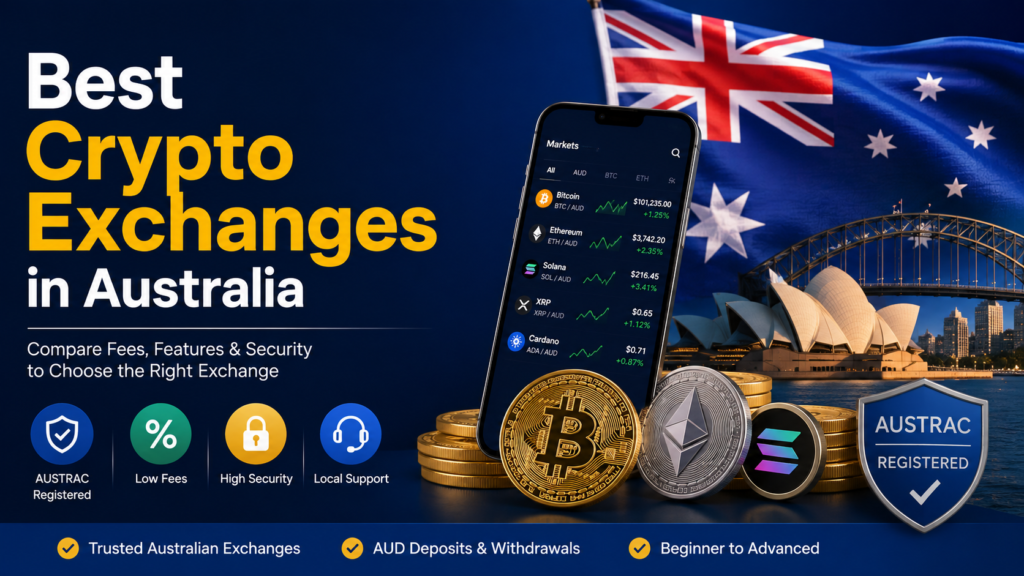
Choosing a crypto exchange in Australia used to mean picking whichever app your mate mentioned at a barbecue. That approach still works about as well as picking a dentist that way. This guide breaks down the real differences between Australia’s top platforms, using verified fee structures, regulatory status, and security records instead of guesswork.
We tested onboarding flows, compared fee schedules line by line, and checked every exchange against Australia’s actual regulatory requirements. No platform on this list paid for a higher ranking. If a fee structure looks messy or a feature feels thin, we say so.
How We Ranked the Best Crypto Exchanges in Australia
Every exchange on this list had to clear the same bar before we even discussed features.
AUSTRAC registration came first. The Australian Transaction Reports and Analysis Centre requires any business exchanging crypto for fiat, or crypto for crypto, to register as a Digital Currency Exchange provider. This isn’t optional, and it isn’t a marketing badge — it’s a legal requirement under the Anti-Money Laundering and Counter-Terrorism Financing Act. We cross-checked every platform against AUSTRAC’s public register before writing a single word.
Fee transparency mattered more than the lowest headline number. A 0.1% trading fee means little if the platform buries a 2% spread inside the price. We compared maker/taker fees, instant-buy premiums, and deposit or withdrawal charges separately.
Security track record carried real weight. We looked at how long each exchange has operated without a customer-fund loss, whether it holds ISO 27001 certification, what percentage of assets sit in cold storage, and whether reserves are independently audited.
Local usability rounded out the score. Fast AUD deposits through PayID or OSKO, Australian-based support, and a coin selection that actually matches what Australians want to trade all fed into the final ranking.
We did not use paid placements, and affiliate relationships (where they exist) never influenced the order below.
Quick Comparison: Best Crypto Exchanges in Australia
| Exchange | Best For | Trading Fees | AUD Deposits | AUSTRAC Registered |
|---|---|---|---|---|
| Swyftx | Best Overall | 0.6% flat, tiered down with volume | PayID, OSKO, POLi, bank transfer — free | Yes |
| Independent Reserve | Low Trading Fees | 0.50% down to 0.02% by volume | PayID, bank transfer | Yes |
| CoinSpot | Beginners | 0.1% market orders, 1% Instant Buy | PayID, POLi, bank transfer — free | Yes |
| CoinJar | AUD Deposits & Withdrawals | 0.1% Exchange, 1–2% instant app | PayID, NPP, card — free bank withdrawals | Yes |
| Digital Surge | Altcoin Selection | Flat 0.5%, drops to 0.1% at volume | PayID, OSKO — instant | Yes |
| Kraken | Advanced/Pro Traders | 0.25% maker / 0.40% taker (Pro) | PayID, bank transfer | Yes |
| BTC Markets | Security | From 0.85% maker/taker | PayID, OSKO, card | Yes |
Fees shift over time as exchanges adjust tiers and promotions, so always check the current fee schedule on the provider’s own site before trading.
Swyftx – Best Overall Crypto Exchange Australia

Swyftx earns the top spot because it doesn’t force a trade-off between ease of use and depth of features. Founded in Brisbane in 2018, the platform built its reputation on a clean interface that somehow still fits in charting tools, recurring buys, and a genuinely useful education hub.
The standout feature is the demo account. Swyftx credits new users with virtual funds to practise trading against live market data before risking real money — a rare offering among Australian exchanges and one that beginners consistently rate highly. It also runs a tiered VIP fee system, so trading costs fall as your monthly volume rises.
Swyftx supports AUD deposits through PayID, OSKO, POLi, and standard bank transfer, all free of charge, and AUD withdrawals cost nothing either. The exchange is AUSTRAC-registered as a Digital Currency Exchange Provider and holds ISO 27001:2022 certification, with customer funds held on a full-reserve basis.
Pros: Free demo trading, wide coin selection, strong mobile app, responsive local support.
Cons: Spread-based pricing can be harder to compare at a glance than a flat percentage fee.
Independent Reserve – Best for Low Trading Fees

Independent Reserve is proof that “cheapest” and “most basic” aren’t the same thing. Operating since 2013, this Sydney-founded exchange built its fee model around rewarding volume, and it shows: rates start at 0.50% and step down through nine tiers to as low as 0.02% for high-volume traders.
That structure makes it the natural home for SMSF investors, active traders, and anyone moving serious money through the market. Independent Reserve also runs an OTC desk for large trades, letting bigger orders settle without disturbing the public order book — useful for anyone who doesn’t want their $50,000 buy order to move the price against them.
The trade-off is coin selection. Independent Reserve lists a comparatively narrow range of major assets rather than chasing every new token, which is a deliberate choice for a platform built around institutional trust rather than speculative variety.
Pros: Aggressive volume-based fee tiers, OTC desk, ISO 27001 certified, long operating history with no major security incident.
Cons: Smaller coin list than most competitors; entry-level fees are higher than CoinSpot’s market-order rate.
CoinSpot – Best for Beginners

CoinSpot is the exchange most Australians open first, and there’s a reason for that. Launched in Melbourne in 2013, it has grown into the country’s largest platform by user count, and the interface is built for people who’ve never touched crypto before.
The onboarding is genuinely fast: verify your identity, deposit AUD through PayID or bank transfer for free, and start buying within minutes. CoinSpot lists an enormous range of digital assets, which means beginners rarely have to look elsewhere when they want to branch out from Bitcoin.
The catch is the pricing structure. Instant Buy, Instant Sell, and Swap transactions carry a 1% fee, while the separate Markets order-book interface charges just 0.1%. New users who stick to Instant Buy out of convenience end up paying ten times more than they need to — a detail worth knowing before your first deposit.
CoinSpot was the first Australian exchange to complete an external statutory financial audit and holds ISO 27001 certification, with proof-of-reserves audits conducted by an independent accountancy firm.
Pros: Enormous coin selection, 24/7 Melbourne-based support, low fee on Markets orders, strong compliance history.
Cons: Instant Buy fee is expensive relative to competitors; charting tools are basic.
CoinJar – Best for AUD Deposits & Withdrawals
CoinJar has quietly run since 2013 and built one of the smoothest AUD funding experiences in the country. Bank transfers and PayID deposits are free and typically land within the hour, and AUD withdrawals back to an Australian bank account cost nothing at all.
Where CoinJar pulls ahead is flexibility of funding methods. Alongside PayID and bank transfer, it accepts Visa and Mastercard deposits — handy if you want to top up instantly, though card top-ups carry a separate 2% charge, so bank transfer remains the cheaper route.
The CoinJar Card adds a practical layer most competitors don’t offer: a Mastercard linked to the crypto balance that lets you spend holdings directly, both online and in-store. For everyday AUD movement in and out of a crypto account, CoinJar’s rails are hard to beat.
CoinJar Exchange, the platform’s order-book product, charges maker fees from around 0.04% and taker fees from roughly 0.10%, well below the 1–2% charged on the simpler consumer app.
Pros: Free AUD withdrawals, multiple funding methods, spendable crypto card, competitive Exchange-tier fees. Cons: Smaller coin selection than CoinSpot or Digital Surge; consumer app fees are steep if you skip the Exchange interface.
Digital Surge – Best for Altcoin Selection

Digital Surge, based in Brisbane and running since 2017, built its reputation on letting Australians buy altcoins directly with AUD — no need to purchase Bitcoin first and convert it, which is still a clunky extra step on some platforms.
The coin list runs into the hundreds, covering everything from established Layer 1 tokens to smaller DeFi and meme assets, making it a genuine destination for investors who want more than the top ten cryptocurrencies. Fees sit at a flat 0.5% for most trades, dropping automatically as 30-day trading volume increases.
It’s worth noting that Digital Surge went through voluntary administration in late 2022 after funds held on the collapsed FTX exchange became inaccessible. Creditors approved a rescue plan in 2023, the platform reopened, and affected users were reimbursed under that plan. It’s a relevant data point for anyone weighing counterparty risk, even though the exchange has continued operating since.
Pros: Wide altcoin range, direct AUD-to-altcoin purchases, low flat fee, fast PayID deposits.
Cons: Past voluntary administration event; fewer advanced trading tools than Kraken or Swyftx.
Kraken – Best for Advanced/Pro Traders

Kraken brings genuine international trading infrastructure to the Australian market. Headquartered in the US with a registered Australian entity, it’s one of the longest-running exchanges globally and pairs that history with tools serious traders actually want: margin trading, futures access, and a detailed order book through Kraken Pro.
The fee structure rewards using the right interface. The simple Buy/Sell/Convert screen charges around 1.5% once the built-in spread is included — fine for a casual purchase, expensive for regular trading. Kraken Pro flips that entirely, with maker fees from 0.25% and taker fees from 0.40% on standard volumes, dropping further as your 30-day volume increases.
Security is where Kraken consistently scores well: ISO 27001 certification, proof-of-reserves audits using cryptographic verification, and a long operating history without a customer-fund-affecting breach. The trade-off for Australians is a narrower set of AUD trading pairs compared with local exchanges, occasionally requiring a conversion step through USD markets.
Pros: Deep liquidity, advanced order types, margin and futures access, strong security certifications.
Cons: Instant-buy fees are high without switching to Pro; no demo account for practising first.
BTC Markets – Best for Security

BTC Markets has been operating out of Melbourne since 2013, making it one of the oldest continuously running crypto exchanges in Australia — and in over a decade of operation spanning multiple market crashes, it has not reported a major hack or loss of customer funds.
It was the first exchange to receive Gold Certification from what was then Blockchain Australia (now the Digital Economy Council of Australia), and it maintains AUSTRAC registration alongside strict internal KYC and AML processes. The platform supports API trading for automated strategies, a feature not every retail-focused exchange bothers to offer.
The coin selection is deliberately conservative — a few dozen well-established assets rather than a sprawling list — which lines up with BTC Markets’ overall philosophy of prioritising operational stability over chasing every new token listing. Fees start from around 0.85% maker/taker, higher than some rivals, which is the price of that conservative, compliance-first approach.
Pros: Longest clean security track record in the local market, Gold Certified, solid liquidity in major pairs, API access for automated trading.
Cons: Higher base fees, narrower coin selection, fewer advanced retail features than Swyftx or Kraken.
Is Crypto Trading Legal in Australia?
Yes — buying, selling, and holding cryptocurrency is entirely legal in Australia. What’s regulated is how businesses provide crypto services, not whether individuals can use them.
Any exchange operating in Australia, whether domestic or international, must register with AUSTRAC as a Digital Currency Exchange provider before offering services to Australian customers. This registration obliges the platform to verify user identity, monitor transactions, and report suspicious activity under the AML/CTF Act. Operating without registration is a criminal offence.
It’s worth being precise about what AUSTRAC registration actually guarantees, because it’s often oversold. Registration confirms an exchange follows anti-money-laundering rules — it is not a financial services licence, and it doesn’t vet how safely a platform holds your money or guarantee compensation if something goes wrong. Some Australian exchanges have separately obtained an Australian Financial Services Licence (AFSL) from the Australian Securities and Investments Commission for specific products, but this doesn’t extend to spot crypto trading in most cases.
Australia’s regulatory framework has also been expanding. AUSTRAC broadened its AML/CTF regime to capture a wider range of digital asset businesses, including certain custodians and intermediaries that previously sat outside the registration requirement. If you’re evaluating an exchange, checking its current status on AUSTRAC’s public register takes two minutes and tells you more than any marketing page will.
Factors to Consider When Choosing a Crypto Exchange in Australia
Regulatory status. Confirm AUSTRAC registration before you deposit a single dollar — it’s the baseline, not a bonus feature.
Fee structure, not just the headline number. Compare maker/taker fees, instant-buy premiums, and withdrawal fees together. A platform advertising “0.1% fees” while charging 1% on its default buy screen is technically accurate and practically misleading.
Security certifications and track record. Look for ISO 27001 certification, published cold-storage percentages, and independent proof-of-reserves audits. A decade without a breach says more than any security page.
AUD funding options. PayID and OSKO transfers are typically free and near-instant. Card deposits are convenient but almost always cost extra.
Coin selection matched to your goals. A narrower, security-focused exchange suits Bitcoin-and-Ethereum investors; altcoin hunters need a platform that actually lists them.
Customer support quality. Australian-based, 24/7 support matters more than it sounds like it should — especially the first time a transfer doesn’t show up when expected.
No government deposit protection. Unlike bank deposits covered by the Financial Claims Scheme, crypto holdings on an exchange carry no government-backed guarantee. That risk sits with the platform’s own security arrangements, not the state.
Centralized vs. Decentralized Exchanges: Which Is Right for You?
Centralized exchanges (CEXs) — CoinSpot, Swyftx, Kraken, and every platform reviewed above — act as intermediaries. You deposit AUD, the exchange holds it, and it executes trades on your behalf against its own order book or liquidity pools.
Decentralized exchanges (DEXs) cut out that middleman. Trades execute directly between users’ own crypto wallets through smart contracts, with no company custodying your funds at any point. Platforms like Uniswap fall into this category.
The practical difference comes down to control versus convenience. A CEX handles AUD conversion, customer support, and account recovery if you lose access — but you’re trusting that platform with custody of your assets (“not your keys, not your coins,” as the well-worn crypto phrase goes). A DEX gives you full control of your funds at all times, but there’s no AUD on-ramp, no customer support line, and no way to reverse a mistaken transaction.
For most Australians starting, a regulated centralized exchange is the sensible entry point — it’s where AUD deposits, AUSTRAC compliance, and beginner support actually exist. DEXs become more relevant once you’re comfortable managing your own wallet and understand the added responsibility that comes with full self-custody.
How to Start Trading Crypto in Australia (Step-by-Step Guide)
1. Choose a registered exchange. Confirm AUSTRAC registration and compare fees against your likely trading style.
2. Create your account. Sign up with your email and a strong password, then enable two-factor authentication immediately.
3. Complete identity verification (KYC). Australian exchanges require government ID and, usually, a selfie for biometric matching under AUSTRAC’s AML/CTF rules.
4. Fund your account with AUD. PayID or OSKO transfers are typically free and land within minutes. Card deposits are instant but cost more.
5. Place your first trade. Start small while you learn the interface. If the exchange offers a demo account, use it first — Swyftx’s is the standout example.
6. Secure your holdings. For funds beyond active trading, consider a hardware wallet for self-custody. An exchange is a convenient place to trade, not necessarily the safest place to store long-term holdings.
7. Keep records from day one. Every buy, sell, swap, and disposal is a potential tax event. Export transaction history regularly rather than reconstructing a year of trades in June.
Crypto Tax Rules in Australia
The Australian Taxation Office does not treat cryptocurrency as money or foreign currency. Instead, it classifies crypto assets as property, subject to Capital Gains Tax (CGT) — the same basic framework applied to shares or investment property.
A CGT event is triggered whenever you sell crypto for AUD, swap one crypto asset for another, spend crypto on goods or services, or gift it to someone else. The gain or loss is calculated as your sale proceeds minus your cost base — the original purchase price plus any associated fees.
Hold an asset for 12 months or more before disposing of it, and eligible Australian resident individuals can generally apply a 50% CGT discount on the gain. Capital losses can offset capital gains, though they cannot be used to offset ordinary income.
Income earned from crypto — staking rewards, some airdrops, and interest-style returns — is generally taxed as ordinary income at the time you receive it, separately from any later CGT event when you dispose of that asset.
The ATO runs an active data-matching program with Australian exchanges, meaning unreported crypto activity carries real audit risk rather than a theoretical one. Keeping detailed records of every transaction, and using crypto tax software that reconciles against your exchange history, makes tax time considerably less painful. Given how quickly the rules evolve, a conversation with a registered tax agent who understands digital assets is worth the fee for anyone with a non-trivial portfolio.
Frequently Asked Questions (FAQs)
Is it safe to keep crypto on an Australian exchange long-term? Reputable AUSTRAC-registered exchanges use cold storage and independent audits, but no exchange offers government-backed deposit protection as a bank does. Many experienced investors keep trading funds on an exchange and move long-term holdings to a personal hardware wallet.
Do I need to pay tax if I only buy and hold crypto without selling? No. Simply buying and holding doesn’t trigger a CGT event. Tax obligations arise when you sell, swap, spend, or gift the asset — or when you earn crypto income such as staking rewards.
What’s the difference between AUSTRAC registration and a financial services licence? AUSTRAC registration is an anti-money-laundering requirement focused on identity verification and transaction monitoring. An Australian Financial Services Licence, issued by ASIC, is a separate and broader authorisation that most spot crypto exchanges do not currently hold for their core trading product.
Which exchange has the lowest fees in Australia? It depends on your trading volume. CoinSpot’s Markets interface charges a flat 0.1%, while Independent Reserve drops as low as 0.02% for high-volume traders — but only after you clear its higher-volume tiers.
Can I buy crypto in Australia using a credit card? Most exchanges accept card deposits, but they typically carry a fee of around 2%, compared with free or near-free PayID and bank transfer deposits.
Are decentralized exchanges legal in Australia? Yes, though they operate in a less clearly regulated space than centralized exchanges, since there’s no central Australian entity to register with AUSTRAC. Using a DEX shifts responsibility for security and compliance entirely onto the individual user.
Final Verdict: Which Crypto Exchange Should You Choose?
There isn’t a single “best” exchange — there’s a best exchange for what you’re actually trying to do.
If you want one platform that handles everything reasonably well, Swyftx is the strongest all-rounder, backed by a demo account that genuinely helps beginners avoid expensive early mistakes. If cost is your primary concern and you trade in real volume, Independent Reserve’s tiered fees are hard to beat. First-time buyers who just want the simplest possible path from AUD to Bitcoin should start with CoinSpot, while anyone who values slick AUD banking and a spendable crypto card should look at CoinJar.
Altcoin hunters will find the deepest selection on Digital Surge, active traders who need margin and futures access should head to Kraken, and anyone whose top priority is a clean security record above all else should give real weight to BTC Markets.
Whichever platform you choose, confirm its current AUSTRAC status, read its live fee schedule rather than relying on any review (including this one) for exact numbers, and never deposit more than you understand how to secure. For deeper dives into individual platforms, exchange comparisons, and ongoing coverage of Australia’s crypto regulatory landscape, browse the full exchange library at ExchangeReviewLab.
This article is general information only and does not constitute financial or tax advice. Cryptocurrency is a high-risk, volatile asset class. Speak with a licensed financial adviser or registered tax agent before making investment decisions.
