
Choosing between two large crypto exchanges feels a bit like choosing between two airlines that both claim “on-time performance.” The marketing pages look similar. The real differences show up only after you book the ticket, sit through a layover, or, in this case, try to withdraw your funds at 2 a.m. on a Sunday.
Bybit and Gate.io are both multi-billion-dollar platforms with millions of users, but they are built for slightly different kinds of traders. This guide breaks down exactly where they differ, using verified data from official sources, regulatory filings, and independent research — not guesswork.
Quick Verdict — Bybit vs Gate.io at a Glance
If you want a shorter answer before the long one: Bybit is the stronger pick for derivatives trading, a cleaner interface, and a security story it has actually been tested on. Gate.io wins if your priority is altcoin variety, since it lists one of the widest catalogs of tokens in the industry, along with a large built-in bot suite.
| Category | Bybit | Gate.io |
|---|---|---|
| Founded | 2018, Dubai HQ | 2013, Cayman Islands HQ |
| Best for | Derivatives, clean UX | Altcoin variety, trading bots |
| Spot fee (standard) | 0.10% maker / 0.10% taker | 0.20% maker / 0.20% taker (before GT discount) |
| Futures fee (standard) | 0.02% maker / 0.055% taker | 0.015% maker / 0.05% taker |
| Coins listed | 1,800+ | 3,800+ |
| Major hack | Feb 2025, $1.5B (Lazarus Group) | Disputed 2018 incident, unresolved |
| KYC | Mandatory since 2023 | Mandatory for deposit/withdrawal |
| US access | Restricted | Restricted (separate Gate US entity exists) |
Numbers shift often in crypto, so treat this table as a starting point and confirm current rates on each platform before you fund an account.
1. Company Background & Trust Factor
Bybit launched in 2018 under Bybit Fintech Limited, founded by Ben Zhou. It moved its headquarters from Singapore to Dubai in 2022 and now ranks as one of the largest exchanges globally by trading volume, according to Bloomberg’s exchange rankings referenced on Wikipedia.

Gate.io has been around longer. It started in 2013, based out of the Cayman Islands, and rebranded to simply “Gate” in 2025 while keeping the Gate.io domain active for its global platform. Its longevity gives it a decade-plus track record, which matters in an industry where exchanges disappear overnight.

Trust in crypto isn’t built on age alone, though. It comes down to how an exchange behaves when something goes wrong. Both platforms have had a defining moment, and both handled it differently — more on that in the security section.
2. Supported Countries & Regulatory Restrictions
Bybit operates in more than 160 markets but keeps a formal restricted list under Section 11.3 of its Service Agreement. The United States, Canada, mainland China, and Singapore remain fully blocked. Retail access from Dubai itself is also excluded, even though Bybit is headquartered there. The United Kingdom returned to Bybit’s supported list through a regulated partnership with Archax, and the European Economic Area is served through a MiCA-licensed Bybit EU entity, per independent research from Datawallet.
Gate.io restricts more jurisdictions on paper — over 30, according to its User Agreement — but has also built out region-specific entities. Gate US serves select states directly, Gate EU operates under a Malta MiCA license, and Gate Technology FZE holds a VARA license in Dubai, based on details compiled by CoinPerps’ regulatory tracker.
Neither exchange serves the US on its main global platform. If you’re in a restricted country, using a VPN to get around the block violates both platforms’ terms of service and can freeze your account, so it’s not a real workaround.
3. Account Setup & KYC Process
Signing up for either exchange takes a few minutes: email, password, and a 2FA method. The real gatekeeper is identity verification.
Bybit made KYC mandatory across all products in 2023. Before that, casual traders could dabble without submitting ID. That door is now closed.

Gate.io took the same route. Verification now happens in two tiers — a basic ID-and-selfie check, followed by a proof-of-address step for higher limits. Gate’s own help documentation states that both deposits and withdrawals require verification, closing an older loophole where unverified accounts could still move small amounts.
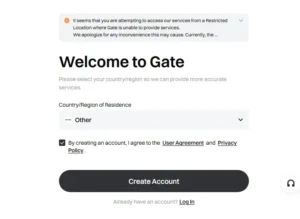
Practically speaking, expect the same 10-to-30-minute process on both platforms, sometimes stretching to several hours if the automated system flags your documents for manual review.
4. Trading Fees Breakdown
This is where most comparisons oversimplify things, so let’s slow down.
Bybit spot trading charges a flat 0.10% for both makers and takers at the standard tier. VIP tiers, based on 30-day volume or asset balance, push that down significantly, and paying fees in Bybit’s native token unlocks an additional discount.
Bybit futures run on a maker-taker split: 0.02% for makers and 0.055% for takers on USDT perpetuals at the base tier. That gap rewards traders who use limit orders instead of market orders.
Gate.io spot trading is where sources genuinely disagree, which tells you something on its own: check the live fee page in your account rather than trusting any single screenshot. Gate’s own schedule for the Regular tier shows 0.20% maker/taker, dropping through a 16-step VIP ladder tied to GateToken (GT) holdings or trading volume. Several independent reviewers report an effective lite-tier rate closer to 0.10%/0.20% after standard discounts apply.
Gate.io futures start lower on paper, around 0.015% maker and 0.05% taker, though a few trackers list the standard taker rate as high as 0.075% depending on the contract type.
The honest takeaway: Bybit’s fee schedule is simpler to predict. Gate.io can be cheaper at scale once you hold GT tokens, but the entry-level rate needs more attention.
5. Product Range & Trading Tools
Bybit covers spot, derivatives with leverage up to 100x, options, copy trading, an Earn program, a Web3 wallet, an NFT marketplace, and the Bybit Card for spending crypto directly in supported regions.
Gate.io leans into breadth. Beyond spot and futures (some contracts up to 200x leverage), it runs one of the more extensive built-in bot libraries in the industry — grid bots, DCA bots, arbitrage bots, and martingale strategies — plus IEO/Startup access that lets users buy into new token launches before they hit the open market.
If you want fewer buttons and a shorter learning curve, Bybit fits better. If you want every tool available in one place, even if it takes longer to find the one you need, Gate.io delivers more surface area.
6. Security Track Record
Here’s the part nobody enjoys reading but everybody needs to.
On February 21, 2025, Bybit suffered the largest cryptocurrency theft on record. Attackers linked to North Korea’s Lazarus Group compromised the infrastructure of Safe{Wallet}, a third-party multisig tool Bybit used to move funds between cold and warm storage. The attackers injected malicious code into the signing interface, tricking Bybit’s own executives into approving a transaction that rerouted roughly $1.5 billion in Ethereum to attacker-controlled wallets. The FBI formally attributed the attack to Lazarus Group, as detailed by the Center for Strategic and International Studies.
What happened next matters. Bybit disclosed the breach publicly within hours, confirmed it remained solvent, and used bridge loans from partners to keep withdrawals running normally while it rebuilt reserves, according to Bybit’s own incident timeline. No user lost funds. That response — fast disclosure, no lockouts, transparent postmortem — is genuinely rare in this industry, even if the breach itself was catastrophic.
Gate.io’s biggest cloud is older and murkier: an alleged 2018 breach worth around $234 million that on-chain investigators resurfaced years later. Gate.io has never confirmed the incident occurred and points to its proof-of-reserves audits as evidence that user balances stayed fully backed throughout. Since then, the exchange has invested in zero-knowledge proof-of-reserves technology, independently assessed by security firm Hacken, which found no critical vulnerabilities in the implementation, per Hacken’s published case study.
Neither story is simple. Bybit survived a confirmed, massive, publicly documented hack without losing user funds. Gate.io has an unresolved historical allegation but a clean recent record and strong reserve transparency. Pick your comfort level: a known crisis handled well, or an unconfirmed shadow with nothing since. Our team dug deeper into this exact question in our full Gate.io safety review.
7. User Experience: App & Interface
Bybit’s interface earns consistent praise for being clean and easy to navigate, even for people coming straight from a bank app with zero crypto background. Menus are logically grouped, and the derivatives dashboard doesn’t feel like a cockpit.
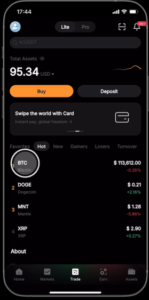
Gate.io’s interface carries the weight of its own product catalog. With spot, futures, bots, NFTs, launchpad, and a Web3 wallet all under one roof, first-time users often describe it as cluttered. The mobile app trims this down and is generally easier to use than the desktop site.
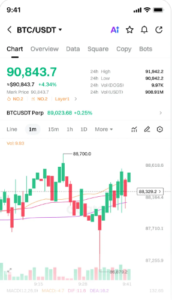
Neither platform is objectively bad here — it’s a trade-off between simplicity and feature density.
8. Withdrawal Fee Comparison Table
Withdrawal fees move with network congestion on both exchanges, so treat these as reference points, not fixed prices.
| Asset/Network | Bybit (approx.) | Gate.io (approx.) |
|---|---|---|
| BTC (Bitcoin network) | ~0.0005 BTC | ~0.0001 BTC |
| ETH (ERC-20) | Varies with gas | ~0.002 ETH |
| USDT (TRC-20) | ~1 USDT | Varies by tier |
| Fiat withdrawal | Varies by method | Not supported directly to bank |
Gate.io does not support direct crypto-to-bank withdrawals; funds move to an external wallet first. Bybit offers more direct fiat off-ramp routes in supported regions through its card and bank partnerships. Always check the live withdrawal screen — both exchanges adjust network fees in real time.
9. Mobile App Comparison
Both apps are available on iOS and Android and cover the core functions: spot, futures, deposits, withdrawals, and account security settings.
Bybit’s app mirrors its desktop simplicity, with quick access to Earn products and a smoother onboarding flow for new users. Gate.io’s app supports more languages out of the box and gives mobile users access to its bot suite, which is unusual for a mobile trading app. The trade-off is a steeper learning curve if you’re opening a crypto app for the first time.
10. Fiat On-Ramp / Payment Method Comparison
Bybit supports card purchases, bank transfers in select regions, P2P trading, and the Bybit Card, which carries no monthly fee and 0% FX markup for EEA users, plus Apple Pay and Google Pay compatibility.
Gate.io supports card purchases via Visa, Mastercard, and Apple Pay, typically carrying a fee around 2.9%, along with its own P2P marketplace for peer-to-peer fiat conversion. Neither exchange treats fiat on-ramps as a core focus compared to dedicated brokerages, so expect card fees to run higher than a direct bank transfer on both platforms.
11. Liquidity & Order Execution
Liquidity is where trading theory meets trading reality. A tight spread on paper means nothing if your order slips five basis points on execution.
Bybit reports daily trading volume north of $11 billion, giving it deep order books on major pairs like BTC/USDT and ETH/USDT. Gate.io’s futures segment alone reportedly handles over $10.9 billion in daily volume, which is substantial, though liquidity thins out noticeably once you move into its smaller-cap altcoin listings — a natural consequence of listing thousands of tokens instead of a few hundred.
For high-frequency or large-size trading on major pairs, both platforms can generally fill orders without major slippage. For thin altcoins, check the order book depth before placing anything beyond a small test trade, regardless of which exchange you use.
12. Staking/Earn APY Comparison
Bybit’s Earn program covers structured staking, flexible staking, and short-term promotional products. Standard flexible and fixed staking yields sit in a moderate, realistic range for major assets, while short-duration promotional products can advertise very high annualized rates — these usually apply to small deposit caps and brief lock periods, not your full balance, so read the fine print before treating a headline APY as your real return.
Gate.io runs a Simple Earn product for GT and other assets, with flexible options offering daily payouts and no lock-up, alongside fixed-term products that pay more for longer commitments.
Rule of thumb for both platforms: flexible, no-lock staking pays less but keeps your funds liquid. Fixed terms and promotional teaser rates pay more but come with either a lock-up period or a strict deposit cap. Nothing in crypto staking is “risk-free,” even when an exchange calls it “Earn.”
13. Last Verified Trust Line
Fee schedules, staking rates, and country restrictions in crypto change often — sometimes monthly. The figures in this article reflect published exchange documentation and independent trackers checked as of August 2026. Before moving funds, confirm current fees and availability directly on Bybit’s and Gate.io’s official fee and country-restriction pages.
14. Customer Support Reality Check
Bybit offers 24/7 live chat and a multilingual support ticket system, generally regarded as responsive for account and trading issues.
Gate.io also runs 24/7 support across live chat, email, and social channels, but user reviews are more mixed — some praise quick replies, others report delays on complex withdrawal or KYC disputes. Neither exchange offers phone support, which is standard across the crypto exchange industry, not a red flag specific to either platform.
15. Unique Differentiators — What Sets Each Exchange Apart
Bybit’s edge is coherence: a cleaner interface, a strong derivatives engine, TradingView integration, and — somewhat ironically — a security incident it handled about as well as an exchange can handle a $1.5 billion breach.
Gate.io’s edge is breadth: the deepest altcoin catalog most traders will ever need, an in-house bot ecosystem that rivals dedicated third-party bot platforms, and early-access token launches through its Startup/IEO program. It was also among the first major exchanges to adopt public proof-of-reserves, well before that became an industry expectation post-FTX.
16. Pros and Cons
Bybit
Pros:
- Clean, beginner-friendly interface
- Competitive futures fees for limit-order traders
- Transparent, fast public response during its 2025 security incident
- Strong derivatives and copy-trading tools
Cons:
- Higher standard futures taker fee than some direct competitors
- Retail access blocked even in its own Dubai headquarters
- History includes the largest crypto hack on record, even though user funds were protected
Gate.io
Pros:
- Widest altcoin selection among major exchanges
- Extensive built-in trading bot suite
- Early proof-of-reserves adopter with third-party security audits
- Regional entities (Malta, Dubai, US) improving regulatory footing
Cons:
- Interface can overwhelm new users
- Fee schedule reporting varies across sources — verify before trading
- Unresolved 2018 breach allegation still shows up in security discussions
- Mixed customer support reviews on complex cases
17. Verdict by User Type
New traders: Bybit’s simpler layout reduces the learning curve. Our beginner exchange guide covers what else matters at this stage.
Active day traders: Both work, but Bybit’s predictable fee schedule and deep liquidity on major pairs make cost planning easier. See our breakdown of the best exchanges for day trading.
Altcoin hunters: Gate.io wins outright here. No other major exchange on this list matches its 3,800+ coin catalog.
Automated/bot traders: Gate.io’s native bot suite saves you from paying for a third-party bot service.
Security-conscious users: This depends on which risk you’d rather accept — a confirmed, well-handled breach (Bybit) or an unconfirmed historical allegation (Gate.io). Neither answer is wrong; they’re just different bets.
18. Which Exchange Is Better? (Final Verdict)
There’s no universal winner, and any article that tells you otherwise is oversimplifying a genuinely close comparison.
Bybit is the better all-around choice for most traders: simpler fees, a cleaner app, strong derivatives tools, and a security response that, despite the headline-grabbing hack, actually protected users. Gate.io is the better choice for a narrower but real group — traders who specifically want access to thousands of altcoins and a built-in bot ecosystem they’d otherwise pay extra for elsewhere.
If you’re still undecided, our Binance vs Bybit comparison and Binance vs Gate.io comparison show how each stacks up against the market’s largest exchange, which can help narrow the decision further. You can also read our standalone Bybit review and Gate.io review for the full scoring breakdown
19. Frequently Asked Questions
Is Bybit or Gate.io safer in 2026? Bybit suffered a confirmed $1.5 billion hack in February 2025 but kept all user funds intact through fast disclosure and reserve replenishment. Gate.io has no confirmed major breach since an unresolved 2018 allegation and maintains audited proof-of-reserves above 100%. Both are viable, but they carry different kinds of risk history.
Can US residents use Bybit or Gate.io? The main global platforms for both exchanges restrict US residents. Gate has launched a separate, US-facing entity operating in select states, while Bybit’s global platform remains fully blocked for American users.
Which exchange has lower trading fees? Bybit’s flat 0.10% spot fee is simpler to predict. Gate.io’s published schedule starts higher at the base tier but can fall lower once GT token discounts and volume tiers apply. Your actual cost depends heavily on your trading volume and token holdings.
Do I need to complete KYC on both exchanges? Yes. Both platforms require identity verification before you can deposit or withdraw funds. Neither offers a meaningful no-KYC pathway anymore.
Which exchange has more coins listed? Gate.io, with a catalog of 3,800+ cryptocurrencies compared to Bybit’s roughly 1,800+, making it the stronger choice for altcoin discovery.
Is Gate.io the same as Gate.com? Yes. The exchange rebranded from Gate.io to Gate in 2025, though the Gate.io domain remains active and widely used for the global platform.
This comparison uses information sourced from official exchange documentation, regulatory filings, and independent industry research. Crypto exchange terms, fees, and country availability change frequently — always verify current details directly with the exchange before depositing funds.
