
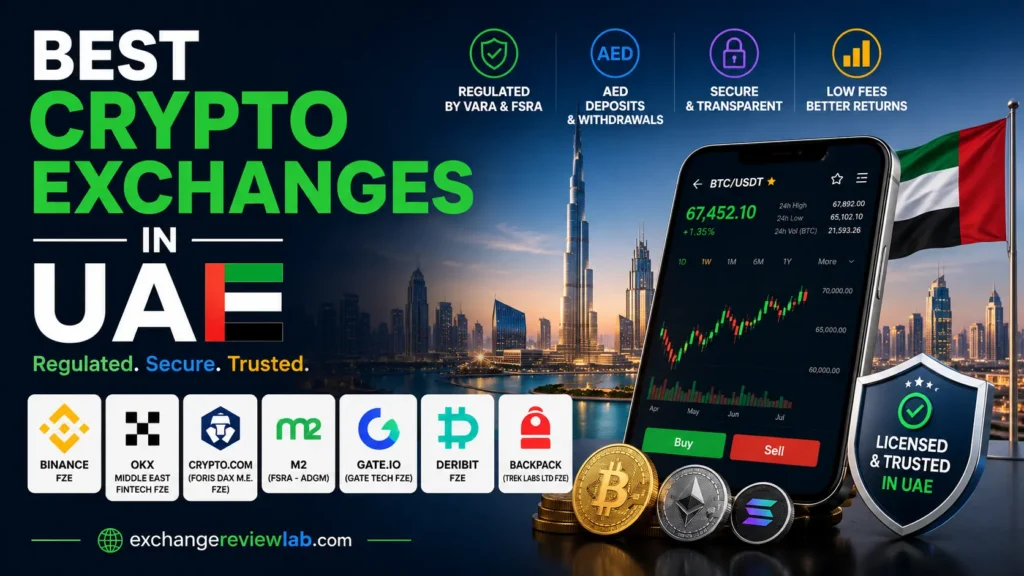
The UAE turned crypto trading into a proper, regulated business instead of a grey-market side hustle. Dubai built the world’s first standalone virtual assets regulator, Abu Dhabi built its own version through ADGM, and a new federal authority just joined the party in 2026. That’s a lot of acronyms for one country, and it’s exactly why picking a crypto exchange in the UAE isn’t as simple as downloading the app with the loudest ads.
This guide breaks down the best crypto exchanges in the UAE right now, based on what’s actually licensed, not what’s trending on a billboard on Sheikh Zayed Road. We checked the official regulator registers, compared real fee schedules, and skipped the marketing fluff.
How We Ranked the Best Crypto Exchanges in the UAE
We didn’t rank these platforms by which one has the flashiest app icon. Four things mattered:
Licensing status. We only shortlisted exchanges that hold an active licence from the Virtual Assets Regulatory Authority (VARA) in Dubai, or from Abu Dhabi’s Financial Services Regulatory Authority (FSRA). A platform that only holds an “in-principle approval” isn’t allowed to service clients yet, according to VARA’s own register, so we treated that as a red flag rather than a green one.
AED support. A crypto exchange in the UAE should let you fund your account in dirhams through a local bank, not force you through three currency conversions and a prayer.
Trading costs. We compared published maker and taker fees instead of trusting “lowest fees guaranteed” banners, because those banners lie more often than a fisherman describing his catch.
Security track record. We looked at proof-of-reserves practices, custody setup, and whether the platform has a clean history or a suspicious number of “temporary maintenance” pages.
Quick Comparison: Best Crypto Exchanges in UAE
| Exchange | Best For | Regulator | Standout Feature |
|---|---|---|---|
| Binance FZE | Best Overall | VARA (Dubai) | Widest product range, $1B SAFU fund |
| OKX Middle East Fintech FZE | Lowest Trading Fees | VARA (Dubai) | 0.08% maker spot fee |
| Crypto.com (Foris DAX Middle East FZE) | Beginners | VARA (Dubai) | Simple app, card funding |
| M2 | AED Deposits & Withdrawals | FSRA (ADGM) | Direct AED trading pairs |
| Gate.io (Gate Technology FZE) | Altcoin Selection | VARA (Dubai) | Thousands of listed tokens |
| Deribit FZE | Advanced/Pro Traders | VARA (Dubai) | Leading crypto options venue |
| Backpack (Trek Labs Ltd FZE) | Security | VARA (Dubai) | Daily zero-knowledge proof of reserves |
Now let’s go through each one properly.
Binance FZE – Best Overall Crypto Exchange in UAE
Binance is the exchange most UAE residents open first, and there’s a decent reason for that beyond habit. Binance FZE holds a full VARA licence covering Exchange Services (including derivatives trading), Broker-Dealer, Management and Investment, and Lending and Borrowing, issued in April 2024.
The platform supports AED funding through bank transfer, card payments, and P2P trading, and it lists hundreds of cryptocurrencies alongside spot, futures, staking, and copy trading tools. Binance also runs the Secure Asset Fund for Users (SAFU), an emergency reserve worth around $1 billion, which acts as a financial airbag if something ever goes badly wrong.
Standard spot trading fees sit at 0.10% for both makers and takers, dropping to around 0.075% if you pay fees using the BNB token. That’s not the cheapest rate on this list, but the trade-off is a genuinely complete platform where you rarely need a second exchange.
Good for: traders who want one app that does everything reasonably well instead of five apps that each do one thing brilliantly.
OKX Middle East Fintech FZE – Best for Low Trading Fees
OKX earned its VARA Exchange Services licence in September 2024, and it undercuts Binance on the spot trading fee that most casual traders actually pay.
Standard spot fees run at 0.08% for makers and 0.10% for takers, slightly below Binance’s flat 0.10%/0.10% structure. Futures fees start even lower, at 0.02% maker and 0.05% taker. Holding the exchange’s native OKB token unlocks further discounts, and OKX’s VIP ladder rewards active traders with rates that keep shrinking as volume grows.
The platform covers spot and derivatives trading, an integrated Web3 wallet, and DeFi access, though the interface can feel a bit crowded if you’re used to simpler apps.
Good for: frequent traders who care about basis points because those basis points add up fast on a busy month.
Read more:
Crypto.com (Foris DAX Middle East FZE) – Best for Beginners
Crypto.com operates in Dubai under the entity Foris DAX Middle East FZE, which holds a full VARA licence for Exchange Services, Broker-Dealer, Management and Investment, and Lending and Borrowing, issued in April 2024.
What makes it beginner-friendly isn’t a gimmick — it’s the basics done well. The app supports card funding, has a clean buy/sell interface without fifteen chart indicators fighting for your attention, and pairs the exchange with a broader ecosystem that includes a Visa card and simple staking options.
New traders in the UAE tend to gravitate here because the learning curve feels closer to a mobile banking app than a Bloomberg terminal.
Good for: someone buying their first Bitcoin who doesn’t want to feel like they need a finance degree to click “buy.”
M2 – Best for AED Deposits & Withdrawals
If getting dirhams in and out of an exchange without friction matters most to you, M2 deserves the top spot. It operates under a license from Abu Dhabi’s FSRA as a Multilateral Trading Facility and Custodian, and it’s the most retail-relevant ADGM platform for UAE residents specifically because it offers direct AED trading pairs.
That’s a bigger deal than it sounds. Plenty of global exchanges route your AED through a stablecoin conversion first, quietly shaving off value along the way. M2 skips that detour, which matters if you’re moving meaningful amounts between your bank and your portfolio regularly.
Good for: UAE residents who want their local currency to behave like local currency, not like a foreign guest that needs converting twice.
Gate.io (Gate Technology FZE) – Best for Altcoin Selection

Gate Technology FZE picked up its VARA Exchange Services licence in April 2025, and Gate.io’s real selling point has always been breadth. Our own Gate.io review found the platform lists well over 1,700 coins across thousands of trading pairs, which dwarfs what you’ll find on Binance or Coinbase.
That breadth is a double-edged sword. It’s fantastic if you’re hunting for a small-cap token before it hits the mainstream exchanges, but it also means the platform lists plenty of low-volume, low-quality assets that deserve real scrutiny before you buy. Gate.io pairs its listings depth with margin trading, futures, copy trading, and a fairly steep learning curve for total beginners.
Good for: traders who already know what they’re looking for and want access to tokens the bigger names haven’t listed yet.
Read more:
Deribit FZE – Best for Advanced/Pro Traders
Deribit FZE holds a VARA licence covering Exchange Services including derivatives trading, issued in November 2024, and it’s built specifically for options and futures rather than general spot trading.
This isn’t the exchange you open to buy your first hundred dirhams of Ethereum. It’s the one professional and institutional traders reach for when they want deep liquidity in Bitcoin and Ethereum options, structured products, and advanced risk management tools. If terms like “delta hedging” and “implied volatility” mean something to you already, Deribit is where that vocabulary gets put to work.
Good for: experienced traders who see spot trading as the training wheels they took off years ago.
Backpack (Trek Labs Ltd FZE) – Best for Security
Backpack, operated locally by Trek Labs Ltd FZE, was actually one of the earliest platforms to secure a VARA Exchange Services licence, back in October 2023. Its real differentiator is transparency around custody.
The platform publishes daily zero-knowledge proof-of-reserves, independently verified by the security firm OtterSec, so anyone can cryptographically confirm the exchange holds enough assets to cover what customers have deposited, without exposing individual account balances. It also uses Multi-Party Computation (MPC) for custody, which removes the classic single point of failure that has sunk other exchanges in the past.
The trade-off is a smaller trading pair selection than the giants on this list, since Backpack has focused on building trust before building breadth.
Good for: traders who lost sleep over past exchange collapses and want a platform that shows its receipts daily instead of once a quarter.
Is Crypto Trading Legal in UAE?
Yes, and it’s not just tolerated — it’s actively regulated with real infrastructure behind it. The UAE runs one of the more mature licensing regimes for virtual assets anywhere in the world, built around several regulators depending on where and how a platform operates.
VARA governs Dubai’s mainland and free zones outside the Dubai International Financial Centre (DIFC). It was established under Dubai Law No. 4 of 2022 as the world’s first dedicated virtual assets regulator. The FSRA does the same job for Abu Dhabi Global Market, and it’s been running a virtual asset regime since 2018, longer than any other UAE regulator. The DFSA covers the DIFC separately.
On top of those, a federal layer arrived on 1 January 2026. Federal Decree-Laws 32 and 33 of 2025 replaced the old Securities and Commodities Authority with a new Capital Market Authority (CMA) and formally brought virtual assets into scope as regulated financial products across the country. Every VARA-licensed exchange now carries a CMA registration number alongside its Dubai licence.
The practical takeaway: trading crypto in the UAE is completely legal when you’re using a properly licensed platform. Using an unlicensed one is a different story, and enforcement has already started — VARA ordered at least one major exchange to halt all Dubai activity in 2026 for operating without a licence. Always check the VARA public register for the actual licensed legal entity name behind any app you’re considering, not just the brand name on the logo.
Factors to Consider When Choosing a Crypto Exchange in the UAE
Licensing, first and always. Confirm the platform holds an active VASP licence for Exchange Services, not just a Broker-Dealer permission or an in-principle approval. These sound similar but authorize very different things.
AED funding routes. Check whether you can deposit and withdraw via a local bank transfer rather than relying only on cards, which usually cost more and process slower.
Fee structure. Compare maker and taker rates on the specific trading pairs you’ll actually use, not just the headline number on the homepage.
Custody and proof of reserves. Find out whether the exchange publishes regular, independently verified proof that customer assets are fully backed.
Coin selection versus your goals. A platform with thousands of listings is exciting for altcoin hunters and overwhelming for someone who just wants Bitcoin and Ethereum.
Customer support quality. Test it before you deposit serious money. A slow support team during a market crash is the financial equivalent of a lifeguard who’s on lunch break.
Centralized vs. Decentralized Exchanges: Which Is Right for You?
Centralized exchanges (CEXs) like the ones covered above act as the middleman. They hold your funds, run the order book, handle KYC checks, and give you customer support when things go sideways. For anyone new to crypto, or anyone who wants a regulated entity accountable for their funds, a CEX is the sensible starting point — and it’s the only option that fits neatly inside the VARA and FSRA licensing frameworks discussed above.
Decentralized exchanges (DEXs) skip the middleman entirely. You trade directly from your own wallet using smart contracts; nobody holds your keys but you, and there’s no company to call if something goes wrong. That self-custody is genuinely powerful, but it also means you’re your own customer support team, your own security department, and your own recovery plan if you send funds to the wrong address.
For most people trading crypto in the UAE, a licensed CEX makes more practical sense. Reach for a DEX once you’re comfortable managing your own wallet security, and you understand exactly what “not your keys, not your coins” really means in practice.
How to Start Trading Crypto in UAE (Step-by-Step Guide)
Step 1: Confirm the exchange is licensed. Search the exact legal entity name, not the brand, on VARA’s or FSRA’s public register before you sign up.
Step 2: Complete KYC verification. Every licensed exchange requires identity verification, usually an Emirates ID or passport plus a selfie check. This typically takes minutes rather than days.
Step 3: Fund your account. Link your UAE bank account for a direct AED transfer where the exchange supports it, since this is usually cheaper than card funding.
Step 4: Enable two-factor authentication. Turn on 2FA through an authenticator app before you deposit a single dirham, not after.
Step 5: Place your first trade. Start with a market order for something liquid like Bitcoin or Ethereum before experimenting with limit orders or smaller-cap tokens.
Step 6: Choose how you’ll store your assets. Decide whether you’ll keep funds on the exchange for active trading or move them to a personal hardware wallet for long-term holding.
Step 7: Track your activity. Keep records of trades and transfers, both for your own sanity and because good record-keeping matters if you’re trading at business scale.
Crypto Tax Rules in UAE
Here’s the part that makes UAE residents smile a little wider than traders elsewhere: individuals pay no personal income tax and no capital gains tax on crypto profits. If you buy Bitcoin, watch it climb, and sell it for a profit as an individual, that gain isn’t taxed as personal income.
Trading as a registered business changes the picture. UAE corporate tax applies at 9% on taxable income above AED 375,000, so anyone running crypto trading as a formal business activity needs to factor that threshold into their planning. Virtual asset transfers and conversions are also exempt from VAT, which removes another layer of friction for active traders.
This is general information, not tax advice. Rules can shift, and your personal situation might involve residency status, business structuring, or other details that change the outcome. Speak with a qualified UAE tax advisor before making decisions based on any article, including this one.
Frequently Asked Questions (FAQs)
Which crypto exchange is best for beginners in the UAE? Crypto.com tends to suit beginners best because of its simple interface and straightforward card funding, though Binance’s app is also approachable once you look past its more advanced features.
Do I need a VARA licence check before using an exchange? Yes. Search the platform’s exact legal entity name on VARA’s public register and confirm the status reads “VASP Licence” and “Active,” not “In-Principle Approval.”
Can I deposit AED directly into a crypto exchange in the UAE? Several licensed platforms, including Binance and M2, support direct AED funding through local bank transfers, which is usually cheaper than card payments.
Is crypto trading profit taxed in the UAE? Individual capital gains from crypto are not taxed. Corporate tax at 9% applies only above AED 375,000 in taxable income for businesses formally trading crypto.
What’s the safest crypto exchange in the UAE? Safety depends on regulation and custody practices together. Backpack stands out for daily proof-of-reserves transparency, while Binance offers the added backstop of its SAFU emergency fund.
Are decentralized exchanges legal in the UAE? The UAE’s licensing framework is built around centralized, regulated platforms. DEX usage isn’t specifically banned for individuals, but no regulator currently licenses a DEX the way VARA licenses centralized exchanges, so you carry the full risk yourself.
Final Verdict: Which Crypto Exchange Should You Choose?
There’s no single “best” answer here, and honestly, anyone who tells you otherwise is probably trying to sell you something. Binance remains the strongest all-around pick if you want one platform that handles everything competently. OKX wins on pure trading costs if you’re active enough for basis points to matter. Crypto.com fits first-time buyers who want simplicity over features.
If AED liquidity is your priority, M2 solves a genuine pain point. Gate.io is the obvious choice for altcoin hunters willing to do their own research. Deribit belongs to traders who’ve already outgrown spot markets. And Backpack rewards anyone who values daily, verifiable proof over a company’s word alone.
Whichever platform you choose, confirm its VARA or FSRA licence yourself before depositing a single dirham, since that single check protects you more than any feature comparison ever will.
This article is for general informational purposes only and does not constitute financial, investment, or tax advice. Cryptocurrency trading carries significant risk, including the potential loss of your entire investment. Always verify a platform’s current licensing status directly on the relevant regulator’s register before depositing funds, and consult a licensed financial advisor for guidance specific to your circumstances.
