
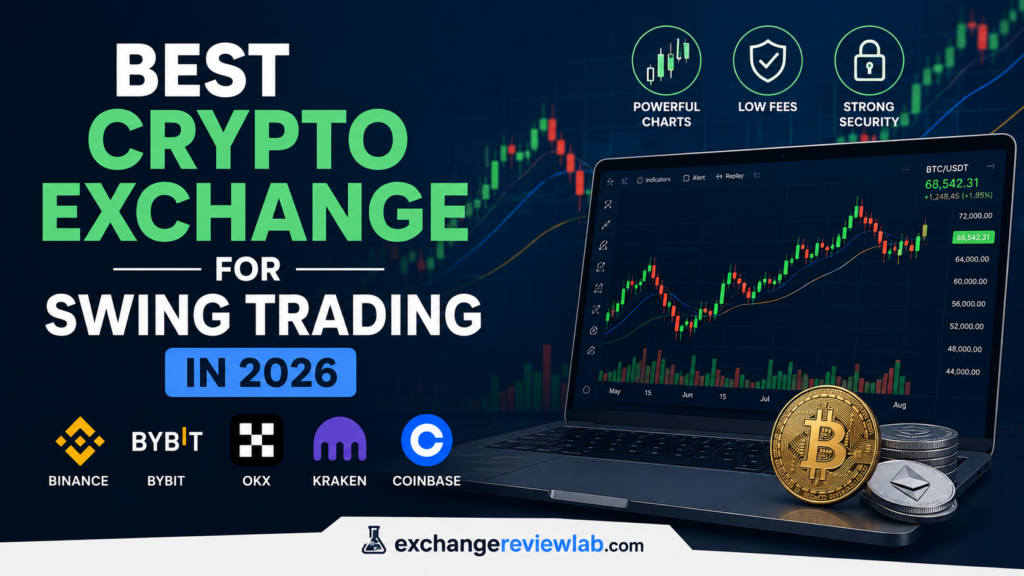
Swing trading sits in a strange middle zone. You’re not glued to five screens like a day trader chasing one-minute candles. You’re also not the “buy and forget” investor who checks their portfolio once a season. You hold positions for days, sometimes weeks, and you need an exchange that behaves itself during that entire stretch — not just at the moment you click “buy.”
That’s a harder ask than it sounds. A platform can look great on entry and then quietly cost you money on funding fees, slow withdrawals, or a clunky charting setup that makes you second-guess your own stop-loss. This guide breaks down which exchanges actually hold up for swing trading in 2026, based on fees, charting tools, order types, liquidity, and security records — not marketing pages.
Quick Answer: Best Crypto Exchange for Swing Trading
If you want the short version before the deep dive: Binance is the strongest all-round pick for swing trading in 2026, thanks to deep liquidity across hundreds of spot and futures markets, low fees when paying with BNB, and a full set of conditional order types (OCO, trailing stop, take profit/stop loss).
Bybit is the best runner-up for traders who prioritize a clean, fast interface and derivatives depth. OKX wins on spot maker fees and reserve transparency. Kraken is the go-to if regulatory comfort matters more than shaving fractions of a percent off every trade. Coinbase rounds things out as the safest bet for US-based traders who want audited financials over crypto-native proof of reserves.
There’s no single “best” exchange for everyone — your ideal pick depends on your region, your risk tolerance, and whether you trade mostly spot or lean into derivatives. The comparison below should make that decision a lot less painful.
Comparison Table: Top Crypto Exchanges for Swing Trading
| Exchange | Spot Maker/Taker Fee | Futures Maker/Taker Fee | Standout Feature | Best For |
|---|---|---|---|---|
| Binance | 0.10% / 0.10% (0.075% with BNB) | 0.02% / 0.05% | Largest liquidity pool, full order-type suite | Traders who want scale and flexibility |
| Bybit | 0.10% / 0.10% | 0.02% / 0.055% | Clean UI, fast execution, derivatives depth | Precision entries and exits |
| OKX | 0.08% / 0.10% | 0.02% / 0.05% | Lowest spot maker fee, zk-STARK proof of reserves | Traders who want low costs without holding a native token |
| Kraken | 0.10%-0.15% / 0.12%-0.20% | 0.02% / 0.05% | Strong regulatory standing, long uptime record | Traders who prioritize compliance and stability |
| Coinbase | Higher on Simple Trade, competitive on Advanced Trade | N/A (limited derivatives in most regions) | Publicly listed, audited financials | US-based, compliance-first traders |
Fee figures reflect standard (non-VIP) tiers reported by DailyCoin’s 2026 exchange fee comparison and BitDegree’s OKX fee breakdown. Always confirm current rates on the exchange’s own fee page before trading, since VIP tiers and token discounts shift these numbers regularly.
For a side-by-side breakdown of two of the biggest names here, our own Binance vs Bybit comparison digs into the fee and security differences in more detail.
Binance Review
Binance is the exchange most swing traders end up on eventually, even if they didn’t start there. The sheer size of its order books means you can enter and exit large positions without the price moving against you mid-trade — which matters a lot when you’re holding for several days and don’t want slippage eating your edge.
On the tools side, Binance supports OCO orders, trailing stops, and take-profit/stop-loss pairs, which is basically the minimum toolkit for disciplined swing trading. You set your exit before emotions get a vote.
Fees start at 0.10% maker and taker for spot trades, but paying fees in BNB knocks that down by 25%, landing around 0.075%. Futures fees sit at 0.02% maker and 0.05% taker at the base tier, matching OKX and staying just ahead of Bybit’s 0.055% taker rate, according to Trade Reclaim’s 2026 fee data.
On security, Binance publishes a Merkle-tree-based proof of reserves and maintains the Secure Asset Fund for Users (SAFU), an exchange-controlled emergency reserve. It’s worth noting SAFU is not government insurance — it’s Binance’s own safety net, not a regulator’s. The exchange has not experienced a customer-loss hack since 2019, per Coin Bureau’s 2026 Binance security coverage.
The catch: regional availability varies, and US users get routed to Binance.US, which has a smaller product menu. If you’re outside a restricted region, though, Binance is hard to beat on raw market depth.
Bybit Review
Bybit built its reputation on derivatives before spot trading, and that heritage shows in how the platform handles execution. Order fills feel quick, the charting is clean without being cluttered, and conditional orders are easy to set up without digging through three sub-menus.
For swing traders specifically, Bybit’s interface makes it simple to lay out a full trade plan — entry, stop, target — in one motion. That matters more than people admit. A clunky order screen is how disciplined plans turn into panic-clicks.
Spot fees run 0.10% maker and taker. Futures fees are 0.02% maker and 0.055% taker at the standard tier — close to Binance and OKX, with the gap mostly showing up on the taker side, per OKX’s fee breakdown from BitDegree.
Security is the one area where Bybit has a documented scar: the exchange suffered a major hack in 2025. Since then, it has rebuilt reserves, expanded regulatory licensing, and tightened account controls, and Coin Bureau’s 2026 safety review credits its crisis response as one of the stronger recovery efforts in the industry. Still, if a clean breach history is non-negotiable for you, Kraken has the edge here.
EU-based traders should also note that Bybit is migrating accounts to a MiCA-licensed entity, bybit.eu, through 2026, though the fee schedule stays the same across the transition.
Read more:
- Bybit Review After 7 Days of Use (2026) – Fees, Safety & Real Experience
- Is Bybit Safe or a Scam? (2026) – Read before star trading
- Bybit Fees Review: Spot, Futures, Hidden Costs & How to Pay Less
OKX Review
OKX quietly wins the fee game for spot swing traders. Its 0.08% maker fee is the lowest of the major three (Binance, Bybit, OKX), and you don’t need to hold a native token to get it. Taker fees sit at 0.10%, matching the field, but that maker-side advantage adds up if you’re placing limit orders rather than market orders — which, frankly, you should be doing anyway as a swing trader.
Futures fees mirror Binance at 0.02% maker and 0.05% taker, making OKX one of the cheapest venues for leveraged swing positions.
On transparency, OKX uses a zero-knowledge proof system (zk-STARK) to verify reserves without exposing individual account data, and it publishes these reports monthly — one of the more frequent cadences in the industry, according to BlockchainReporter’s 2026 proof-of-reserves ranking. OKX also disclosed a 2025 U.S. AML settlement, which is worth knowing about even though the exchange has since expanded regional licensing across Europe, Dubai, and Singapore, per Coin Bureau’s OKX safety report.
Product breadth is another strength — OKX combines centralized trading with an integrated Web3 wallet, giving swing traders a bridge into on-chain assets without switching platforms entirely.
Read more:
Kraken Review

Kraken is the exchange for traders who’d rather sleep well than shave off a fraction of a percent in fees. It doesn’t have the flashiest interface or the lowest rates, but it has something harder to fake: a long track record without a customer-loss hack, and a proof-of-reserves process that Coin Bureau describes as the cleanest security history among major exchanges.
Fees are a bit higher than the competition — spot maker/taker runs roughly 0.10%–0.15% and 0.12%–0.20% depending on the pair, according to Kraken’s own published fee comparison. Futures fees, however, land at the same 0.02%/0.05% base rate as Binance and OKX, and Kraken’s institutional futures tier even pays a negative maker fee (a rebate) for traders doing $1 billion or more in monthly volume — not exactly a swing trader’s world, but it says something about how the fee ladder is built.
Kraken also processes an enormous trade volume with 99.9% uptime and sub-2-millisecond latency, per its own reported figures — reassuring if you’re holding a swing position through a volatile news day and need the platform to not fall over.
If you’re a US-based swing trader who wants a middle ground between Coinbase’s simplicity and Binance’s scale, Kraken is a sensible landing spot.
Coinbase Review
Coinbase plays a different game entirely. It doesn’t offer a cryptographic proof-of-reserves system like Kraken or OKX — instead, it relies on audited public-company financials, since it’s listed on NASDAQ. That’s a genuinely different trust model, and for a lot of US traders, it’s a more familiar one.
The catch for swing traders: Coinbase’s default “Simple Trade” interface is not built for anyone running conditional orders or watching charts closely. You need Advanced Trade to get competitive fees and real order types, and even then, the product menu (especially for derivatives) is thinner than Binance, Bybit, or OKX in most regions.
Coinbase makes the most sense for traders who value regulatory clarity above all else, and who are comfortable trading fewer altcoins in exchange for that peace of mind. It’s less of a swing-trading power tool and more of a reliable base camp.
Read more:
- Coinbase Review for Beginners 2026: Read before trading
- Coinbase Fees 2026: Hidden Costs & How to Save
- Is Coinbase Safe or a Scam? (2026 Honest Review)
How We Ranked the Best Exchanges for Swing Trading
Ranking exchanges for swing trading isn’t the same as ranking them for day trading or long-term holding, so the criteria had to reflect what actually matters when you’re holding a position for days or weeks:
Order type support. Stop-loss, take-profit, trailing stop, and OCO orders aren’t optional extras for swing trading — they’re how you protect a position while you’re asleep or at work. Exchanges without solid conditional order support dropped down the list fast.
Liquidity and slippage. A multi-day hold means you’re exposed to bigger market swings than a scalper. Deep order books matter because they reduce the odds of your exit order moving the price against you.
Fee structure over time. Swing trades aren’t single clicks — they involve an entry, sometimes a partial exit, and a final close. We weighed total cost across that lifecycle, not just the headline maker/taker number.
Charting and analysis tools. TradingView-grade charting, multiple timeframes, and indicator support help you actually plan a swing trade instead of guessing.
Security and reserve transparency. Given that a swing position sits on the exchange for longer than a day trade, custody risk matters more. We looked at proof-of-reserves practices, breach history, and regulatory standing.
Coin selection. More tradable pairs means more opportunities to catch a multi-day swing in an asset that’s actually moving.
This lines up closely with the methodology used by FXEmpire’s swing trading exchange guide, which also weighted charting depth, order support, and fee structure heavily for the swing trading use case.
Fees Comparison for Swing Trading
Fees look tiny on paper — 0.02% here, 0.1% there — but swing trading involves holding through volatility, and small percentages compound across dozens of trades a year.
Here’s a practical way to think about it: a trader running $10,000 in monthly volume at a 0.5% average taker fee pays $600 annually just in trading costs. Drop that to a 0.1% taker fee, and the same volume costs $120 a year — a $480 difference without changing a single trading decision, based on the fee math in DailyCoin’s exchange comparison.
For futures-heavy swing traders, the gap between Binance/OKX (0.02%/0.05%) and Bybit (0.02%/0.055%) looks negligible on a single trade — but at meaningful volume, it adds up to real money over a year, according to SpotedCrypto’s 2026 maker-taker rate breakdown.
Withdrawal fees deserve attention too, since swing traders who move funds to self-custody between trades pay them repeatedly. Bitcoin withdrawal costs vary meaningfully across platforms — MEXC and OKX charge roughly 0.0001 BTC, Kraken around 0.00015 BTC, while Binance and Bybit sit near 0.0002 BTC, per the same SpotedCrypto data. That’s roughly a 2x gap between the cheapest and most expensive options, which matters if you withdraw often.
The takeaway: don’t just chase the lowest headline rate. A slightly higher fee on an exchange with better liquidity can still save you money, because slippage on thin order books often costs more than the fee difference ever will.
Security & Regulation
Security in 2026 isn’t just about “has this exchange been hacked.” It’s about whether the exchange can prove, in a verifiable way, that your funds exist and are properly custodied — and whether a regulator is watching over its shoulder.
Proof of reserves has become the baseline, not the bonus. Binance, Kraken, OKX, Bybit, and several other major exchanges now publish some form of third-party-verified proof of reserves, though the frequency and rigor vary, according to FinanceFeeds’ 2026 proof-of-reserves report. Kraken uses independent accountant reviews with user-verifiable Merkle Leaf IDs. OKX uses zk-STARK proofs that verify solvency without exposing individual balances.
It’s worth being clear-eyed about what proof of reserves actually proves, though. It’s a snapshot of assets at one point in time — it doesn’t account for liabilities or guarantee solvency the next day. The collapse of Poland’s Zondacrypto in April 2026, where hot wallet Bitcoin reserves reportedly fell 99.7% while the platform kept claiming solvency, is a stark reminder that a proof-of-reserves badge isn’t a guarantee, per FinanceFeeds’ reporting.
Regulation adds a second layer of accountability. Binance’s compliance framework now operates under an ongoing DOJ settlement requiring five years of monitoring. OKX disclosed a U.S. AML settlement in 2025 and has since expanded licensing across multiple regions. Kraken and Coinbase generally carry the cleanest regulatory profiles among major exchanges, largely because they’ve built their businesses around compliance-first positioning in the US and EU markets.
Practical takeaway for swing traders: don’t park your entire portfolio on any single exchange for the long haul, no matter how good its reserve reports look. Use the exchange for what it’s good at — active trading — and move meaningful long-term holdings to self-custody when you’re not actively swinging a position. It’s not paranoia; it’s just how professional traders treat custody risk.
For deeper coverage of individual exchange security setups, our exchange review methodology explains exactly how we test licensing, custody structure, and incident history before assigning a safety score.
Frequently Asked Questions
What is the best crypto exchange for swing trading beginners? Kraken and Coinbase tend to suit beginners best because of their regulatory clarity and simpler interfaces, though Coinbase requires switching to Advanced Trade to access competitive fees and real order types.
Do I need futures trading for swing trading, or is spot enough? Spot trading is enough for most swing strategies, and it avoids funding fees and liquidation risk entirely. Futures can amplify gains (and losses) but add complexity that isn’t necessary for a basic swing approach.
How important are trailing stop and OCO orders for swing trading? Very important. These order types let you lock in profits and cap losses automatically while you’re away from the screen, which is the whole point of holding a position for multiple days.
Is proof of reserves the same as an audit? No. Proof of reserves is a point-in-time snapshot of assets, not a full audit of assets and liabilities. Treat it as one data point in your due diligence, not the final word on an exchange’s safety.
Which exchange has the lowest fees for swing trading? OKX generally has the lowest spot maker fee at 0.08%, while Binance, OKX, and Bybit are closely matched on futures fees. The best choice depends on whether you trade spot or futures more often, and whether you qualify for token-based fee discounts.
Can I swing trade on a decentralized exchange (DEX)? Technically yes, but DEXs typically lack customer support, fiat on-ramps, and the conditional order types (like OCO or trailing stop) that make disciplined swing trading manageable. Most swing traders stick to centralized exchanges for this reason.
Final Verdict: Best Exchange for Swing Trading
There’s no universal winner here, and any article that tells you otherwise is probably trying to sell you something. What we can say with confidence: Binance offers the best overall combination of liquidity, order types, and fee flexibility for most swing traders. Bybit is a strong alternative if you want a faster, cleaner execution experience and don’t mind its 2025 security history. OKX deserves serious consideration if spot fees and reserve transparency top your priority list. Kraken remains the safer harbor for traders who’d rather pay slightly more for regulatory peace of mind, and Coinbase is the sensible choice for US traders who want audited financials over crypto-native proof systems.
The real advice, though, is simpler than picking a “winner”: open accounts on two or three platforms, place a properly structured swing trade — limit entry, stop-loss, and a defined target — and see which exchange makes that discipline feel effortless rather than annoying. That’s the platform you’ll actually stick with, and sticking with a sound process is where swing trading profits genuinely come from.
For ongoing, hands-on testing of these platforms — including fee verification against live trades and updated security scorecards — check our full exchange reviews section at Exchange Review Lab.
This article is for informational purposes only and does not constitute financial advice. Fee structures, security practices, and regulatory status change frequently — always verify current terms directly on the exchange’s official website before trading.
