
Options trading has a reputation problem. People hear “options” and picture spreadsheets, Greek letters, and a headache. Add “crypto” to that sentence, and most traders quietly back away.
But crypto options are not that scary once you understand what they do. They let you hedge a position, bet on volatility instead of direction, or generate income on assets you already hold — without needing to sell anything. The real challenge isn’t the strategy. It’s picking a platform that actually supports it well.
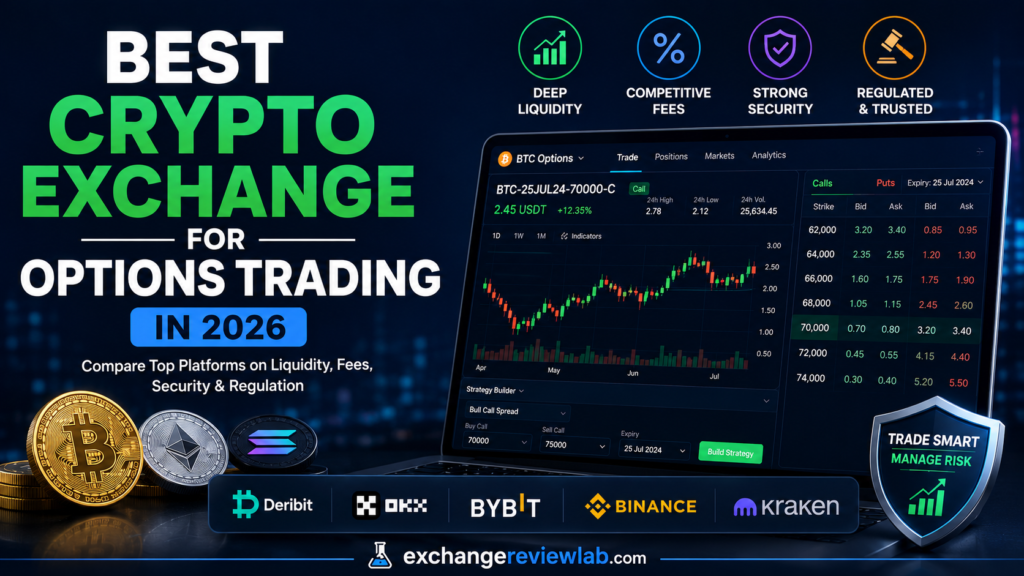
This guide breaks down the best crypto exchange for options trading in 2026, based on liquidity, fee structure, security history, and regulatory standing. No guesswork, no recycled marketing copy — just what each platform actually offers and where it falls short.
Quick Answer: Best Crypto Exchange for Options Trading
If you want the short version before the deep dive, here it is.
Deribit remains the strongest all-round choice for serious options traders. It carries the deepest order books for Bitcoin and Ethereum options anywhere in crypto, and Coinbase’s acquisition of the platform gave it a level of institutional backing that few competitors can match.
OKX and Bybit work well if you already trade spot and perpetual futures and want options bundled into the same account instead of jumping between platforms.
Binance suits traders who prioritize brand recognition and simple, flat-rate options pricing over deep order book access.
Kraken fits professional and institutional traders in regions where regulatory comfort matters more than raw liquidity, especially since its options desk launched under U.S. oversight.
There’s no single “best” exchange for every trader. Your ideal pick depends on your experience level, your region, and how much you value regulation versus liquidity. Keep reading for the full breakdown.
Comparison Table: Top Crypto Exchanges for Options Trading
| Exchange | Best For | Options Fee | Regulatory Status | US Access |
|---|---|---|---|---|
| Deribit | Deep liquidity, institutional flow | Maker rebate ~0.02%, capped at 12.5% of premium | VARA-licensed (Dubai), owned by Coinbase | Not available |
| OKX | Traders who want spot, futures, and options in one account | ~0.02% maker / 0.05% taker (varies by tier) | VASP license (Dubai/VARA), partial EU coverage under MiCA | Limited, phased rollout |
| Bybit | Active derivatives traders, copy trading users | ~0.02% maker/taker on options | MiCAR-licensed EU entity; broader global registration | Not available |
| Binance | Brand trust, straightforward flat pricing | 0.03% flat on notional value | Varies heavily by entity and country | Not on Binance.US |
| Kraken | Institutional and professional US-adjacent traders | Quoted via RFQ, tier-dependent | Long-standing US registration, expanding EU coverage | Available to eligible professional clients |
Fee figures reflect published base-tier rates at the time of writing and change with trading volume and VIP status. Always confirm current numbers on the exchange’s own fee page before trading.
Deribit Review
Deribit isn’t the flashiest exchange out there, and it doesn’t try to be. It built its entire identity around one thing: derivatives, done properly.
The platform handles the overwhelming majority of global Bitcoin options open interest among crypto-native venues, and that liquidity is exactly why serious traders keep coming back. Deep order books mean tighter spreads and cleaner fills, which matters far more in options than in spot trading.
The biggest development for Deribit’s credibility came when Coinbase completed its acquisition of the exchange, folding it into a publicly listed, US-regulated parent company (Markets Media). That deal answered the two questions institutional desks used to ask before onboarding: who actually owns this platform, and what happens to my funds if something goes wrong.
Deribit now operates as Deribit FZE, licensed in Dubai under the Virtual Assets Regulatory Authority (VARA) as a Virtual Asset Service Provider. It requires mandatory KYC, offers portfolio margining for multi-leg strategies, and supports block trades for large positions that would otherwise move the market.
What holds it back: no fiat deposits, so you need to already own crypto to fund an account. There’s no live chat support either, which stings when you’re staring at a liquidation warning at 2 a.m. And it isn’t available to US residents, which rules out a large chunk of the market.
Best for: experienced traders who understand options Greeks and want the deepest liquidity in the space.
OKX Review
OKX takes a different approach: instead of specializing purely in derivatives, it bundles options into a full exchange stack that includes spot, margin, futures, copy trading, and a non-custodial Web3 wallet.
That “everything in one place” design matters for options traders who also trade spot or want to hedge a futures position without moving funds between platforms. OKX’s derivatives fees sit meaningfully lower than its spot fees, which rewards active options and futures traders specifically.
The exchange publishes monthly proof-of-reserve reports verified with zk-STARK cryptography and Merkle tree checks, letting any user independently confirm their assets are backed 1:1 (Blockchain Reporter). That’s a meaningful transparency step, not just a marketing line.
Regulation is a mixed bag. OKX holds a VASP license from Dubai’s VARA and has expanded coverage under Europe’s MiCA framework, but it settled a $505 million matter with the US Department of Justice tied to historical compliance gaps (TokenWeir). US access remains limited and rolled out in phases rather than being fully open.
Best for: traders who want options alongside a genuinely deep product suite, and who are comfortable with an exchange still building out full US regulatory coverage.
Read more:
Bybit Review
Bybit built its reputation on derivatives long before options became a mainstream product line, and that heritage still shows in how the platform is structured.
Options sit inside Bybit’s Unified Trading Account alongside perpetuals and spot, which means one collateral pool covers everything instead of forcing you to shuffle margin between separate wallets. That’s a genuinely useful feature if you run hedged positions across products.
The elephant in the room is the February 2025 security incident, where attackers linked to North Korea’s Lazarus Group stole roughly $1.5 billion in Ethereum from a Bybit cold wallet through a sophisticated supply-chain attack on the signing interface, not a direct breach of Bybit’s own code (FBI Internet Crime Complaint Center; Chainalysis). It remains the largest crypto exchange hack on record.
To its credit, Bybit closed the resulting shortfall within 72 hours through partnerships with Galaxy Digital, FalconX, and Wintermute, and published independent proof-of-reserve confirmation from Hacken shortly after. That response mattered. It’s also since built out a MiCAR-licensed European entity, adding regulatory weight it didn’t have before.
Best for: active derivatives traders who want a unified margin account across spot, futures, and options — provided you’re comfortable with a platform still rebuilding trust after 2025.
Read more:
- Bybit Review 2026: Best Crypto Exchange for Beginners?
- Bybit Fees Review: Spot, Futures, Hidden Costs & How to Pay Less
- Is Bybit Safe or a Scam? (2026) – Read before star trading
Binance Review
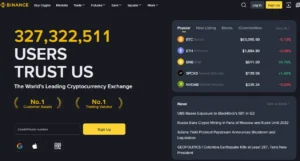
Binance is the exchange most people have already heard of, and that brand weight counts for something when you’re trusting a platform with your funds.
Its options product covers BTC, ETH, BNB, XRP, and DOGE through European-style, USDT-settled contracts. The fee structure is refreshingly simple: 0.03% of the option’s notional value, charged the same way whether you’re opening or closing a position (Binance official fee schedule). No confusing tiers to decode before you even place a trade.
Binance also serves over 185 million users across more than 180 countries, giving it liquidity depth that smaller platforms simply can’t replicate for the assets it lists.
The catch: Binance.US does not offer options at all, due to stricter domestic derivatives regulation. If you’re a US-based trader hoping to use your existing Binance account for options, you’ll be redirected elsewhere. Global users outside the US face fewer restrictions but should still confirm their local entity’s exact regulatory standing before funding an account.
Best for: traders who already use Binance for spot trading and want options without opening an account on a separate platform — as long as you’re not trading from the United States.
Kraken Review

Kraken is the newest serious entrant on this list, and it approached the launch differently than everyone else.
Instead of copying Deribit’s model, Kraken built European-style, cash-settled options on BTC and ETH that plug directly into Kraken Pro’s existing portfolio-margined wallet. Clients manage spot, futures, and options collateral from one account, supported across more than 30 collateral currencies (Kraken Blog).
Access currently runs through a request-for-quote system rather than a public order book, with weekly, monthly, quarterly, and semi-annual expiries available at launch. Alexia Theodorou, Kraken’s Director of Derivatives, described the goal plainly: broaden a market that’s historically been “built for a narrow slice of the trader base” (CoinDesk).
Kraken is one of the longest-operating exchanges in the industry, and that history matters when you’re deciding who to trust with a multi-leg options position. European access is expanding through the rest of 2026, with a public order book planned for a later phase.
Best for: professional and institutional clients who want options from a platform with a long regulatory track record, even if the order book is thinner than Deribit’s for now.
How We Ranked the Best Exchanges for Options Trading
Ranking options platforms isn’t the same exercise as ranking spot exchanges. A low trading fee means nothing if the order book is so thin that your fill price moves against you the moment you click “buy.”
Here’s what actually shaped this list:
Liquidity and open interest. An options exchange lives or dies by depth. We weighted platforms with real, sustained trading volume in BTC and ETH options above those with a “we technically offer this” product page.
Fee transparency. Flat, published fee schedules beat confusing multi-tier systems that only reveal your real cost after you’ve already traded.
Security track record. Past incidents, how the exchange responded, and current custody practices — cold storage percentages, proof-of-reserve reporting, insurance funds — all factored in.
Regulatory standing. Licensing under recognized frameworks like VARA, MiCA, or established US registration reduces (though never eliminates) counterparty risk.
Product depth. Portfolio margining, block trades, and multi-asset options coverage separate exchanges built for options from exchanges that added an options tab as an afterthought.
You can read our full scoring breakdown on the methodology page, which applies the same criteria across every exchange we review.
Fees Comparison for Options Trading
Fees in options trading are trickier to compare than spot fees, because the number you see on a fee page isn’t always the number you pay.
| Exchange | Options Fee Structure | Fee Cap |
|---|---|---|
| Deribit | Maker rebate around 0.02%, taker fees vary by tier | Capped at 12.5% of the option’s premium |
| OKX | Tiered maker/taker, roughly 0.02%–0.05% base | Discounted further with OKB holdings |
| Bybit | Around 0.02% maker and taker at base tier | Reduced through VIP volume tiers |
| Binance | Flat 0.03% of notional value | No published cap; exercise fee applies separately, capped at 10% of value |
| Kraken | Quoted per trade via RFQ | Varies by client tier and volume |
A few things worth remembering before you assume the lowest headline fee wins:
Options fees are usually capped as a percentage of the premium, which protects you on cheap, far-out-of-the-money contracts but matters less on expensive, at-the-money ones.
Settlement and exercise fees are often separate line items. Deribit charges a settlement fee on top of trading fees; Binance charges a separate exercise fee. Read the fine print before assuming the headline rate is your total cost.
Volume discounts change everything at scale. A trader doing $15 million in monthly volume pays a fraction of the base rate on most of these platforms — so the “cheapest” exchange for a casual trader isn’t always the cheapest for a high-frequency one.
Security & Regulation
Security in crypto options trading isn’t optional homework — it’s the difference between a bad trade and losing your entire account.
The clearest cautionary tale in recent memory is the Bybit hack. In February 2025, attackers linked to North Korea’s Lazarus Group used a supply-chain attack against a third-party wallet interface to redirect roughly $1.5 billion in Ethereum during what looked like a routine cold-to-hot wallet transfer (FBI). The multisig protections weren’t bypassed through stolen keys — signers were shown a manipulated transaction that looked legitimate. It’s a reminder that even exchanges with strong internal security can be compromised through a trusted third-party tool.
What separates exchanges that recover from exchanges that collapse is transparency after the fact. Bybit closed its shortfall within 72 hours using outside liquidity partners and published third-party proof-of-reserve verification. That kind of response is now a genuine differentiator, not just a PR exercise.
On the regulatory side, look for these signals before funding an account:
- Licensing under a recognized framework — VARA in Dubai, MiCA/MiCAR in the EU, or established US state and federal registration.
- Published proof-of-reserves, ideally verified by an independent auditor rather than self-reported.
- Cold storage ratios. Reputable platforms hold the large majority of user funds offline, with only operational liquidity in hot wallets.
- Insurance or recovery funds that cover losses from liquidation cascades or platform-level failures, separate from user-caused losses.
No exchange, regardless of size or reputation, is immune to attack. Treat every platform’s security claims as a starting point for due diligence, not a guarantee.
Frequently Asked Questions
What is crypto options trading, exactly?
A crypto option gives you the right, but not the obligation, to buy or sell a cryptocurrency at a set price before a specific expiry date. Traders use options to hedge existing positions, speculate on volatility without picking a direction, or generate income on assets they already hold.
Is crypto options trading legal in the United States?
It depends on the platform and the product. Some venues, like Kraken and Crypto.com, offer regulated options access to eligible US clients under specific licensing. Others, including Deribit and Bybit, restrict US residents entirely due to derivatives regulation.
Which exchange has the most liquid options market?
Deribit holds the deepest order books for Bitcoin and Ethereum options among crypto-native exchanges, which generally means tighter spreads and better execution for larger trades.
Are crypto options riskier than futures?
They carry different risks. Options limit your downside to the premium paid if you’re buying, while futures and perpetuals can expose you to unlimited losses without careful risk management. Selling options, however, can carry its own significant risk.
Do I need KYC to trade crypto options?
On every major regulated exchange covered here — Deribit, OKX, Bybit, Binance, and Kraken — yes. KYC verification is now standard practice across licensed derivatives platforms.
What happens if an exchange gets hacked while I hold open options positions?
This depends entirely on the platform’s response and reserve structure. Bybit’s ability to cover its 2025 shortfall within 72 hours through liquidity partnerships is the kind of resilience worth researching before you deposit funds, not after.
Final Verdict: Best Exchange for Options Trading
There isn’t a universal winner here, and any article claiming otherwise is oversimplifying a genuinely nuanced decision.
If liquidity and institutional backing top your list, Deribit is still the exchange to beat. Coinbase’s ownership resolved the counterparty-risk questions that used to hold serious traders back.
If you want options bundled with a full trading suite you’re already using, OKX or Bybit make more practical sense — just go in aware of each platform’s regulatory and security history.
If flat, predictable pricing and brand familiarity matter more than the deepest possible order book, Binance covers the basics well, provided you’re not trading from the US.
And if you’re a professional or institutional trader who prioritizes regulatory pedigree over raw liquidity, keep an eye on Kraken as its options product matures through 2026.
Whichever platform you choose, the fee schedule is the easy part to compare. Security history and regulatory standing take real research — and that research is worth doing before you fund an account, not after something goes wrong. For deeper platform-by-platform breakdowns, browse our full exchange reviews or check the about page to see how we test and score every exchange on this list.
This article reflects publicly available fee schedules, regulatory disclosures, and security reports at the time of writing. Exchange fees, licensing status, and product availability change frequently — always confirm current terms directly on the exchange’s official site before trading. Nothing in this article constitutes financial advice.
