
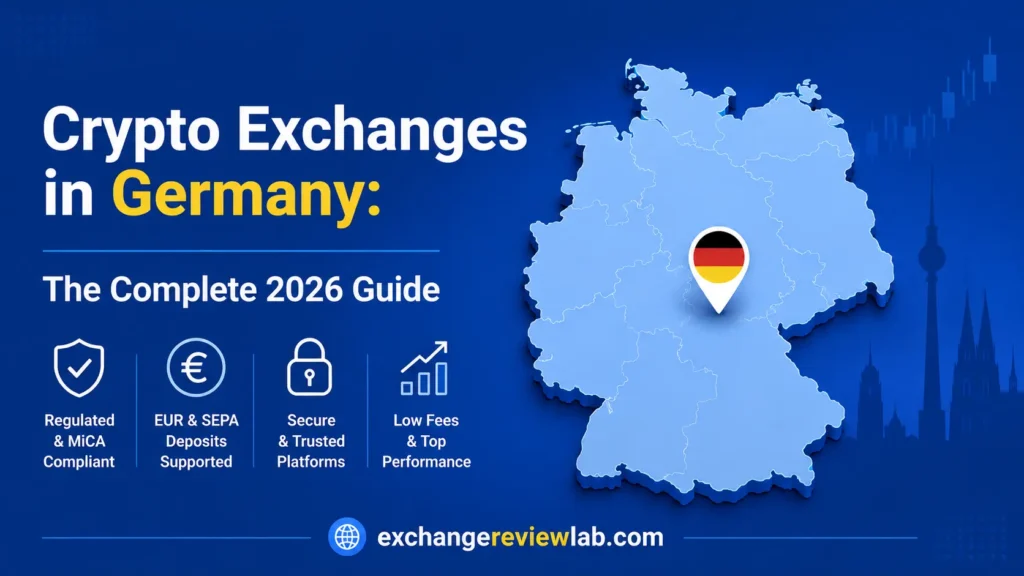
Germany treats crypto differently from most of Europe. Regulators don’t panic about it, and long-term investors don’t pay tax on their gains. That combination has turned the country into one of the most serious crypto markets in the EU, but it also means picking the wrong exchange can cost you money, time, or your BaFin-mandated peace of mind.
This guide compares the platforms that actually serve German residents today, explains how German crypto tax law works, and walks you through opening your first account without making a rookie mistake.
How We Ranked the Best Crypto Exchanges in Germany
We didn’t just copy a fee table and call it a review. Every exchange on this list earned its spot after we checked five things that matter to someone trading from Munich, Berlin, or anywhere in between.
Regulatory status first. Since July 1, 2026, every exchange serving German customers needs a valid MiCA (Markets in Crypto-Assets) license, either issued directly by BaFin or passported in from another EU regulator. Exchanges that never secured one, including Binance, have started pulling out of the EU entirely. We only ranked platforms that clear this bar.
Then fees, coin selection, EUR/SEPA support, security track record, and how the platform actually feels to use. A cheap exchange with a confusing interface doesn’t help a beginner, and a beginner-friendly app with thin liquidity doesn’t help an active trader. We weighed each factor against who the platform is actually built for.
We also cross-checked claims against exchange disclosures, BaFin’s public register, and independent trackers such as Exchange Review Lab’s exchange comparison hub, rather than taking marketing pages at face value.
Quick Comparison: Best Crypto Exchanges in Germany
| Exchange | Best For | Regulatory Status | Notable Strength |
|---|---|---|---|
| Bitpanda | Overall | BaFin MiCA license | Crypto, stocks, ETFs, metals in one account |
| Bitvavo | Low Trading Fees | AFM (Netherlands) MiCA license, passported | Low-cost EUR-focused trading |
| Coinbase | Beginners | BaFin custody license + CSSF MiCA license | Simple UX, publicly listed on Nasdaq |
| BISON | SEPA/EUR Deposits | BaFin MiCA custody license | Backed by Börse Stuttgart, direct bank funding |
| Kraken | Altcoin Selection | EU MiCA-aligned, long EU track record | Hundreds of listed tokens |
| Bitget | Advanced/Pro Traders | BaFin license | Deep derivatives and margin toolkit |
| Bitstamp | Security | CSSF MiCA license, passported | Oldest exchange still running, ISO 27001 certified |
Bitpanda – Best Overall Crypto Exchange in Germany
Bitpanda started in Vienna in 2014, and it became one of the first platforms anywhere to win a full MiCA license through BaFin, back in January 2025. That gives it a regulatory head start most competitors are still chasing.
What makes it the strongest all-rounder isn’t just the license. You get crypto, stocks, ETFs, and precious metals from a single euro balance, with free SEPA deposits and a native German interface. If you want one app that handles your whole portfolio instead of juggling three, this is it.
The catch is pricing. Bitpanda earns its margin through the spread rather than a published maker-taker fee, so a round trip costs more than a pure trading venue like Kraken Pro. For buy-and-hold investors, that trade-off is easy to accept.
Bitvavo – Best for Low Trading Fees
Bitvavo isn’t a household name in Germany the way Bitpanda or Kraken are, but it’s one of the largest euro-focused exchanges in Europe, and it holds a Dutch AFM MiCA license that passports across the entire EEA, including Germany.
The appeal here is simple: low fees, a broad coin selection, and an interface built entirely around the euro. If your main goal is minimizing what you pay per trade rather than chasing every feature under the sun, Bitvavo earns its place on this list.
Coinbase – Best for Beginners
Coinbase Germany GmbH held the country’s first BaFin crypto custody license back in 2021, and in June 2025 the wider Coinbase group became the first US-based exchange to secure a full MiCA license, issued through Luxembourg’s CSSF and passported EU-wide.
For a first-time buyer, that regulatory depth translates into something simpler: confidence. Video-based ID verification takes minutes, the app guides you through your first purchase step by step, and the layout resembles a banking app more than a trading terminal.
Fees are the honest downside. Standard purchases can run up to 1.49%, and card purchases climb higher still. Treat Coinbase as your on-ramp, not necessarily your long-term trading home.
Read more:
- Coinbase Review for Beginners 2026: Read before trading
- Coinbase Fees 2026: Hidden Costs & How to Save
- Is Coinbase Safe or a Scam? (2026 Honest Review)
BISON – Best for SEPA & EUR Deposits and Withdrawals
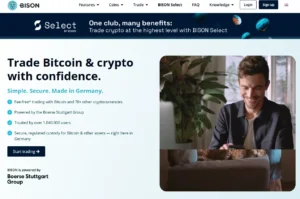
BISON deserves a special mention because it isn’t a crypto-native startup pretending to understand banking. It’s built and operated by Börse Stuttgart Group, Germany’s second-largest stock exchange, and it holds a BaFin MiCA custody license through its subsidiary.
You don’t need a separate crypto wallet to get started. Fund the app straight from a German bank account using Instant SEPA, Apple Pay, or a standard transfer, and your euro balance carries statutory deposit protection up to €100,000. Deposits and withdrawals are free; BISON makes its money on a standard trading spread instead.
It’s not built for altcoin hunting; the coin list stays deliberately smaller. But if smooth, boring, reliable euro transfers matter more to you than chasing the newest token, BISON is hard to beat.
Kraken – Best for Altcoin Selection
Kraken launched one of the first BTC/EUR trading pairs back in 2013, and that early bet on the euro market still shows. The exchange lists hundreds of cryptocurrencies, supports free SEPA deposits, and publishes proof-of-reserves data so you can independently check that customer assets match what the exchange reports.
The standard “Instant Buy” interface carries a wide spread, so serious traders switch to Kraken Pro, where maker and taker fees start around 0.25% and 0.40%. That interface has a steeper learning curve than beginner apps, but the coin selection and order-book depth make it worth the adjustment for anyone who wants more than the top ten tokens.
Bitget – Best for Advanced and Pro Traders

Bitget built its reputation on transparent, aggressively low fees and a full derivatives suite, and it holds a BaFin license to operate legally in Germany. Spot trading fees sit around 0.01% for both maker and taker orders, while futures trading runs roughly 0.02% maker and 0.06% taker, figures that undercut most beginner-focused apps by a wide margin.
Beyond spot and futures, Bitget offers margin trading and staking on select assets, plus copy-trading tools that let less experienced users mirror strategies from verified traders. If you’ve outgrown a simple buy-and-hold app and want real trading infrastructure, this is where you go next.
Bitstamp – Best for Security
Founded in 2011, Bitstamp is the longest continuously operating cryptocurrency exchange in the world, and its security record backs up that longevity. Around 95% of customer assets sit in cold storage, the company holds ISO/IEC 27001 and SOC 2 Type 2 certifications, and its financial statements have been audited annually by a Big Four firm since 2016.
Its only major breach happened in 2015, when attackers stole roughly 19,000 BTC from a hot wallet. Bitstamp absorbed the loss internally and restored trading within a week, and it hasn’t reported a comparable incident since. The exchange holds a MiCA license from Luxembourg’s CSSF, is passported into Germany, and independent tracker Kaiko has repeatedly ranked it among the top exchanges for market quality and reliability.
One thing to know: Bitstamp doesn’t yet publish a user-verifiable, Merkle-tree-style proof of reserves. You’re relying on its audit history and regulatory oversight rather than a cryptographic check you can run yourself.
Is Crypto Trading Legal in Germany?
Yes, and it has been for over a decade. Germany doesn’t treat Bitcoin as legal tender, but BaFin has long classified crypto assets as a “unit of account,” which places them under existing financial supervision rather than a legal gray zone.
Since the EU’s Markets in Crypto-Assets Regulation (MiCAR) came into force, every exchange, custodian, and broker serving German customers needs a MiCA license, either granted directly by BaFin or passported in from another EU regulator. You can check an exchange’s license status yourself on BaFin’s official company database.
The practical upshot for you as a trader: stick to licensed platforms, and you’re operating within a clear, well-established legal framework. Wander off to an unlicensed offshore platform, and you lose every consumer protection that comes with BaFin oversight, including deposit segregation rules and mandatory anti-money-laundering checks.
Factors to Consider When Choosing a Crypto Exchange in Germany
Not every “best” exchange is best for you specifically. Run through these checkpoints before you commit your money anywhere.
License and regulatory status. Confirm the exchange holds a BaFin MiCA license or a valid EU passport. This single check eliminates most scam platforms before you even look at fees.
Fee structure. Compare maker/taker percentages, not just headline numbers. Spread-based platforms like BISON and Bitpanda look “free” until you calculate the actual round-trip cost.
Coin and product range. A beginner buying Bitcoin and Ethereum doesn’t need 400 altcoins. An active trader chasing smaller-cap tokens does.
EUR and SEPA support. German bank transfers should be fast, ideally free, and directly integrated, without routing through a third-party payment processor that adds delay and cost.
Security track record. Look for cold storage percentages, published audits, and a history of handling incidents transparently rather than quietly.
Tax reporting tools. Since Germany’s one-year holding rule affects your tax bill directly, exchanges that generate clean annual reports save you real headaches at filing time.
Centralized vs. Decentralized Exchanges: Which Is Right for You?
Centralized exchanges (CEXs) like Kraken, Bitpanda, and Coinbase hold your funds on your behalf, verify your identity, and act as the counterparty to your trades. They’re regulated, insured to varying degrees, and far easier for a newcomer to navigate. The trade-off is custody: you’re trusting a company with your assets, even a well-audited one.
Decentralized exchanges (DEXs) let you trade directly from your own wallet, with no company holding your funds and no identity check required. You keep full control of your private keys, which appeals to privacy-conscious traders and anyone wary of exchange collapses. The downside is real: no customer support line, no chargebacks if you send funds to the wrong address, and a steeper technical learning curve.
For most people trading in Germany, a licensed CEX makes more sense. It comes with BaFin oversight, German-language support, and straightforward tax reports. DEXs suit experienced users who understand wallet security and want to interact directly with DeFi protocols.
How to Start Trading Crypto in Germany (Step-by-Step Guide)
Getting started takes less time than most people expect. Here’s the process, start to finish.
- Pick a licensed exchange. Match the platform to your goals using the comparison table above, then confirm its MiCA license status directly on the exchange’s site or BaFin’s register.
- Create your account and verify your identity. Most German-facing exchanges use video-based ID verification (Video-Ident), which typically takes only a few minutes.
- Fund your account. Deposit euros via SEPA transfer, and check whether the exchange charges a deposit fee. Many, including BISON and Bitpanda, don’t.
- Enable two-factor authentication. Do this before you deposit a single euro, not after. It’s the single cheapest security upgrade available to you.
- Place your first trade. Start small. Buy a well-established asset like Bitcoin or Ethereum before venturing into smaller-cap tokens.
- Decide on custody. Leaving funds on the exchange is convenient; moving them to a personal hardware wallet gives you full control. For long-term holdings, most security-conscious investors choose self-custody.
- Track your transactions from day one. Germany’s tax rules reward accurate record-keeping, so start logging trades immediately rather than trying to reconstruct a year of activity in April.
Want deeper platform-by-platform breakdowns before you decide? Exchange Review Lab’s Germany section covers individual exchange reviews in more depth than a single comparison guide can.
Crypto Tax Rules in Germany
Germany’s approach to crypto tax genuinely stands out in Europe, and it rewards patience.
The one-year holding rule (Haltefrist). If you hold a cryptocurrency for longer than one year before selling, converting, or spending it, the gain is completely tax-free for private investors. There’s no cap on this exemption. Sell within a year, and the gain gets taxed as other income, at your personal income tax rate.
The annual exemption threshold. Even for assets held less than a year, gains stay tax-free up to €1,000 total per year. Cross that threshold, and the entire gain becomes taxable, not just the amount above it.
Staking and mining income. Rewards from staking or mining count as income and carry their own small exemption limit of €256 per year. Beyond that, they’re taxed as ordinary income.
No separate capital gains tax. Crypto isn’t classified as a security in Germany, so it falls under private disposal rules (private Veräußerungsgeschäfte) rather than the flat capital gains tax that applies to stocks.
This information is a general overview, not personalized tax advice. Crypto tax rules involve nuance around DeFi, lending, and business-level trading that a blanket summary can’t fully cover. The German Federal Ministry of Finance (BMF) publishes official circulars on crypto tax treatment, and a tax advisor familiar with digital assets is worth the consultation fee before you file.
Frequently Asked Questions (FAQs)
Do I need to report every crypto trade to the German tax office?
Yes. Even trades that stay under the €1,000 exemption should be documented, since the tax office calculates your total annual gain across all transactions, not per trade.
Can I use a non-German exchange if I live in Germany?
Yes, as long as the exchange holds a valid MiCA license, either from BaFin or another EU regulator with a valid passport. The license travels with the license holder, not the country where the company is headquartered.
Is Binance still available to German users?
Binance never secured a MiCA license and has been withdrawing from EU markets. Existing German users should migrate to a licensed alternative rather than risk being locked out with funds still on the platform.
What happens if an exchange loses its license?
BaFin can order a platform to wind down operations, as it did with Ethena GmbH’s stablecoin business in 2025. Customers typically get a defined window to withdraw or convert their holdings under regulatory supervision.
Do I pay tax on crypto-to-crypto trades?
Yes. Swapping Bitcoin for Ethereum counts as a disposal event under German tax law, the same as selling for euros, so the one-year holding rule and €1,000 exemption both apply.
Final Verdict: Which Crypto Exchange Should You Choose?
There’s no single “best” exchange in Germany, only the best fit for how you actually plan to trade.
If you want one account for crypto, stocks, and everything in between, Bitpanda covers the most ground. If minimizing fees is your priority, Bitvavo makes the strongest case. Complete beginners get the smoothest ride with Coinbase, while anyone who wants their crypto tied directly to a trusted German bank relationship should look at BISON. Active traders chasing altcoins belong on Kraken, professional and derivatives traders will find more depth on Bitget, and if security track record is your deciding factor above everything else, Bitstamp has earned that reputation the hard way, over more than a decade in an industry that hasn’t always rewarded longevity.
Whichever platform you choose, confirm its MiCA license status before you deposit a single euro. That one check protects you more than any fee comparison ever will.
