
Table of Contents
If you’ve ever felt like crypto exchange fees were designed by someone who really loves confusing people, you’re not alone. Phemex is one of the more straightforward exchanges out there, but even then, understanding its full fee structure takes a little digging.
This review breaks it all down, spot fees, futures fees, withdrawal charges, hidden costs, and everything in between. No fluff. No filler. Just the facts you actually need.
Phemex Trading Fees Overview
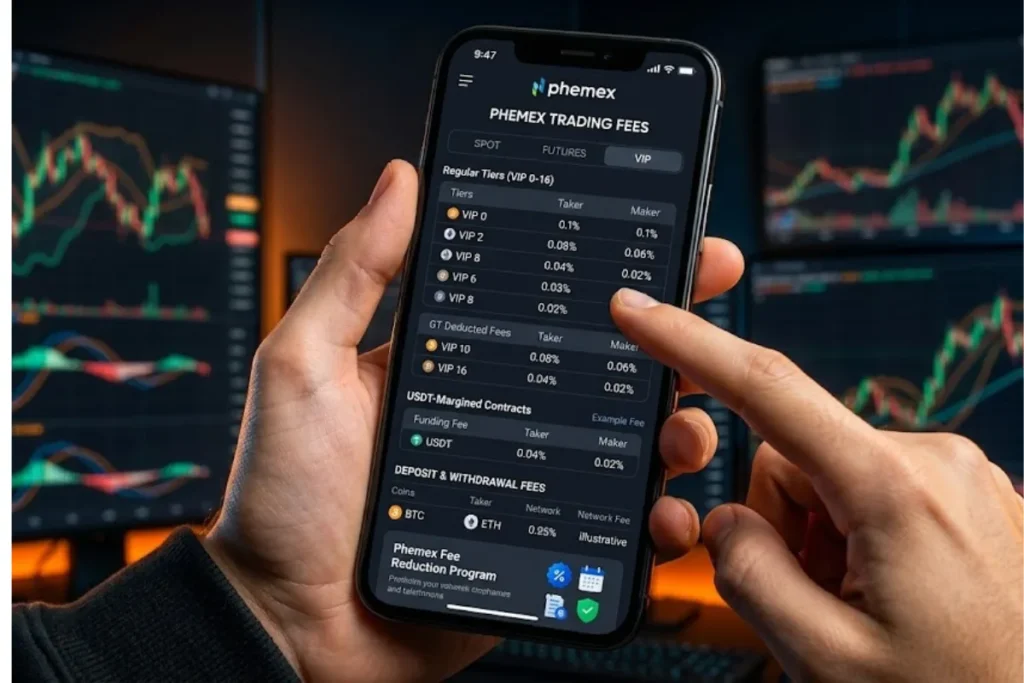
Phemex launched in 2019 and built its reputation on competitive derivatives trading and a clean user experience. It was founded by eight former Morgan Stanley executives, which explains why the platform leans toward professional-grade tools.
The fee structure on Phemex falls into two main camps: standard (free) account fees and Premium membership fees. This tiered system is honestly one of the smarter things Phemex does, but it also means your fee experience depends heavily on which tier you’re on.
Here’s the quick overview before we go deeper:
| Fee Type | Standard Account | Premium Member |
| Spot Maker | 0.1% | 0% |
| Spot Taker | 0.1% | 0% |
| Futures Maker | 0.01% | 0.01% |
| Futures Taker | 0.06% | 0.06% |
| Crypto Deposit | Free | Free |
| Fiat Deposit | Third-party fees apply | Third-party fees apply |
Source: Phemex Official Fee Schedule – Always verify current rates directly on the platform before trading.
These numbers look attractive. But as with any exchange, the full picture is more nuanced. Let’s walk through each category.
Spot Trading Fees
Spot trading on Phemex uses a classic maker-taker model. If you’re new to this concept ,makers add liquidity to the order book (limit orders), while takers remove it (market orders). Exchanges reward makers with lower fees because they help the market run smoothly.
Standard Account
Standard account holders pay 0.1% on both maker and taker orders for spot trading. That’s on par with Binance’s base rate and slightly above Kraken’s maker fees of around 0.16% (though Kraken’s takers can go higher).
For context: if you buy $5,000 worth of Bitcoin on a standard Phemex account, you pay $5 in fees. Not the cheapest, but not alarming either.
Premium Membership Account
Here’s where things get interesting. Phemex’s Premium membership gives you 0% maker and 0% taker fees on spot trading. Zero. Absolutely none.
The Premium plan costs $9.99/month or roughly $99/year if paid annually. If you trade with even moderate volume, say $10,000+ per month, the math works strongly in your favour. You’d save more in fees than the membership costs.
There’s also a Gold membership for more active traders. Phemex updates these tiers periodically, so it’s worth checking the official membership page for the latest pricing.
Futures Trading Fees
Phemex built a solid reputation in the derivatives space. Its perpetual futures and contract trading products are among its most popular features , and the fees here are genuinely competitive.
Perpetual Contracts (USD-Settled)
- Maker fee: 0.01%
- Taker fee: 0.06%
A 0.01% maker fee is extremely low by industry standards. Bybit charges 0.02% for makers on its USD-M futures. That difference might sound tiny, but for high-frequency or high-volume traders, it compounds fast.
The taker fee of 0.06% is standard. Binance Futures charges 0.05% for takers at the base level, so Phemex is slightly above, though their maker fee advantage more than compensates if you’re a patient trader who uses limit orders.
Coin-Margined Contracts (BTC-Settled)
- Maker fee: 0.01%
- Taker fee: 0.06%
Same structure as USD-settled. Phemex keeps it consistent, which is appreciated; there’s no need to remember different rate tables for different contract types.
Funding Rates
Funding rates on perpetual futures aren’t technically a “fee” , they’re periodic payments between long and short position holders to keep the contract price anchored to the spot price. Phemex updates funding rates every 8 hours.
These rates fluctuate based on market conditions. During bullish periods, longs typically pay shorts. During bear markets, the reverse can happen. Funding rates can significantly affect your PnL on held positions, so always factor them in when holding futures overnight or longer.
You can monitor live funding rates on Phemex’s platform or through third-party trackers like Coinglass.
Deposit Fees
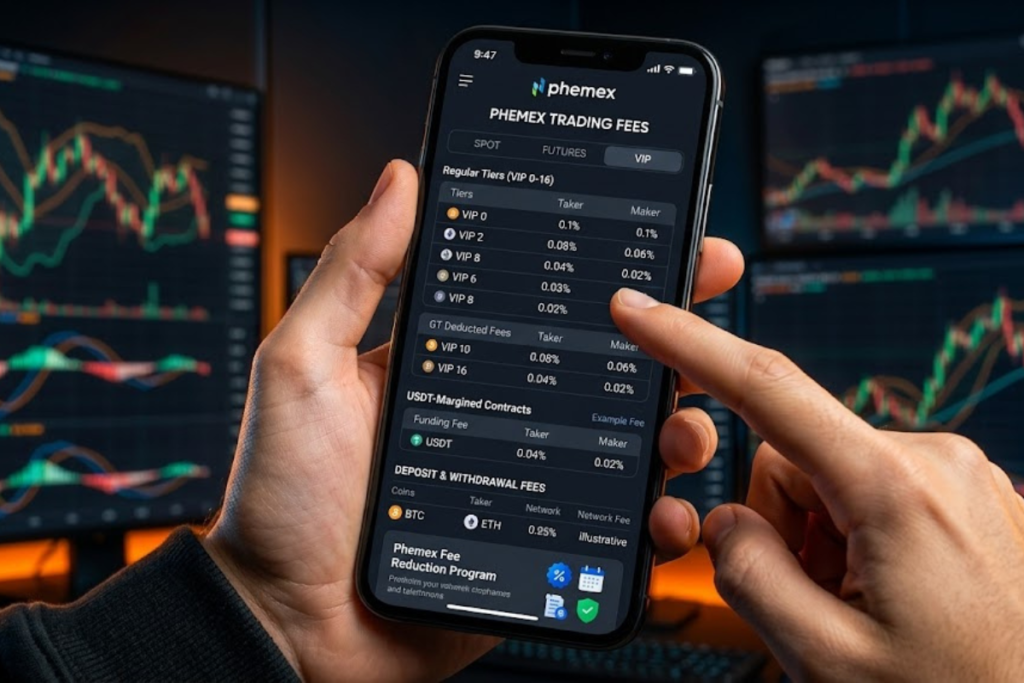
Good news here – Phemex charges zero fees for cryptocurrency deposits. You only pay the standard network transaction fee (gas fee or miner fee), which goes to the blockchain itself, not to Phemex.
For fiat deposits, Phemex works with third-party payment providers. These providers typically charge between 1.5% to 3.5%, depending on the payment method (card, bank transfer, etc.) and your region. Phemex itself doesn’t pocket these fees — they flow to the payment processor. But you still feel them in your wallet, so it’s worth knowing they exist.
Always compare fiat on-ramp costs. Using a bank transfer rather than a debit card can cut these fees significantly with most processors.
Withdrawal Fees
This is where things get a bit more granular – and where exchanges often make up for what they give with one hand.
Phemex charges fixed withdrawal fees per cryptocurrency, which is standard across most exchanges. These fees cover the network transaction cost and include a small platform margin.
Here are some examples of common withdrawal fees on Phemex (rates subject to change – always verify on the official withdrawals page):
| Asset | Withdrawal Fee (Approx.) |
| Bitcoin (BTC) | 0.0005 BTC |
| Ethereum (ETH) | 0.005 ETH |
| USDT (ERC-20) | 10 USDT |
| USDT (TRC-20) | 1 USDT |
| XRP | 0.25 XRP |
A few things worth noting:
Network selection matters. Sending USDT over Tron (TRC-20) is dramatically cheaper than ERC-20. If your destination wallet supports TRC-20, always use it. The fee difference of 9 USDT might seem small, but across dozens of withdrawals it adds up.
Withdrawal minimums exist. Phemex sets minimum withdrawal amounts per asset. If you try to withdraw below the minimum, the platform blocks the transaction. Check these minimums before moving small amounts -you don’t want to discover mid-transfer that your $15 withdrawal attempt doesn’t clear the threshold.
Hidden Charges Explained
“Hidden fees” is a loaded phrase. In Phemex’s case, there aren’t fees the platform deliberately conceals. But some costs don’t appear front-and-centre and catch traders off guard. Let’s name them plainly.
1. Spread on Market Orders
When you place a market order, you execute at the best available price – which includes a bid-ask spread. On liquid pairs like BTC/USDT, this is minimal. On lower-volume altcoins, the spread can widen significantly. You might technically pay the “taker fee” but lose more to spread than you realise.
2. Liquidation Fees
If a leveraged position gets liquidated, Phemex charges a liquidation fee. This is separate from your normal trading fees. On Phemex, the insurance fund handles liquidations, but residual losses and fees apply depending on the margin mode (isolated vs. cross).
3. Contract Expiry (Dated Futures)
For fixed-date futures contracts (as opposed to perpetuals), contract expiry triggers settlement. While settlement itself isn’t a hidden fee per se, rolling your position into the next contract cycle means paying taker fees again. Traders running long-term strategies in dated contracts should factor this in.
4. Currency Conversion Costs
If you deposit in one currency and trade in another, conversion happens — sometimes automatically, sometimes requiring a manual swap. Each conversion step typically carries a small cost, either through the spread or a conversion fee from a third-party processor.
5. API Rate Limits (Not a Fee, But a Cost)
For algorithmic traders, Phemex’s API rate limits can force less efficient order execution. This doesn’t show up as a fee line item but translates to real costs through worse fill prices and slippage.
How to Reduce Phemex Fees
Nobody became wealthy by overpaying fees. Here’s how smart traders minimise their costs on Phemex.
1. Upgrade to Premium (If Your Volume Justifies It)
This is the single biggest fee reduction available. Zero spot trading fees on a Premium account is a genuinely exceptional offer. Run your monthly trading volume through the math , if you trade $5,000+ per month in spot, Premium pays for itself within the first few trades.
2. Use Limit Orders Over Market Orders
Maker fees are always lower than taker fees. By placing limit orders instead of market orders, you earn maker status and pay the lower rate. This requires a bit more patience — your order sits on the book until it fills — but the fee saving is consistent and real.
3. Choose the Right Network for Withdrawals
As mentioned, USDT on TRC-20 is far cheaper than ERC-20. The same logic applies to other multi-network tokens. Always check which networks Phemex supports for a given asset and choose the cheapest option that’s compatible with your destination wallet.
4. Consolidate Withdrawals
Each withdrawal incurs a fixed fee. Withdrawing $1,000 once costs the same fixed fee as withdrawing $100 ten times. Batch your withdrawals where possible, especially for smaller amounts, to reduce the per-unit cost of moving funds.
5. Monitor and Manage Funding Rates
If you hold perpetual futures positions overnight or across multiple days, funding rates silently erode your PnL. Check the funding rate before holding a position through a payment window. If the rate is high against your position, it may make more sense to close and re-enter than to absorb repeated funding payments.
6. Use the PT Token (Phemex Token)
Phemex’s native PT token occasionally offers fee discounts when used to pay for certain platform services. Check the current token utility on Phemex’s official token page — benefits evolve as the platform updates its tokenomics.
Phemex Fees vs Other Exchanges
Phemex vs Other Exchange Fees
Context matters in fee comparisons. Here’s how Phemex stacks up against major competitors across key fee categories.
| Exchange | Spot Maker | Spot Taker | Futures Maker | Futures Taker |
|---|---|---|---|---|
| Phemex (Standard) | 0.10% | 0.10% | 0.01% | 0.06% |
| Phemex (Premium) | 0.00% | 0.00% | 0.01% | 0.06% |
| Binance | 0.10% | 0.10% | 0.02% | 0.05% |
| Bybit | 0.10% | 0.10% | 0.02% | 0.055% |
| OKX | 0.08% | 0.10% | 0.02% | 0.05% |
| Kraken | 0.16% | 0.26% | 0.02% | 0.05% |
How to Reduce Your Phemex Fees (Deeper Strategies)
You’ve seen the basics. Here’s the layer beneath, strategies more experienced traders use.
Stack Discount Layers
Phemex lets you combine multiple discount mechanisms. Premium membership, plus PT token usage, plus strategic order placement can bring your effective fee rate lower than any single discount alone. Map out which combinations apply to your trading style.
Trade During Low-Volatility Periods
This isn’t a fee reduction per se – but during high-volatility windows, spreads widen on market orders, effectively increasing your cost of execution. Placing limit orders during calmer market conditions gets you better fills and avoids inflated spread costs.
Set Up Sub-Accounts Strategically
Phemex supports sub-accounts. Some experienced users separate spot and futures activity into different sub-accounts for cleaner accounting. This also makes it easier to track where fees are accumulating and optimise accordingly.
Keep an Eye on Promotional Fee Events
Phemex runs occasional promotions, zero-fee trading days, reduced withdrawal fees on specific networks, and referral bonuses that offset costs. Following their official announcements, the Telegram community keeps you updated on these.
Are Phemex Fees Worth It?
Straightforward answer: it depends on what you’re trading.
For futures traders – yes, emphatically. A 0.01% maker fee on perpetuals is among the best available anywhere. If futures are your primary vehicle, Phemex’s fee structure is a genuine competitive advantage.
For spot traders on a standard account, the average. You’re paying 0.1% like most other exchanges. Not bad, not special.
For spot traders, Premium – excellent. Zero fees on spot is hard to argue with, and at $9.99/month (or $99/year), the membership breaks even at surprisingly low trading volumes.
For low-volume traders – think carefully before going Premium. If you trade $500/month in spot, you’d save $5/month at 0.1% , which barely justifies a $9.99 membership. The math only works once your volume crosses a meaningful threshold.
The honest verdict: Phemex is well-priced for active traders, particularly those who operate in derivatives markets or are willing to use the Premium tier for spot.
Pros and Cons
Phemex Fees Review: Pros & Cons
A balanced breakdown of where Phemex performs well — and where traders should be cautious.
Pros
- 0.01% futures maker fee — best-in-class at base tier
- Premium plan eliminates spot trading fees entirely
- No deposit fees for crypto
- Consistent fee structure — same rates across USD-settled and coin-margined contracts
- TRC-20 withdrawals available for cheap USDT transfers
- Clean, transparent fee page — no buried fine print
Cons
- Standard spot fees are unremarkable — 0.1% matches the industry average but doesn’t lead it
- Fiat on-ramp fees come from third parties and can be steep (up to 3.5%)
- Premium membership is a recurring cost — only worth it above a certain trading volume
- Fewer VIP tiers than Binance or OKX — large institutional traders have less room to negotiate volume discounts
- Funding rate monitoring is the user’s responsibility — no automatic alerts for high funding periods
- Withdrawal fees vary by asset and can feel opaque until you check each coin individually
Frequently Asked Questions
Q: Does Phemex charge fees for crypto deposits?
No. Phemex does not charge any platform-side fees for cryptocurrency deposits. You’ll only pay the standard network fee, which goes to the blockchain, not to Phemex.
Q: What is the cheapest way to withdraw USDT from Phemex?
Use the TRC-20 (Tron) network. The withdrawal fee is typically around 1 USDT, compared to approximately 10 USDT for ERC-20. Make sure your destination wallet supports TRC-20 before selecting this option.
Q: Is Phemex Premium worth it?
If you regularly trade spot markets and your monthly volume exceeds roughly $1,000–$2,000 in spot, the math tends to favour Premium. At 0.1% standard fees, $2,000 in monthly volume generates $20 in fees – enough to offset the $9.99 monthly membership cost. Above that, you’re saving money.
Q: Are Phemex futures fees lower than Binance’s?
At base tier, yes – specifically on the maker side. Phemex charges 0.01% for futures makers versus Binance’s 0.02%. Taker fees are slightly higher on Phemex (0.06% vs 0.05%), so the advantage depends on your order types.
Q: Does Phemex have VIP fee tiers based on volume?
Yes, Phemex does offer volume-based fee tiers for high-frequency traders beyond the standard and Premium tiers. Details are available on their official fee schedule. For institutional-level volumes, contacting Phemex directly may yield additional arrangements.
Q: What are funding rates, and how do they affect my costs?
Funding rates on perpetual futures are periodic payments (every 8 hours on Phemex) between long and short traders. They’re not technically fees charged by Phemex – they’re market-driven transfers. But they can meaningfully affect your P&L if you hold leveraged positions for extended periods without monitoring them.
Q: Does Phemex have hidden fees?
Not in a deceptive sense. All fees appear on Phemex’s official fee schedule. However, costs like bid-ask spread, liquidation fees, and funding rates aren’t always visible upfront to new traders. Understanding these is part of using any leverage-enabled platform responsibly.
Q: Can I use a referral code to get a fee discount?
Phemex runs referral programmes periodically, where both the referrer and new user receive fee rebates or bonuses. Check the current referral programme terms on the official Phemex website, as terms change over time.
Final Verdict
Phemex earns its place among competitive exchanges primarily because of one thing: its futures maker fee of 0.01% sits at the top of the industry.
For derivatives traders , especially those who run limit orders and care about maker/taker economics , Phemex is genuinely worth considering. The platform’s fee structure rewards patience and volume in equal measure.
For casual spot traders, the story is more nuanced. Standard spot fees at 0.1% are fine but unexceptional. The Premium plan’s zero-fee spot trading changes that calculus entirely, but only if your volume justifies the subscription cost.
The transparency around fees is also a positive. Phemex maintains a clear, accessible fee schedule. There’s no archaeological effort required to find your actual costs , which, frankly, is more than can be said for some competitors.
As always, read the current fee schedule directly on Phemex’s official website before making trading decisions, since fees can and do change.
Disclaimer
This article is for informational and educational purposes only. It does not constitute financial advice, investment advice, or any form of trading recommendation. Cryptocurrency trading involves significant risk, including the potential loss of your entire investment. Fee structures and platform terms are subject to change , always verify current information directly on Phemex’s official website before trading. The author and publisher of this article hold no responsibility for trading decisions made based on information contained herein. Always conduct your own due diligence before using any financial platform.
