
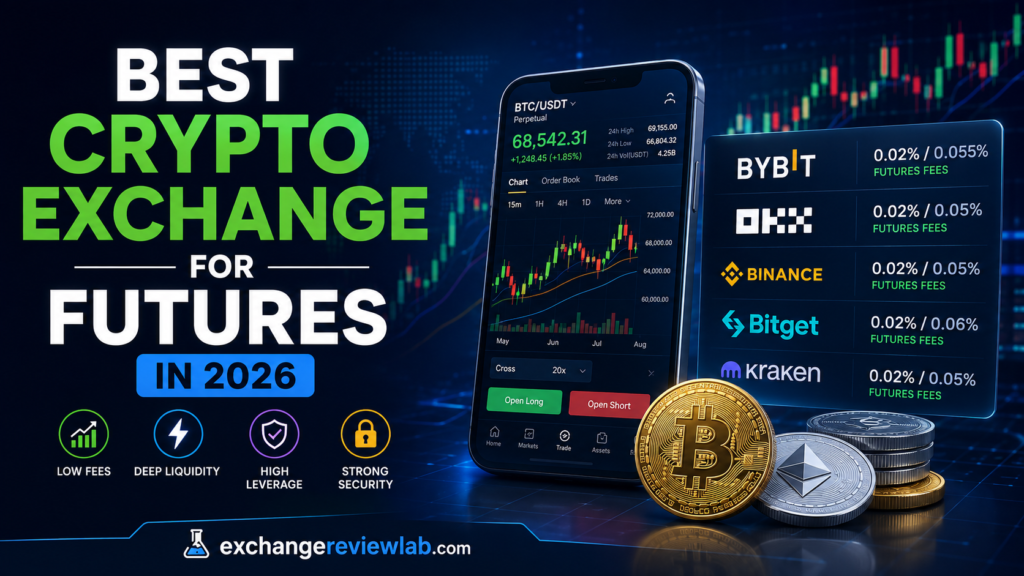
Crypto futures trading looks simple on the surface. You pick a direction, add leverage, and let the market decide the rest. The exchange you trade on decides a lot more than that. It decides how much you pay per trade, how fast your order fills during a crash, and whether your funds are still there next month.
We compared five major platforms on fees, liquidity, leverage limits, and regulatory standing to answer one question: which exchange actually deserves your futures volume in 2026.
What Crypto Futures Actually Are (Quick Refresher)
A crypto futures contract lets you speculate on the future price of an asset like Bitcoin or Ethereum without owning the coin itself. You can go long if you think the price will rise, or short if you think it will fall.
Most exchanges on this list offer perpetual futures, contracts with no expiration date that track the spot price through a mechanism called funding. Some platforms, like Kraken, also offer dated futures that settle on a fixed schedule and connect to regulated venues like the CME.
Leverage is what makes futures different from spot trading, and also what makes them riskier. Borrowing capital to open a larger position multiplies your gains, but it multiplies your losses just as fast, and a big enough move against you triggers liquidation. The exchange you pick determines your fee costs, but it also determines how well those liquidation mechanics protect you during a fast market.
Quick Answer: Best Crypto Exchange for Futures
If you only read one section, read this one.
Bybit takes the top spot for most active futures traders. It ranks as the second-largest derivatives exchange by open interest, carries a 0.02% maker and 0.055% taker fee, and offers deep liquidity across major perpetual pairs.
OKX is the pick for traders who want European regulatory backing (MiCA and MiFID licenses) alongside competitive 0.02%/0.05% futures fees.
Binance still wins on raw market breadth and brand trust, though it isn’t available to US residents for futures.
Bitget stands out for transparency, with 43 straight months of published proof-of-reserves reports.
Kraken is the safest bet for US-based and compliance-conscious traders, thanks to its CFTC-registered futures arm and over 100 active regulatory licenses worldwide.
There isn’t one universal winner. The right exchange depends on your location, your fee sensitivity, and how much you value regulation over raw features. The comparison below breaks that down properly.
Comparison Table: Top Crypto Exchanges for Futures
| Exchange | Futures Maker Fee | Futures Taker Fee | Max Leverage | Best For |
|---|---|---|---|---|
| Bybit | 0.02% | 0.055% | Up to 125x | Liquidity and derivatives breadth |
| OKX | 0.02% | 0.05% | Up to 125x | EU-regulated trading |
| Binance | 0.02% | 0.05% | Up to 125x | Widest market selection |
| Bitget | 0.02% | 0.06% | Varies by pair | Transparency and reserve proof |
| Kraken | 0.02% (scales to a rebate) | 0.05% (scales down with volume) | Lower, regulation-first | US and compliance-first traders |
Fees shown are standard, non-VIP rates and can change with volume tiers, token discounts, or promotions. Always confirm current rates on the exchange’s own fee page before trading.
Bybit Review
Bybit built its reputation on derivatives, and it shows. The platform runs a maker-taker fee model with a 0.02% maker fee and a 0.055% taker fee on standard futures accounts, dropping toward 0.03% taker and 0% maker at higher VIP tiers.
It’s currently the second-largest crypto derivatives exchange by open interest, with more than $11 billion in reported open interest. That depth matters when you’re trying to enter or exit a large position without moving the price against yourself.
Bybit isn’t without scars. In February 2025, the exchange suffered a security breach involving roughly $1.5 billion in assets from one of its Ethereum cold wallets, one of the largest crypto exchange hacks on record. Bybit covered the shortfall and continued operations, but the incident is worth knowing before you commit serious capital.
Bybit restricts access for users in the United States and the United Kingdom. If you’re in either region, skip ahead to the Kraken or OKX sections.
Read More:
Bybit Review 2026: Best Crypto Exchange for Beginners?
Is Bybit Safe or a Scam? (2026) – Read before starting to trade
Bybit Fees Review: Spot, Futures, Hidden Costs & How to Pay Less
OKX Review
OKX plays the regulation card better than most competitors. It holds a MiCA authorization and a MiFID II license for derivatives in Europe, which puts it in a small group of exchanges that can legally offer EU traders regulated crypto futures rather than an offshore workaround.
Fee-wise, OKX matches Binance almost exactly: 0.02% maker and 0.05% taker on standard futures accounts, with an additional discount available for traders who pay fees in OKB, the exchange’s native token. Reported Q1 2026 derivatives volume put OKX among the top exchanges globally by trading activity.
OKX also publishes monthly proof-of-reserves data and states it has maintained a clean security record on customer funds since launching in 2017. That’s a claim worth verifying independently rather than taking at face value, but the monthly disclosures give traders something concrete to check.
The catch: OKX isn’t available to residents of the United States, Canada, or Japan.
Read more:
Binance Review
Binance remains the biggest name in crypto for a reason. It offers one of the widest futures product ranges in the industry, spanning USDⓈ-Margined (USDT-M) and Coin-Margined (COIN-M) contracts, with standard fees of 0.02% maker and 0.05% taker.
Paying fees in BNB, Binance’s native token, knocks an additional discount off futures costs and a larger one off spot trading fees. For high-frequency traders, that adds up fast.
Binance’s history isn’t spotless. In November 2023, the exchange agreed to a $4.3 billion settlement with the US Department of Justice over anti-money-laundering compliance failures. It continues to operate as the largest exchange by trading volume globally, but the settlement is part of its regulatory record and worth factoring into any risk assessment.
Binance.com does not offer futures trading to US residents. If you’re trading from the US, you’ll need Kraken, Coinbase, or a similarly licensed domestic platform.
Bitget Review

Bitget leans hard into transparency as its selling point, and the numbers back that up. As of its June 2026 disclosure, Bitget had published 43 consecutive months of proof-of-reserves reports, reporting a total reserve ratio of 127%, meaning it holds meaningfully more in reserves than user deposits require.
On top of that, Bitget maintains a self-funded Protection Fund, kept above $300 million, as a backstop against extreme events like exchange hacks or bad debt from liquidations.
Futures fees sit at 0.02% maker and 0.06% taker on standard accounts, slightly higher than Bybit or OKX on the taker side, though paying with BGB (Bitget’s native token) brings costs down.
Bitget also runs one of the more prominent copy-trading systems in the industry, letting newer futures traders mirror the positions of experienced ones. That’s convenient, but remember it’s still a live trading strategy with real leverage risk attached, not a passive investment product.
Read more:
Kraken Review
Kraken is the grown-up in the room. Operating since 2011, it holds more regulatory licenses than any other major exchange on this list, over 100 active licenses across more than 30 countries, spanning banking, securities, and derivatives.
For US traders specifically, Kraken Derivatives US operates as a Futures Commission Merchant registered with the CFTC and a member of the National Futures Association, giving American traders a compliant path into crypto futures that Binance, Bybit, and OKX simply can’t offer domestically.
In Europe, Kraken holds MiCA authorization through the Central Bank of Ireland and a MiFID license for derivatives through Cyprus’s securities regulator, letting it passport services across the entire EEA.
Futures fees start at 0.02% maker, scaling down to a negative rate (a rebate) for high-volume traders, and 0.05% taker, scaling down toward 0.0125%. Kraken also publishes independently verified proof-of-reserves data on a quarterly basis.
The trade-off is choice. Kraken offers fewer exotic contract types and a smaller pool of perpetual markets than Bybit or Binance. For traders who prioritize a regulated, audited platform over having 400+ perpetual pairs to choose from, that’s a fair exchange.
How We Ranked the Best Exchanges for Futures
We didn’t rank these exchanges by which one has the flashiest homepage. Every platform on this list was evaluated against the same criteria:
- Trading fees. Maker and taker rates on standard, non-VIP accounts, since most traders never reach the top volume tiers.
- Liquidity and open interest. Deep order books matter more than a long list of obscure pairs nobody actually trades.
- Leverage and risk tools. Access to stop-loss, take-profit, reduce-only, and conditional orders, not just raw leverage caps.
- Security track record. Past incidents, proof-of-reserves practices, and how the exchange responded when something went wrong.
- Regulatory status. Licenses held, jurisdictions served, and whether the exchange can legally operate where you live.
For the full breakdown of how we score and weight each factor, see our review methodology.
Fees Comparison for Futures
Sticker-price fees only tell part of the story. Here’s what actually moves your total trading cost:
Maker vs. taker orders. A maker order rests on the order book and adds liquidity; it typically earns the lower fee. A taker order fills instantly against existing liquidity and costs more. Traders who use limit orders instead of market orders consistently pay less over time.
Funding rates. Perpetual futures contracts charge or pay a funding rate every few hours between long and short positions. This isn’t a trading fee, and no exchange discount reduces it, but it directly affects the cost of holding a position overnight.
Native token discounts. Binance (BNB), OKX (OKB), and Bitget (BGB) all offer reduced fees for traders who hold or pay with the exchange’s own token. It’s a real discount, but it also means holding an extra asset with its own price risk.
Volume tiers. Every exchange on this list lowers fees as your 30-day trading volume increases. If you’re a casual trader doing a few trades a month, don’t expect VIP-tier pricing; that math only works for high-frequency accounts.
The takeaway: a 0.01% difference in taker fees looks tiny on paper. Across hundreds of trades a month with leverage attached, it stops being tiny.
Here’s a quick way to picture it. On a $10,000 position, a 0.05% taker fee costs $5 to enter and another $5 to exit, so $10 round-trip. Bump that to 0.06%, and you’re at $12. That $2 gap barely registers on one trade. Multiply it by 20 trades a week over a year, and the difference stops being a rounding error and starts being real money that never had a chance to compound.
This is exactly why comparing headline fee percentages without checking your own trading frequency doesn’t tell you much. A trader who opens two positions a month should weigh security and regulation far more heavily than fee shaving. A trader running dozens of trades a week should do the opposite math.
Security & Regulation
Futures trading already carries leverage risk. Don’t add custody risk on top of it by ignoring how an exchange handles security and oversight.
Proof of reserves has become the baseline transparency standard. Bitget, OKX, and Kraken all publish regular reserve reports, letting users cryptographically verify that the exchange holds enough assets to cover customer balances. It’s not a perfect guarantee against fraud, but it’s far better than the total opacity that defined the industry a few years ago.
Regulatory licensing varies enormously by platform and by region. Kraken’s CFTC registration and MiCA authorization put it in a different category from exchanges operating without a formal license in the US or EU. That matters most if something goes wrong and you need legal recourse.
Past incidents matter, but so does the response. Bybit’s 2025 hack and Binance’s 2023 DOJ settlement are both part of the public record. Neither exchange collapsed, and both continued serving customers, but a track record with zero major incidents (like Kraken’s, so far) or a clean security history since launch (as OKX states) still carries weight in a risk assessment.
Self-custody is still the safest option for anything you’re not actively trading. Keep only the funds you need for active futures positions on any exchange, and move the rest to a wallet you control.
Frequently Asked Questions
What is the safest crypto exchange for futures trading? Kraken currently holds the most extensive regulatory licensing among major futures-enabled exchanges, including CFTC registration in the US and MiCA authorization in the EU, which makes it the strongest choice for compliance-focused traders. OKX and Bitget also score well on transparency through regular proof-of-reserves disclosures.
Which exchange has the lowest futures trading fees? Binance and OKX both charge 0.02% maker and 0.05% taker on standard accounts, matching each other almost exactly. Bybit’s 0.055% taker fee sits slightly higher, and Kraken’s rates scale favorably at high volume but start a touch above the others for smaller accounts.
Can US residents trade crypto futures? Not on Binance.com, Bybit, or OKX; all three restrict futures access for US residents. Kraken Derivatives US, a CFTC-registered Futures Commission Merchant, offers a compliant path for American traders.
How much leverage can I use on crypto futures? Most major exchanges cap leverage around 100x to 125x on their most liquid pairs, though the actual maximum drops on smaller or more volatile assets. Higher leverage doesn’t mean a better strategy; it just moves your liquidation price closer to your entry.
Is crypto futures trading profitable for beginners? Futures trading carries substantially more risk than spot trading because leverage amplifies both gains and losses. Beginners are generally better served starting with spot trading and small position sizes before adding leverage, and treating any futures account as money they can afford to lose entirely.
What’s the difference between perpetual futures and dated futures? Perpetual futures have no expiration date and stay open indefinitely, funded by periodic payments between long and short traders. Dated futures expire on a set date and settle automatically, which is closer to how traditional commodity futures work. Bybit, OKX, Binance, and Bitget focus mainly on perpetuals, while Kraken offers both perpetuals and CME-cleared dated contracts.
Do I need to verify my identity to trade futures? Yes, on every exchange covered here. Know Your Customer (KYC) verification is standard across regulated and semi-regulated platforms alike, and futures accounts typically require a higher verification tier than basic spot accounts due to the added leverage risk involved.
Final Verdict: Best Exchange for Futures
There’s no single “best” exchange for everyone, and anyone claiming otherwise is probably trying to sell you something.
If you trade actively and want deep liquidity with a strong derivatives focus, Bybit is the strongest all-around pick. If regulatory backing in Europe matters more to you than shaving off a fraction of a percent in fees, OKX earns that spot. Binance still makes sense for traders who want the widest possible market selection and don’t mind its regulatory baggage. Bitget rewards traders who prioritize verifiable transparency. And if you’re trading from the US or simply want the most heavily regulated option on the table, Kraken is the only realistic choice.
Whichever platform you choose, start small, understand the fee structure before you trade, and never put more into a leveraged position than you’re prepared to lose completely. Futures trading isn’t gambling, but it stops being anything else the moment you skip the homework.
For deeper, hands-on breakdowns of these platforms, browse our full exchange reviews or check our beginner-friendly exchange guide before you fund an account.
This article is for informational purposes only and does not constitute financial advice. Crypto futures trading involves substantial risk of loss. Always verify current fees, leverage limits, and availability directly with the exchange before trading.
