
Staking sounds simple until you actually try to compare exchanges. One platform advertises a huge APY, another quietly takes a third of your rewards as commission, and a third makes you lock your coins up for so long you forget you ever staked them. This guide cuts through that noise and compares the real numbers: commissions, lock-up terms, supported assets, and, just as important, whether the exchange holding your coins has a track record worth trusting.
Quick Answer: Best Crypto Exchange for Staking
If you want one answer and no scrolling: Coinbase is the best all-around crypto exchange for staking in 2026 for US-based investors who prioritize security and regulatory standing over raw yield. It’s publicly traded on Nasdaq, its financials get audited every quarter, and it holds a clean slashing record, though its 25–35% commission on rewards is the steepest of any major platform.
If your priority is yield instead of polish, Kraken and Crypto.com both offer meaningfully higher returns on select assets, with Kraken leaning toward transparency and Crypto.com leaning toward promotional APYs tied to its CRO token. Binance wins on cost, since it charges no separate staking or unstaking fee, but it isn’t available to US residents at all. KuCoin rounds things out as the pick for altcoin variety, assuming you’re comfortable with a smaller, non-US-licensed exchange.
There’s no single “best” exchange for everyone. There’s a best exchange for your situation, and that depends on where you live, how much commission you’re willing to hand over, and how long you’re willing to lock your coins away.
Comparison Table: Top Crypto Exchanges for Staking
| Exchange | Staking Commission | Representative ETH APY | Lock-Up Style | US Availability |
|---|---|---|---|---|
| Coinbase | 25% (ETH) / 35% (most other coins) | ~2.8–3.5% | Flexible, with unstaking queue | Yes |
| Kraken | 25–30% depending on product | ~2.4–4% | Flexible or Bonded | Yes (not NY or ME) |
| Binance | 0% (no staking/unstaking fee) | ~3–5% | Flexible and locked options | No |
| Crypto.com | Built into advertised APY | Up to ~19% on select on-chain assets | Locked (up to 12 months for top CRO rate) | Yes, with regional limits |
| KuCoin | Built into advertised APY | ~2.1–2.15% | Flexible and fixed | Limited |
APYs shift constantly with network conditions, so treat these as a snapshot rather than a promise. Always check the live rate on the exchange itself before you commit funds.
Coinbase Review
Coinbase runs staking as a straightforward, custodial service: you hold the coin, Coinbase runs the validator infrastructure, and it takes a cut of what the network pays out. That cut is the headline number to understand. Coinbase charges a 25% commission on ETH rewards and a 35% commission on most other staking assets, including SOL, ADA, DOT, ATOM, and AVAX, according to Coinbase’s own fee disclosures. Subscribers to Coinbase One get a discount on that 35% bucket, stepping down to roughly 25.25% at the top membership tier.
Run the math and the commission stings less than it sounds. If Ethereum pays out around 3.5% before fees, a 25% cut leaves you close to 2.6%. Not thrilling, but it’s a real yield with essentially no technical setup required.
Where Coinbase earns its reputation is custody and accountability, not yield. It’s a publicly traded company on Nasdaq under the ticker COIN, part of the S&P 500, with quarterly audited financials from a major accounting firm. Coinbase reports a clean slashing record across its validator operations and keeps the large majority of assets in cold storage. FDIC coverage applies to USD cash balances, not to staked crypto — that distinction trips up a lot of new users, so it’s worth repeating.
Read more:
- Coinbase Review for Beginners 2026: Read before trading
- Coinbase Fees 2026: Hidden Costs & How to Save
- Is Coinbase Safe or a Scam? (2026 Honest Review)
Kraken Review
Kraken splits staking into two paths, and the difference matters more than most beginners expect. Flexible Staking and Auto Earn carry a 30% commission but let you unstake without much delay. Bonded staking starts at a 25% commission below $1 million in staked value and drops further at higher tiers, but it locks your funds for the bonding and unbonding period, which for assets like DOT can run three days or longer once you request an exit.
Kraken supports more than 20 stakeable assets, including Ethereum, Solana, Cardano, and Polkadot, with some tokens advertising yields as high as 20–22% APY depending on network conditions and lock-up choice. According to Kraken’s own staking guide, the platform doesn’t require you to hold a native exchange token to access its best rates. Unlike some competitors.
Security-wise, Kraken holds ISO/IEC 27001 certification and a SOC 2 Type 1 report for its retail platform, with a separate SOC 2 Type 2 examination covering institutional custody. It’s registered with FinCEN in the US and regulated by the FCA in the UK. It hasn’t been fully spotless: in mid-2024, security researchers at CertiK found a deposit-crediting flaw and withdrew a few million dollars from Kraken’s treasury before the issue was patched and the funds returned, with Kraken stating customer balances were never affected. Worth knowing, and also a reasonable example of a bug bounty process actually working the way it’s supposed to. One more regulatory note for US readers: the SEC took enforcement action against Kraken’s staking-as-a-service program for US customers back in 2023, which led to that specific product being discontinued domestically — on-chain staking through Kraken has continued as a separate arrangement since then.
Kraken doesn’t operate in New York or Maine, so double-check your state before signing up.
Binance Review
Binance’s pitch for stakers is simple: no separate staking or unstaking fee, an enormous asset catalog, and reward rates that are often published upfront rather than buried in fine print. Reported ranges put BNB staking around 5–8%, Ethereum around 3–5%, and Polkadot as high as 10–14%, though these numbers move with network conditions and promotional periods.
The bigger story with Binance in 2026 is regulatory. The exchange operates under a $4.3 billion settlement with the US Department of Justice from 2023 for historic anti-money-laundering failures, and its founder stepped down from leadership shortly afterward. Binance has since pushed hard on compliance — it publishes proof-of-reserves attestations showing over $160 billion in verified assets, and it maintains the SAFU fund, an insurance reserve created in 2018 and funded by a slice of trading fees. In early 2026, Binance converted the roughly $1 billion SAFU balance fully into Bitcoin, pledging to top it back up if the value drops below $800 million, as CoinDesk reported. SAFU has been drawn down twice publicly in the exchange’s history: once after a 2019 hack and once following a 2022 bridge exploit on BNB Chain.
None of that changes the access problem for American readers: Binance.com geo-blocks US IP addresses, and Binance also lost its ability to serve French customers in mid-2026 after failing to secure a MiCA license there in time. If you’re comparing Binance against a derivatives-heavy alternative, our Binance vs Bybit comparison covers the fee and security differences in more detail.
Crypto.com Review
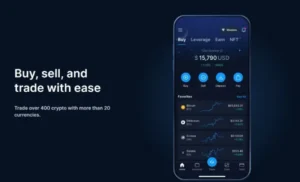
Crypto.com plays a different game than Coinbase or Kraken. Instead of a flat commission model, it advertises headline APYs directly — up to roughly 19% on select on-chain assets through its broader staking rollout, and up to 9.5% on its native CRO token if you’re willing to lock funds for 12 months. That’s the trade-off: Crypto.com’s best numbers usually require holding or staking CRO, and the platform has been criticized for making rate comparisons harder to do at a glance than competitors like Kraken, which publish flat commission percentages.
On the regulatory side, Crypto.com has actually made solid progress. It holds a MiCA license covering 29 EEA countries, along with SOC 2 Type 1, PCI DSS Level 1, and multiple ISO certifications (27001, 27701, 22301) for its security and business-continuity practices. Trading fees start at 0.25% maker and 0.50% taker, and staking or locking CRO tokens brings both down, with the biggest discount tier requiring 50,000 CRO locked up.
If your plan is “stake and forget,” Crypto.com’s ecosystem-linked perks (Visa card cashback, fee discounts) can add real value on top of the staking yield itself. If you’d rather keep things simple and token-agnostic, that CRO dependency is worth weighing carefully first.
KuCoin Review
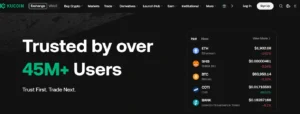
KuCoin’s staking product, sometimes still referred to by its earlier Pool-X branding, leans toward breadth over headline yield. Recent published rates put ETH staking around 2.1–2.15% APY, SOL around 5%, and higher-inflation assets like ATOM around 15%, with its native KCS token sitting around 2.28%. The exchange runs regular “Earn Week” promotions that temporarily boost specific asset yields, which is a nice bonus if you happen to be paying attention, and easy to miss if you’re not.
KuCoin publishes proof-of-reserves data showing BTC and ETH reserve ratios above 100% in its most recent snapshots, which is reassuring on paper. It’s also had a real incident to learn from: in September 2020, the exchange disclosed that funds were moved out of its hot wallets in a security breach. KuCoin said cold storage was unaffected and covered the loss through its own funds and insurance arrangements, and users were made whole. That’s the kind of history worth knowing about rather than ignoring, even years later.
Read more:
- KuCoin review for Low Budget Traders (2026) — Worth It
- KuCoin Fees Review (2026) – Hidden Costs & Fees
- Is KuCoin a Scam or Safe in 2026? An Honest Review
How We Ranked the Best Exchanges for Staking
Chasing the highest advertised APY is the easiest way to end up disappointed, so ranking exchanges purely on headline numbers wasn’t the goal here. Instead, four factors carried the most weight.
Commission transparency mattered first. An exchange that publishes a flat, easy-to-find commission percentage (like Kraken’s tiered rates) is easier to evaluate honestly than one where the “real” yield only becomes clear after reading several support articles.
Custody and regulatory standing came next. A platform can offer a fantastic APY, but if your coins sit behind weak custody controls or an unlicensed entity, the yield doesn’t matter much if something goes wrong. Public listings, audited financials, and named regulatory licenses all counted in an exchange’s favor.
Lock-up flexibility was the third factor. Flexible staking that lets you exit quickly is worth more, dollar for dollar, than a slightly higher rate that traps your funds for weeks.
Track record rounded things out. Every exchange in this list has faced some kind of security test — a breach, a bug, a regulatory action — at some point in its history. What mattered for ranking purposes wasn’t whether an incident happened, since that’s true of nearly every major platform eventually, but how the exchange responded and whether users were made whole. This mirrors the scoring methodology we use across all of our exchange reviews: real accounts, published fee schedules, and documented incidents, not marketing copy.
Fees Comparison for Staking
Staking fees hide in two places: the visible commission on rewards, and the less-visible cost of getting your money back out.
Coinbase’s commission structure is the most aggressive of the group at 25% (ETH) to 35% (most other coins), though Coinbase One subscribers can shave several points off that second tier. Kraken splits the difference with a 30% commission on flexible products and a starting 25% on bonded staking that improves at higher balances. Binance stands out by charging no dedicated staking or unstaking fee at all, which is a meaningful structural advantage if the underlying APY is otherwise comparable. Crypto.com and KuCoin both fold their commission into the advertised APY rather than listing it as a separate line item, which makes them harder to compare apples-to-apples without checking the live rate yourself.
Exit costs deserve equal attention. Bonded or locked staking products can hold your funds for days to months depending on the asset and platform, and some exchanges charge an extra fee for instant unstaking outside the normal queue. Before staking any meaningful amount, check the specific unstaking terms for that asset on that exchange — they vary far more than the headline APY numbers suggest.
Security & Regulation
Every exchange on this list has, at some point, had a security incident, a regulatory settlement, or both. That’s not a reason to panic; it’s simply the state of an industry that’s still maturing. What matters is how each platform has responded.
Coinbase leans on its public-company status: quarterly audits, a qualified custodian structure under New York banking law, and a clean slashing record for staking specifically. Kraken backs its claims with ISO 27001 certification and SOC 2 audits, and its 2024 treasury bug was patched and disclosed rather than buried. Binance operates under close regulatory scrutiny following its 2023 DOJ settlement, but has responded with proof-of-reserves reporting and a rebuilt SAFU insurance fund now backed by Bitcoin. Crypto.com has invested heavily in licensing, holding a MiCA passport across 29 EEA countries plus several ISO and PCI certifications. KuCoin publishes reserve ratios and has operated without a repeat incident since its 2020 breach, though it still lacks full US licensing.
None of this is a guarantee against future problems — no exchange can offer that. But a documented response to past incidents, verifiable proof-of-reserves data, and clear licensing are the closest thing to due diligence an individual investor can actually check before depositing funds.
Frequently Asked Questions
Is crypto staking through an exchange safe? It carries less technical risk than running your own validator, but it introduces custodial risk: you’re trusting the exchange to hold your assets securely and to run validator infrastructure without getting slashed. Diversifying across platforms and never staking your entire holdings in one place reduces that exposure.
Which exchange has the highest staking APY? Advertised rates change constantly and often depend on holding a platform’s native token or accepting a long lock-up. Crypto.com and Kraken have both published some of the higher rates on select assets recently, but “highest APY” and “best value after commission and lock-up” aren’t always the same exchange.
Do I pay tax on staking rewards? In most jurisdictions, including the US, staking rewards count as taxable income at the time you receive them, based on their fair market value. Tax treatment varies by country and can change, so this isn’t a substitute for advice from a tax professional familiar with your situation.
What’s the difference between flexible and bonded staking? Flexible staking lets you unstake relatively quickly, often within a day, but usually pays a lower rate. Bonded or locked staking pays more but ties up your funds for a fixed period or an unbonding queue that can run days to weeks depending on the network.
Can US residents stake on Binance? No. Binance.com blocks US IP addresses and requires non-US residency during account verification, so American users looking for similar features need to consider Coinbase, Kraken, or Crypto.com instead.
If I’m brand new to crypto, where should I start? Start with a platform built for beginners rather than the highest APY on the list — our guide to the best crypto exchanges for beginners walks through account setup, fees, and first-stake basics before you commit real money.
Final Verdict: Best Exchange for Staking
For most US-based investors, Coinbase remains the safest default choice for staking in 2026. The commission is the highest on this list, but the trade-off buys you public-company transparency, audited financials, and a clean slashing record — the kind of boring reliability that matters a lot the one time something goes wrong elsewhere.
If yield matters more than polish and you’re comfortable evaluating commission tiers yourself, Kraken offers a genuinely transparent alternative with strong certifications and no requirement to hold a native token. Crypto.com makes sense if you’re already inside its card and rewards ecosystem and don’t mind locking CRO for the best rates. Binance is worth considering purely on cost if you’re outside the US, since its zero staking fee is hard to beat on paper. KuCoin fills the altcoin-variety gap for users comfortable with a smaller, less US-regulated platform.
Whichever exchange you pick, treat the advertised APY as a starting point, not a promise. Check the live commission, the actual lock-up terms, and the platform’s own fee disclosures before you stake a single coin — the numbers on this page are a snapshot, and this industry doesn’t sit still for long.
