
If you’ve typed “Is Bybit safe or a scam” into Google, you’re already doing the right thing. Before putting real money on any exchange, asking that question is just smart. Not paranoid , smart.
The short answer? Bybit is a legitimate, operational crypto exchange used by millions of people worldwide. But like every exchange, it comes with risks you need to understand before you start trading. This review breaks everything down , security features, past incidents, real user feedback, country restrictions, and how Bybit stacks up against its competitors.
No fluff. No fake ratings. Just the facts.
Table of Contents
What Is Bybit?
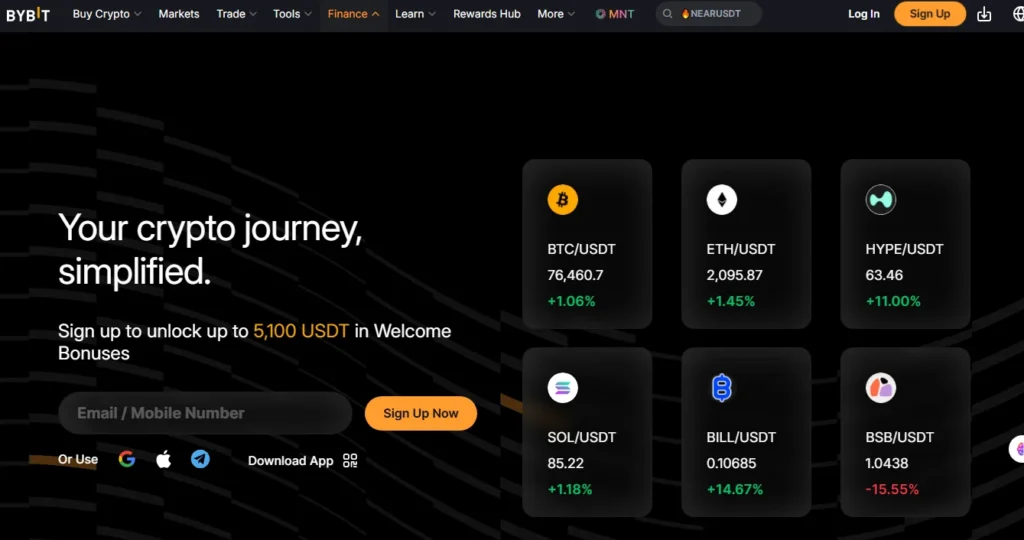
Bybit launched in March 2018, founded by Ben Zhou, a former executive at XM.com. The exchange started as a derivatives-focused platform , think perpetual contracts and futures. Over time, it expanded significantly into spot trading, options, copy trading, a crypto launchpad, NFT marketplace, and even a Web3 wallet.
Today, Bybit is headquartered in Dubai, UAE, and registered in the British Virgin Islands. According to CoinMarketCap, Bybit consistently ranks among the top three largest crypto derivatives exchanges globally by trading volume. The platform reports over 60 million registered users as of recent figures , a number that has grown sharply over the past two years.
The platform supports a wide range of assets – hundreds of spot trading pairs, inverse and USDT-margined futures, and a liquid options market. If derivatives trading is your goal, Bybit has been purpose-built for it.
How Secure Is Bybit?
Security is where exchanges either earn your trust or lose it fast.
Bybit uses a multi-layer security architecture. The majority of user funds sit in cold storage — offline wallets that hackers cannot reach through a network connection. Only a small percentage of funds remain in hot wallets to cover daily withdrawals and operations.
The platform also employs multi-signature (multisig) wallet technology. This means no single key can authorize a transaction alone. Multiple approvals from different keyholders are needed, which adds a meaningful layer of protection against inside threats and external attacks.
Bybit publishes regular Proof of Reserves (PoR) reports, independently verified. This lets users confirm that Bybit holds enough assets to cover its liabilities – a transparency practice that many competing exchanges still haven’t adopted. You can verify this data directly on Bybit’s official transparency page.
For day-to-day login and account protection, the platform supports:
- Two-Factor Authentication (2FA) – Google Authenticator and SMS-based
- Anti-Phishing Code – a unique code that appears in every official Bybit email, so you can instantly spot fakes
- Withdrawal Address Whitelist – restricts withdrawals to pre-approved wallet addresses only
- Hardware Key Support – compatible with FIDO2 security keys for advanced users
- Session Management – ability to view and terminate active sessions from any device
These aren’t decorative checkboxes. Each one addresses a specific, real attack vector that hackers use.
Security Features Explained
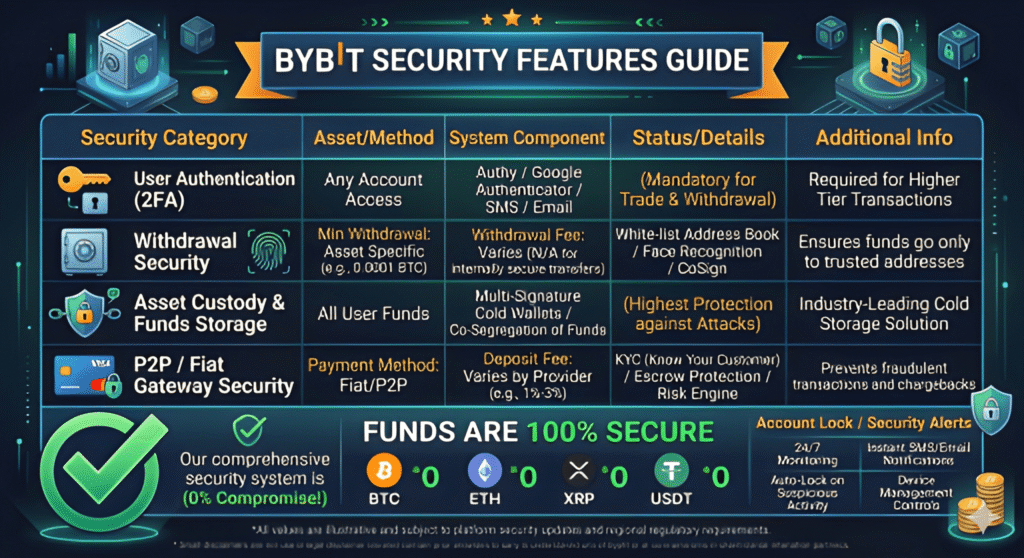
Let’s walk through what each security feature actually does in plain English.
Cold Storage
Cold storage means the private keys to those wallets are never connected to the internet. Even if Bybit’s servers were compromised today, attackers couldn’t reach the bulk of user funds. This is the single most important security feature any exchange can offer.
Multi-Signature Wallets
Think of multisig like a bank vault that requires three different keys held by three different people. One person going rogue – or being compromised , isn’t enough to open it. Bybit uses this system for significant fund movements.
Proof of Reserves
Bybit works with third-party auditors to verify that the assets it claims to hold are actually there. The verification uses Merkle tree proofs, which allow individual users to confirm their own balances are included in the audit. Source: Bybit’s transparency portal and independent audit reports.
Anti-Phishing Code
Phishing – fake emails pretending to be from Bybit – is one of the most common ways users get robbed. With an anti-phishing code set up, any email that doesn’t display your custom code is immediately suspicious. Simple but highly effective.
Withdrawal Whitelist
Even if someone steals your login credentials, they can’t drain your account to a new wallet without going through a verification process. Your funds can only move to addresses you’ve pre-approved.
Has Bybit Ever Been Hacked?
Yes – and this is important to discuss honestly.
In February 2025, Bybit suffered what became the largest crypto hack in recorded history. Approximately $1.5 billion worth of Ethereum (ETH) was stolen from one of Bybit’s cold wallets. Blockchain analytics firm Elliptic and the FBI attributed the attack to the Lazarus Group , a sophisticated hacking collective linked to North Korea. The attackers reportedly exploited vulnerabilities in Safe{Wallet}, a third-party multisig wallet interface that Bybit used for internal transfers.
Here’s what happened next, and why it matters.
Bybit’s CEO Ben Zhou immediately went public, confirmed the breach transparently, and committed to covering all user losses in full. Within 72 hours, Bybit had sourced emergency loans from industry partners and executed over-the-counter (OTC) purchases to restore ETH reserves. Users experienced no loss of funds. Withdrawals remained open throughout the incident.
An independent audit conducted shortly after confirmed that Bybit’s total assets exceeded its liabilities , meaning the exchange remained solvent at every point during the crisis.
This incident does not make Bybit “safe.” No exchange is immune to sophisticated, state-sponsored attacks. But how Bybit responded , transparently, quickly, and without passing losses onto users , matters enormously when assessing trustworthiness. Compare that to how other exchanges have handled (or hidden) breaches historically.
Sources: Elliptic, FBI Public Statement (February 2025), Ben Zhou’s public X thread, Bybit official blog.
Real User Safety Experience
Numbers and security architecture tell one side of the story. Real users tell another.
On Trustpilot, Bybit holds a rating above 4 out of 5, with thousands of reviews. The most common positive themes include fast withdrawals, responsive customer support for security issues, and the effectiveness of account recovery processes.
The most common complaints center around account freezes , which, interestingly, often happen for compliance reasons (KYC verification delays, unusual activity flags). While frustrating for legitimate users, these freezes are also a sign that Bybit’s fraud detection systems are actively working.
Some users in restricted jurisdictions report using VPNs to access Bybit, which violates Bybit’s Terms of Service. If Bybit detects this, accounts can be locked , and that is on the user, not the platform.
The pattern that emerges from real feedback: users who complete KYC thoroughly, use 2FA, and operate in supported regions generally report a smooth and secure experience. Users who skip verification steps or try to work around geographic restrictions run into trouble.
Risks of Using Bybit
Being legitimate doesn’t mean risk-free. Here’s what you genuinely need to know.
1. Regulatory Risk
Bybit operates in a fast-changing regulatory environment. The exchange is not licensed by the FCA (UK), SEC (US), or several other major regulators. Users in unregulated jurisdictions have limited formal recourse if something goes wrong.
2. Derivatives Are High-Risk by Nature
Bybit built its name on leveraged derivatives. Products like perpetual futures with 100x leverage can wipe out your account faster than you can say “margin call.” This is not Bybit being dangerous – this is what derivatives are. If you don’t fully understand leverage, the risk is real regardless of which exchange you use.
3. No FDIC or Government Deposit Insurance
Unlike a bank account, your crypto on Bybit is not insured by any government body. If Bybit were to collapse (with no recovery mechanism like the 2025 hack response), you’d be in line as a creditor , not a protected depositor.
4. Smart Contract and Third-Party Risk
The 2025 hack demonstrated that even cold storage isn’t perfectly safe when third-party tools are involved in fund management. Bybit has since made changes to its infrastructure, but third-party risk remains a factor worth knowing.
5. Counterparty Risk on Earn Products
Bybit offers staking, yield products, and liquidity pools. These involve giving Bybit or third-party protocols custody over your assets to generate returns. The yields are not guaranteed, and some carry smart contract risks.
How to Stay Safe on Bybit
Whether Bybit is your first exchange or your fifth, these steps matter.
Complete full KYC verification. It feels bureaucratic, but fully verified accounts get better support, higher withdrawal limits, and faster account recovery if something goes wrong.
Enable 2FA immediately. Use Google Authenticator – not SMS – as SIM-swap attacks are a real and documented threat. Don’t skip this.
Set your anti-phishing code. Go to your security settings and create a unique code. Every real Bybit email will include it. Anything without it is fake.
Use the withdrawal whitelist. Add only your own verified wallet addresses. Turn on the 24-48 hour delay for new addresses.
Never share your seed phrase or API keys. This sounds obvious, but social engineering attacks specifically target crypto users through fake “support” chats, Telegram groups, and Discord servers.
Store large amounts in your own hardware wallet. Bybit should hold what you actively trade. Long-term holdings belong in a wallet where you control the keys.
Check official channels only. Bybit’s verified Twitter/X, official app, and bybit.com are the only real sources. Screenshot any suspicious contact and report it.
Is Bybit Available in Your Country?
This is a genuinely important question – and one that catches many users off guard.
Bybit is not available in the United States. US residents are blocked from registering due to regulatory restrictions. This is a firm restriction, and attempting to bypass it using a VPN violates Bybit’s Terms of Service.
Bybit is also restricted or limited in the following countries: Canada (certain provinces), the United Kingdom (limited services, no FCA licensing for full derivatives access), Cuba, Iran, North Korea, Syria, and several others under international sanctions lists.
Bybit is available and widely used across most of Southeast Asia, the Middle East (including UAE, where it’s headquartered), Europe (excluding specific restricted jurisdictions), Latin America, and Africa.
Before registering, always check Bybit’s official Terms of Service page for the most current list of restricted regions. Regulations change, and what’s accessible today might not be tomorrow.
If you’re in India, Bybit has historically been accessible, though India’s evolving crypto regulatory framework means users should stay updated on local compliance requirements.
Pros and Cons
Let’s be direct about what Bybit does well and where it falls short.
Pros
Deep liquidity on derivatives – Bybit consistently ranks among the highest-volume derivatives exchanges globally, meaning tighter spreads and better execution on futures trades.
Competitive fees – Maker fees as low as 0.01% on derivatives, with a tiered VIP system that rewards high-volume traders.
Proof of Reserves – Regular, independently verified reserve audits are not yet standard practice across the industry. Bybit doing this is a genuine trust signal.
Strong product variety – Spot, futures, options, copy trading, launchpad, NFT marketplace, Web3 wallet. It’s a comprehensive ecosystem.
Transparent incident response – The 2025 hack showed Bybit will absorb losses rather than pass them to users. That’s not nothing.
Responsive customer support – Live chat support with relatively fast response times, which is better than many competitors.
Cons
No US access – The world’s largest crypto market simply can’t use this platform.
Not FCA licensed – UK users operating in a grey zone with limited formal protections.
Complex interface for beginners — Bybit’s platform depth is an advantage for experienced traders and a steep learning curve for newcomers.
Third-party risk exposure – The 2025 hack originated via a third-party tool, highlighting that cold storage alone isn’t a complete guarantee.
Derivatives product risk – High leverage is available by default. Beginners who don’t understand margin trading can cause serious financial harm to themselves.
How Does Bybit Compare to Other Exchanges on Safety?
Safety comparisons between exchanges are often oversimplified. Here’s an honest look at how Bybit sits relative to the most-referenced alternatives.
Bybit vs Binance
Binance is the largest exchange by volume globally. Both offer cold storage and 2FA. Binance has a SAFU (Secure Asset Fund for Users) – a dedicated insurance fund funded by a portion of trading fees – which Bybit does not have an equivalent of. However, Binance has faced far more regulatory scrutiny globally, including enforcement actions from multiple jurisdictions. Bybit’s regulatory footprint is smaller but its recent crisis response (2025 hack recovery) was notably strong.
Bybit vs Coinbase
Coinbase is US-regulated, publicly listed on NASDAQ, and FDIC insures USD cash balances (not crypto). For US users, Coinbase offers regulatory clarity that Bybit simply cannot provide. For derivatives trading and fee rates, Bybit is significantly more competitive. These exchanges serve different use cases.
Bybit vs OKX
OKX and Bybit are closely matched on derivatives. OKX has a broader geographic license footprint in some regions. Both publish Proof of Reserves. Neither has FCA licensing for full derivatives access in the UK. Bybit’s copy trading and launchpad features are generally regarded as more user-friendly.
Bybit vs Kraken
Kraken is known for its strong security reputation – it has never suffered a significant hack. Bybit suffered the 2025 breach. However, Bybit’s recovery from that breach was comprehensive and user-loss-free. Kraken’s derivatives offering is more limited by comparison. For institutional-grade security reputation, Kraken leads; for derivatives depth, Bybit leads.
The honest conclusion: no single exchange is the “safest” across all dimensions. The right choice depends on your geography, trading goals, and risk tolerance.
FAQ Section
Is Bybit a legitimate exchange?
Yes. Bybit is a legitimate, operational cryptocurrency exchange founded in 2018. It is registered in the British Virgin Islands and headquartered in Dubai, UAE. It has over 60 million registered users and ranks consistently among the largest derivatives exchanges by trading volume globally.
Is Bybit safe to use in 2026?
Bybit is generally considered safe for users who follow proper security practices – enabling 2FA, completing KYC, and using the withdrawal whitelist. The platform uses cold storage, multi-signature wallets, and publishes regular Proof of Reserves. Note that Bybit suffered a $1.5 billion hack in February 2025; however, all user funds were fully covered by the exchange, and no users lost money. No exchange is risk-free, but Bybit has demonstrated a credible response to crisis.
Was Bybit hacked?
Yes. In February 2025, Bybit experienced the largest crypto hack in history – approximately $1.5 billion in Ethereum was stolen by the Lazarus Group, a North Korean state-linked hacking entity. The attack exploited vulnerabilities in a third-party multisig wallet tool. Bybit covered all losses within 72 hours, and no users lost funds. The exchange passed an independent solvency audit conducted after the incident.
Is Bybit available in the USA?
No. Bybit is not available to US residents. US users are blocked from registering. Attempting to access Bybit from the US via VPN violates the platform’s Terms of Service and may result in account restrictions.
Does Bybit require KYC?
Yes. Bybit requires Know Your Customer (KYC) verification for full platform access, including higher withdrawal limits and access to certain products. Basic trading may be available at lower tiers, but full verification is strongly recommended for account security and recovery purposes.
How does Bybit store user funds?
Bybit stores the majority of user funds in cold wallets – offline storage disconnected from the internet. Hot wallets hold only a small operational percentage. The platform uses multi-signature technology for fund transfers. Bybit publishes Proof of Reserves reports verified by third-party auditors.
Is Bybit regulated?
Bybit holds licenses and registrations in select jurisdictions. It is not licensed by the FCA (UK), SEC (US), or certain other major regulators. Users in unregulated regions have limited formal legal protections. Always check current regulatory status for your specific country before trading.
Can I trust Bybit with large amounts of crypto?
This depends on your risk tolerance. Bybit stores assets in cold storage with multisig security and publishes verified reserves. However, the 2025 hack demonstrated that even cold storage can be compromised via third-party interfaces. For large, long-term holdings, keeping crypto in a personal hardware wallet – rather than on any exchange – is widely recommended by security experts.
What should I do if I think my Bybit account is compromised?
Immediately change your password, revoke all active sessions from your security settings, and contact Bybit’s official support through their verified website or app. Do not contact anyone on Telegram or Discord claiming to be Bybit support – these are almost always scams.
Final Verdict
So – is Bybit safe or a scam?
It’s neither a scam nor unconditionally safe. Bybit is a real, functioning, large-scale exchange that has been operating since 2018. It has a genuine security infrastructure, transparent reserve audits, and a proven track record of covering user losses when things go catastrophically wrong.
The 2025 hack will follow Bybit’s reputation for years , as it should. No exchange that’s lost $1.5 billion gets to simply move on without scrutiny. But the way Bybit handled it , zero user losses, full solvency, public communication throughout — is the kind of crisis response that builds long-term trust.
The real risks on Bybit aren’t about the exchange being fraudulent. They’re about your own security practices, the inherent volatility of crypto markets, the high-risk nature of leverage trading, and the regulatory uncertainty in your country.
If you’re in a supported region, you understand derivatives trading, you take security seriously, and you want access to one of the deepest liquidity pools in the derivatives market Bybit is a serious, credible option.
If you’re a beginner looking for a regulated, beginner-friendly spot trading experience, Bybit is probably not your first stop. Start somewhere with clearer regulatory backing for your jurisdiction and a simpler interface.
Do your own research. Never leave more on any exchange than you can afford to lose. And always control your own keys for long-term storage.
