
Bybit Review for Low-Budget Users
Bybit — Scorecard for Low-Budget Users
Rated across six key categories
| Category | Rating | Notes |
|---|---|---|
| Minimum deposit | ★★★★★ | As low as $1–$2; no barriers to entry |
| Trading fees | ★★★★☆ | 0.10% spot; competitive, not cheapest |
| Security | ★★★★☆ | Strong post-breach measures; 2025 incident is a concern |
| Features for beginners | ★★★★☆ | Demo account, copy trading, mobile app |
| Earning products | ★★★★☆ | Solid options for idle funds |
| Geographic access | ★★★☆☆ | Not available in US, UK, Singapore, and others |
Table of Contents
If you have $20 sitting in your wallet and you’re wondering whether Bybit will even look at you, this review is for you. Not for the whales. Not for the hedge fund traders. For the person who just wants to dip a toe into crypto without blowing their rent money.
Let’s talk about whether Bybit actually works for small budgets, what the fees will do to your money, and whether the platform is worth your trust – with real numbers, not marketing fluff.
Can You Start Bybit with Small Money?
Short answer: yes. Longer answer: yes, but read the fine print.
Bybit does not lock you out just because your wallet is modest. The platform is built primarily for derivatives and futures trading, but its spot market is very much open to beginners with limited funds. You can sign up, get verified, and start exploring the platform without committing a large amount upfront.
The real question is not just can you start, but should you? And for that, the fees, minimum requirements, and features matter a lot. Let’s break those down one by one.
Minimum Deposit Requirements

Here’s something Bybit gets right: it does not punish you for being new or small.
The minimum order amount for most trading pairs on Bybit is $1 USD, making the platform accessible to users with smaller budgets or those who wish to test the service. For fiat deposits using methods like credit card or bank transfer, the minimum fiat deposit is $2 USD, though this can vary depending on your payment method and location.
Bybit supports crypto deposits including BTC, ETH, XRP, EOS, and USDT. Fiat deposits are also accepted in currencies like GBP, EUR, and others. There are no fees charged by Bybit for depositing funds, though a miner’s fee may apply for crypto transfers.
So realistically, you can fund your account with as little as $10–$20 and begin trading. That’s nothing, it’s actually quite generous compared to traditional brokerages that sometimes require hundreds of dollars just to open an account.
One thing to keep in mind: Bybit does not currently offer services to users in the United States, mainland China, Singapore, or certain Canadian provinces. Due to regional regulations, Bybit restricts access in specific locations. Attempts to access the platform through workarounds like VPNs can violate platform terms and create legal and financial risk for the user. Always check whether Bybit operates legally in your country before depositing any money.
Low Trading Fees Explained
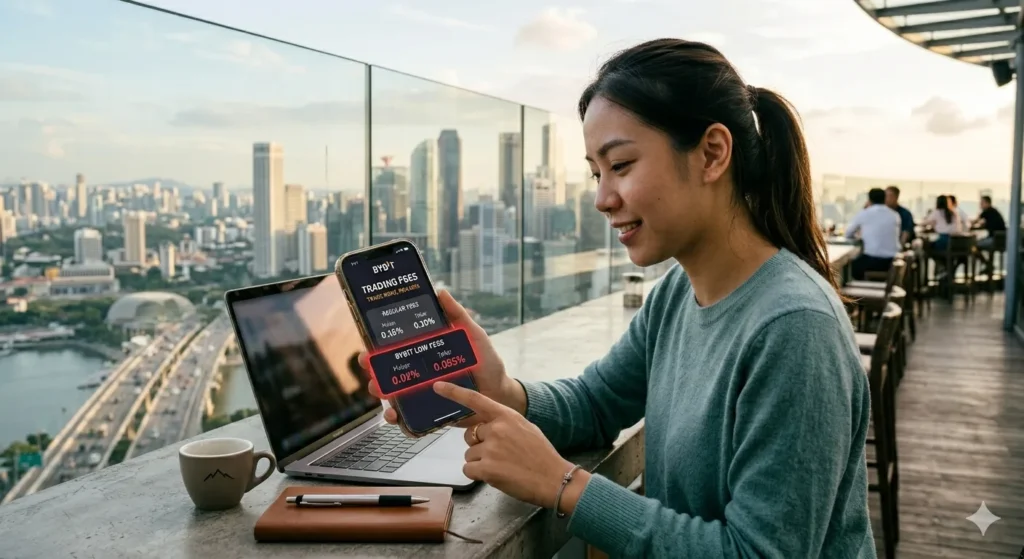
Fees are where the real conversation starts. Because even a “small” percentage can eat into a small budget faster than you expect.
For spot trades, Bybit charges a base fee of 0.1% for both makers and takers. For many futures contracts, the maker fee can start at 0.02% while taker fees may be around 0.055%. There are no deposit fees for on-chain crypto transfers on Bybit, and VIP users may unlock lower rates.
Now, 0.1% sounds tiny. And it is, until you’re making 30 trades a month. Then it starts adding up. But compared to some of the bigger names in the industry, Bybit is genuinely competitive.
Bybit also offers zero trading fees on select spot trading pairs, which is a solid perk if you are trading popular pairs like BTC/USDT. This is something not every exchange advertises clearly, so it’s worth checking the specific pair before you trade.
The maker-taker model is standard across most exchanges. As a quick refresher:
- Maker: You place a limit order that sits in the order book waiting to be filled. You “make” liquidity. Bybit rewards this with lower fees.
- Taker: You place a market order that fills immediately. You “take” liquidity. Slightly higher fees apply.
For low-budget users, placing limit orders wherever possible is one of the easiest ways to cut costs; more on that in the tips section.
How Much Will You Pay in Fees?
Let’s make this concrete. No vague percentages, real math.
Say you start with $100 and make 10 trades per month, each worth $50 (you’re not going all-in every time, smart).
| Fee Type | Rate | Cost Per Trade | Monthly Cost (10 trades) |
| Spot Taker Fee | 0.10% | $0.05 | $0.50 |
| Spot Maker Fee | 0.10% | $0.05 | $0.50 |
| Withdrawal (USDT TRC-20) | ~1 USDT flat | — | $1 per withdrawal |
So if you trade casually and withdraw once a month, you’re looking at roughly $1.50 to $2.50 in total fees. That’s a coffee, not a catastrophe.
The difference between exchanges might look small, but on a $10,000 trade, the gap between Binance’s 0.075% and Coinbase’s 0.60% is $7.50 vs $60. For active traders, this adds up to thousands per year. Bybit sits comfortably in the affordable range at 0.10%.
Where fees get sneaky for small budgets is on credit card purchases. As of August 2025, EU cards show a 1.10% provider fee and non-EU cards 2.70%–3.05% for simple buy purchases, with the final all-in rate shown before you confirm. So if you’re funding through a card, always use the advanced trading interface rather than the simple buy button. The difference matters.
Best Features for Budget Traders
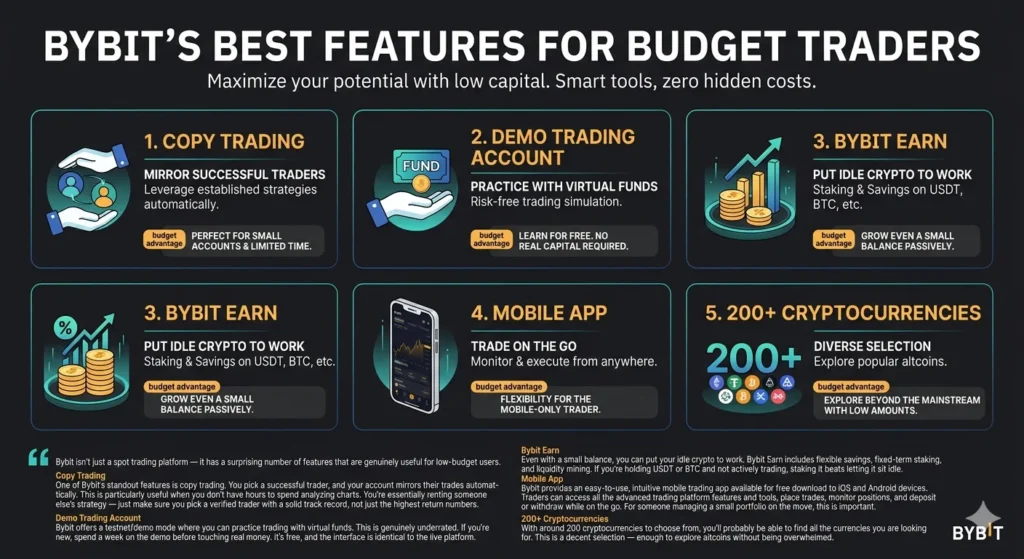
Bybit isn’t just a spot trading platform; it has a surprising number of features that are genuinely useful for low-budget users.
Copy Trading One of Bybit’s standout features is copy trading. You pick a successful trader, and your account mirrors their trades automatically. This is particularly useful when you don’t have hours to spend analyzing charts. You’re essentially renting someone else’s strategy — just make sure you pick a verified trader with a solid track record, not just the highest return numbers.
Demo Trading Account Bybit offers a testnet/demo mode where you can practice trading with virtual funds. This is genuinely underrated. If you’re new, spend a week on the demo before touching real money. It’s free, and the interface is identical to the live platform.
Bybit Earn: Even with a small balance, you can put your idle crypto to work. Bybit Earn includes flexible savings, fixed-term staking, and liquidity mining. If you’re holding USDT or BTC and not actively trading, staking it beats letting it sit idle.
Mobile App Bybit provides an easy-to-use, intuitive mobile trading app available for free download to iOS and Android devices. Traders can access all the advanced trading platform features and tools, place trades, monitor positions, and deposit or withdraw while on the go. For someone managing a small portfolio on the move, this is important.
200+ Cryptocurrencies With around 200 cryptocurrencies to choose from, you’ll probably be able to find all the currencies you are looking for. This is a decent selection, enough to explore altcoins without being overwhelmed.
Pros and Cons for Small Traders
✅ Pros
- Low minimum deposit (effectively $1–$2)
- Competitive 0.10% spot fees with zero-fee pairs available
- No fee on crypto deposits
- Demo account for risk-free practice
- Copy trading for beginners
- Strong mobile app
- Earn products for passive income on idle assets
- Monthly Proof of Reserves verified by Hacken, with a reserve ratio exceeding 100% across all key assets
❌ Cons
- Not available in the US, UK, Singapore, and several other major markets
- Card purchases carry 1.10%–3.05% provider fees
- The derivatives/futures section can be intimidating for complete beginners
- Suffered a major security breach in February 2025, where an estimated $1.46–$1.5 billion was stolen from an Ethereum cold wallet (though reserves were replenished within approximately 72 hours)
- Self-attested Proof of Reserves rather than a fully independent third-party audit for some aspects
Security for Bybit Low-Budget Users
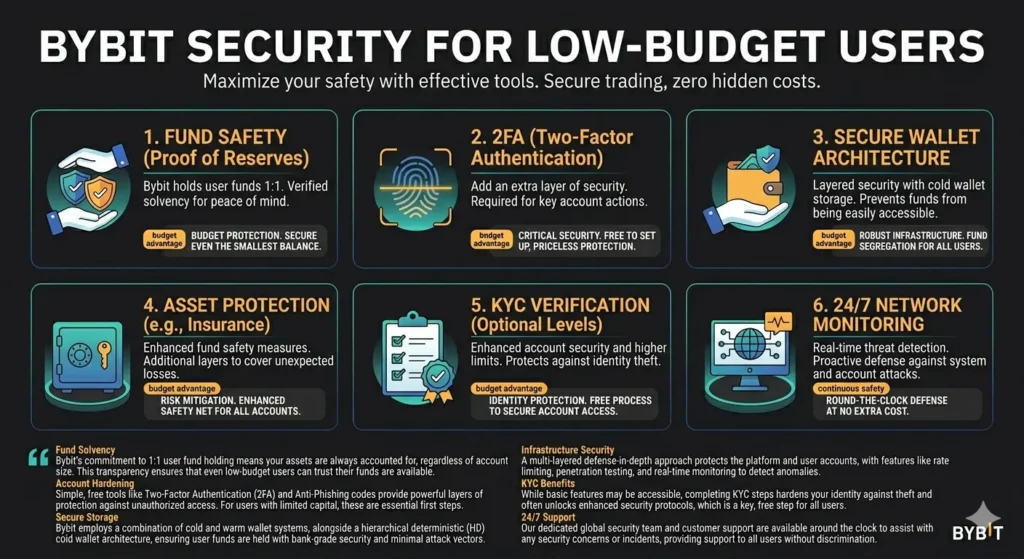
Let’s address the elephant in the room.
In February 2025, Bybit suffered an estimated $1.46–$1.5B loss after attackers compromised an Ethereum cold wallet through a sophisticated phishing attack that manipulated the Safe multisig signing interface. The stolen assets included ETH and liquid-staking tokens, and investigators later linked the operation to the Lazarus Group.
That’s a serious breach. It’s worth knowing about. But here’s the other side of that story:
Bybit publicly stated that customer assets remained fully backed. The exchange kept withdrawals running through the immediate rush, with hundreds of thousands of withdrawal requests processed after the breach. Bybit’s early response centered on transparency, rapid withdrawal processing, and recovery efforts, including a program offering up to 10% of recovered funds as a bounty to security teams and responders.
So the bad news: it happened. The good news: user funds were protected, and the exchange did not crumble.
Post-breach, Bybit significantly upgraded its defenses. Bybit’s security architecture now includes cold wallet storage, multi-signature authorization, TEE (Trusted Execution Environments), and TSS (Threshold Signature Schemes) to protect assets from internal and external threats. Users benefit from 2FA, anti-phishing codes, address whitelisting, and session monitoring, with an optional one-click account freeze for added self-protection. The platform also uses AI to detect anomalies in high-value transactions.
Bybit’s Proof of Reserves audit, verified by Hacken in February 2025, confirmed that the exchange maintains a reserve ratio exceeding 100%, demonstrating its solvency and resilience even following the breach.
For low-budget users, the practical security steps are:
- Enable Google Authenticator (2FA) immediately after signup
- Set up an anti-phishing code so you can verify official Bybit emails
- Whitelist only your own withdrawal addresses
- Never leave large amounts sitting in your exchange account. Withdraw to a personal wallet if you’re not actively trading
Compared to Other Exchanges
How does Bybit actually stack up against the competition for someone on a tight budget?
Binance has the lowest standard spot fees at 0.075% for both makers and takers. With BNB payment discounts and referral rebates, effective fees can drop below 0.04%. Bybit charges 0.10%, so Binance wins on pure spot fees, but only slightly. The practical difference on a $100 trade is $0.025. Not life-changing.
Coinbase charges significantly higher fees than most competitors, with simple purchases often costing 1–2% or more. The advanced trading interface offers lower fees, but they’re still not as competitive as Binance or Bybit. For a low-budget user, Coinbase fees can be genuinely painful.
Here’s a quick comparison for a $500 spot trade:
| Exchange | Spot Fee | Cost on $500 Trade |
| Binance | 0.075% | $0.375 |
| Bybit | 0.10% | $0.50 |
| Kraken Pro | 0.10%–0.16% | $0.50–$0.80 |
| Coinbase Advanced | 0.40%–0.60% | $2.00–$3.00 |
For derivatives specifically, Bybit has a real edge. Independent data placed Bybit among the top three venues for perpetuals by market share in the first half of 2025. If you ever move into futures trading, Bybit is one of the better homes for it.
Tips to Reduce Fees on Bybit
These are practical, not theoretical. They work.
1. Use the Advanced Trading Interface. Never use the “Buy Crypto” simple purchase button if you care about fees. Always go through the Spot or Derivatives trading interface. The simple buy feature includes card provider fees that stack on top of the trading fee.
2. Place Limit Orders (Be a Maker) Market orders fill instantly and charge taker fees. Limit orders wait for your price and charge maker fees. On Bybit, both are currently 0.10% for standard spot , but on some pairs and for higher-volume tiers, makers get lower rates. Get into the habit anyway; it’s the professional approach.
3. Use TRC-20 for USDT Withdrawals. Some USDT withdrawals on TRC-20 cost as little as 1 USDT, while other networks charge more. Always check the withdrawal fee before selecting a network. TRC-20 is usually the cheapest option for USDT transfers.
4. Check Zero-Fee Spot Pairs Bybit offers zero trading fees on select spot trading pairs. Before trading, check if your pair is on that zero-fee list. It’s free money left on the table if you ignore it.
5. Use the Referral Program. The Bybit referral program enables you to invite friends and earn lucrative referral bonuses. Referrers can earn up to 30% commission for referring new users. If you bring in one friend who trades actively, the commission can offset a meaningful chunk of your own fees.
6. Deposit via Crypto, Not Card. Card deposits carry provider fees of 1.10%–3.05%. If you already hold crypto elsewhere, transferring it to Bybit is free (you just pay the network fee, which is often minimal on cheaper chains).
Budget User Action Plan
You have $50, and you want to start on Bybit. Here’s what to do — step by step.
Step 1 – Create Your Account. Sign up at Bybit. Complete KYC (ID verification). This is required for most features and withdrawal limits.
Step 2 – Enable All Security Features Before depositing anything: enable Google Authenticator 2FA, set an anti-phishing code, and whitelist your personal wallet address for withdrawals.
Step 3 – Start with the Demo Account. Spend 3–5 days on Bybit Testnet. Practice placing limit orders, reading charts, and executing a few trades. You’ll make mistakes here, which is exactly why the demo exists.
Step 4 – Make Your First Deposit. Deposit via crypto from another wallet if possible (avoids card fees). Start with $20–$50 maximum. Do not put in money you cannot afford to lose.
Step 5 – Trade One Simple Pair Start with BTC/USDT or ETH/USDT. These are the most liquid, have the lowest spreads, and are easiest to follow. Do not jump into 30 altcoins at once.
Step 6 – Explore Bybit Earn. Once you’re comfortable, put any idle USDT into a flexible savings product. Even a small yield beats zero.
Step 7 – Withdraw Profits to a Personal Wallet. Don’t keep growing balances on the exchange indefinitely. Withdraw to your own hardware or software wallet regularly. This is just good crypto hygiene.
Final Verdict & Rating (For Low-Budget Users)
Here’s the honest scorecard:
| Category | Rating | Notes |
| Minimum Deposit | ⭐⭐⭐⭐⭐ | As low as $1–$2; no barriers |
| Trading Fees | ⭐⭐⭐⭐ | 0.10% spot; competitive, not cheapest |
| Security | ⭐⭐⭐⭐ | Strong post-breach measures; 2025 incident is a concern |
| Features for Beginners | ⭐⭐⭐⭐ | Demo account, copy trading, mobile app |
| Earning Products | ⭐⭐⭐⭐ | Solid options for idle funds |
| Geographic Access | ⭐⭐⭐ | Not available in US, UK, Singapore |
Overall Rating: 4/5 for Low-Budget Users
Bybit is genuinely one of the more accessible major exchanges for someone starting with a small amount. The fees are fair, the barrier to entry is low, and the tools especially copy trading and the demo account , give beginners a fighting chance.
The February 2025 security incident deserves honest weight in any review. It happened. It was serious. But Bybit’s response ,replenishing reserves within 72 hours, maintaining withdrawals, and upgrading its entire security stack , showed a platform that can handle a crisis without abandoning its users.
Is Bybit Worth It for Beginners with a Small Budget?
Yes – with conditions.
Bybit is worth it if you’re outside the restricted regions, willing to learn the interface, and disciplined enough not to jump into leveraged trading before you’re ready. The spot market is perfectly usable with $20–$100, the fees won’t ruin you, and the earning products give your idle crypto something to do.
It’s not worth it if you’re looking for a completely hands-off, zero-learning-curve experience. Bybit has depth, and that depth can be confusing early on. The derivatives section in particular, is not somewhere a complete beginner should wander without preparation.
Start small, use the demo, enable every security feature, and treat your first month as a learning investment rather than a money-making exercise. That mindset will serve you better than any exchange choice.
FAQ
Q: What is the minimum deposit on Bybit?
The minimum order amount for most trading pairs is $1 USD. For fiat deposits, the minimum is $2 USD, though this can vary based on payment method and location.
Q: Does Bybit charge deposit fees?
Bybit does not charge fees for depositing cryptocurrency. However, a miner’s fee may apply depending on the blockchain network used.
Q: What are Bybit’s spot trading fees?
Bybit charges a base fee of 0.1% for both makers and takers on spot trades.
Q: Is Bybit safe for beginners?
Bybit’s security features include cold wallet storage, multi-signature authorization, 2FA, anti-phishing codes, address whitelisting, and session monitoring. Users also have the option of a one-click account freeze. It is a secure platform if users enable all available security tools, though no exchange is completely risk-free.
Q: Can I use Bybit in the US?
Bybit is not licensed or regulated to offer its exchange services to US residents. It restricts access for users in the United States, and circumventing this restriction via a VPN can violate platform terms and create legal risk.
Q: Does Bybit offer a demo account?
Yes. Bybit offers a Testnet environment where users can practice trading with virtual funds before committing real money. It’s free and uses the same interface as the live platform.
Q: What is Bybit’s Proof of Reserves?
Bybit publishes monthly Proof of Reserves snapshots verified by Hacken, confirming that it maintains a reserve ratio of over 100% for all key assets.
Q: What is the cheapest way to withdraw USDT from Bybit?
Some USDT withdrawals on the TRC-20 network cost as little as 1 USDT, making it one of the most cost-effective withdrawal options on the platform.
Final Verdict
Bybit works for low-budget users. The platform’s low entry point, reasonable fees, and beginner-friendly tools like copy trading and the demo account make it a legitimate option for someone starting with $20–$100.
The 2025 security breach is a real part of this exchange’s history, and you should know about it. But Bybit’s response, fast, transparent, and financially complete, demonstrated that the platform prioritizes user protection even under extreme pressure.
Use the demo account first. Enable every security feature before depositing. Start with spot trading, not derivatives. And never deposit money you can’t afford to lose. Do those four things, and Bybit is as solid a starting point as any exchange in this price range.
