
I’ll start by checking your website for real internal link targets, then pull current fee and regulation data from official sources.# Best Exchange for Professional Traders
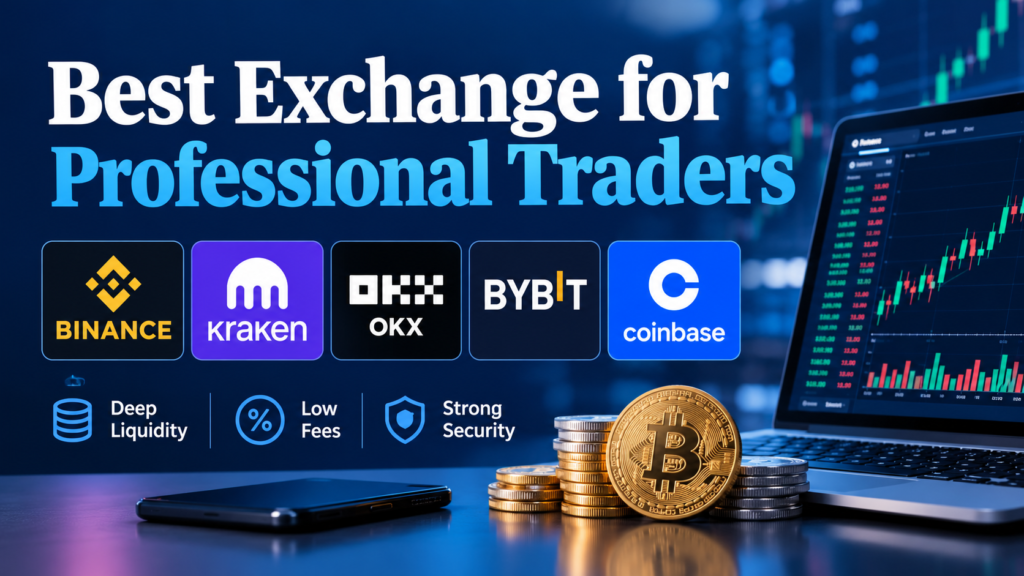
Professional traders don’t pick a crypto exchange for its logo. They pick it for deep order books, low fees, and a platform that holds up when the market gets loud. This guide compares five exchanges on those points. It draws on published fee schedules, court records, and each platform’s own security pages.
This article is educational, not financial advice. Crypto trading carries a high risk of loss.
Quick Answer: Best Exchange for Professional Traders
Binance is the best exchange for professional traders who want deep liquidity, high leverage, and low base fees. It also carries the heaviest legal baggage, so the pick comes with homework.
Here is how the other four fit:
- Kraken Pro: best for compliance-minded traders who want documented security.
- OKX: lowest base spot maker fee of the five.
- Bybit: best fit for derivatives-heavy strategies.
- Coinbase Advanced: best for US traders who want a publicly listed counterparty.
No platform wins every category. The best exchange for professional traders depends on your volume, your region, and how much regulatory risk you accept.
Comparison Table: Best Exchange for Professional Traders
| Exchange | Best For | Spot Fee at Entry (Maker / Taker) | Futures Fee at Entry (Maker / Taker) | Main Caveat |
|---|---|---|---|---|
| Binance | Liquidity and leverage | 0.10% / 0.10% | 0.02% / 0.05% | Guilty plea over AML failures |
| Kraken Pro | Security and compliance | 0.40% / 0.80% | 0.02% / 0.05% | Highest entry fees here |
| OKX | Low spot maker fees | 0.08% / 0.10% | 0.02% / 0.05% | Guilty plea over unlicensed US operations |
| Bybit | Derivatives | 0.10% / 0.10% | 0.02% / 0.055% | Large exchange hack |
| Coinbase Advanced | US-regulated trading | 0.40% / 0.60% | Not covered | Higher fees, fewer coins |
Fee schedules change. Confirm live rates before you fund an account.
Binance Review
Size matters on an order book. The US Department of Justice calls Binance the world’s largest cryptocurrency exchange. More traders usually mean tighter spreads and less slippage on big fills.
Spot fees start at 0.10% for makers and takers. Pay fees in BNB and Binance takes 25% off, which lands you at 0.075%. Futures start at 0.02% for makers and 0.05% for takers, and VIP levels cut those rates as your volume grows.
Binance also offers high leverage. Our own comparison lists up to 125x on Binance versus 100x on Bybit. Leverage is a power tool. It builds houses, and it also removes thumbs.
Now the weak spot. Binance and its founder pleaded guilty to federal charges tied to anti-money-laundering failures. The company agreed to pay over $4 billion and to work with a compliance monitor, according to the Justice Department. US residents also face limits because Binance.US runs as a separate and narrower platform.
Bottom line: Binance suits liquidity-focused traders outside the US who accept the compliance history.
Read more: Binance vs Bybit 2026: Fees, Security & Full Comparison
Kraken Pro Review

Kraken Pro is the order-book side of Kraken, and it wins on documentation. Kraken’s security page lists an ISO/IEC 27001:2022 certification, a SOC 2 Type 1 examination, and proof-of-reserves audits by an external auditor. It also supports FIDO2 passkeys and granular API key permissions.
The fees tell a different story at the start. The official schedule opens at 0.40% maker and 0.80% taker. Your tier rises with the better of two measures: 30-day spot volume or assets held on the platform.
The ladder rewards size. At $100K in monthly volume, the schedule lists 0.12% maker and 0.25% taker. At $10M or more, makers pay 0.00%, and takers pay 0.10%. The top Pro 5 tier, at $500M in volume, lists a 0.05% taker fee.
Kraken Pro futures start at 0.02% maker and 0.05% taker. Futures are not available to customers in the US, Canada, or New Zealand. US customers can trade 11,000+ stocks and ETFs commission-free on Kraken Pro, which helps traders who mix asset classes.
Bottom line: Kraken Pro fits high-volume or high-balance traders who put security records ahead of entry-level pricing.
OKX Review
OKX has the lowest base spot maker fee in this group. Regular users pay 0.08% maker and 0.10% taker on spot, and 0.02% and 0.05% on futures. On a $10,000 spot trade, that works out to $8 as a maker or $10 as a taker.
OKX lists more than 350 coins. That covers most professional strategies without sending you to a second venue.
The compliance record needs attention. OKX’s operator pleaded guilty to running an unlicensed money transmitting business in the US and agreed to pay more than $504 million. The DOJ said OKX knew the US registration rules and chose not to follow them.
OKX does hold a VARA licence in Dubai. Our UAE guide covers how that regulator works and how to check any licence yourself.
Bottom line: OKX works well for fee-sensitive spot and futures traders who accept its past enforcement action.
Read more: Best Crypto Exchanges in UAE (2026)
Bybit Review
Bybit built its name on derivatives. Its base rates are 0.10% for spot and 0.02% maker / 0.055% taker on perpetuals. Paying fees in MNT adds a 25% discount on spot and 10% on futures.
Order type matters more than the venue here. On a $10,000 trade, a taker round trip costs $11, and a maker round trip costs $4. Limit orders pay for themselves quickly.
Security is the sore spot. The FBI attributed the theft of roughly $1.5 billion from Bybit to North Korea’s TraderTraitor group. The attackers swapped a benign Safe{Wallet} JavaScript file for malicious code aimed at Bybit’s Ethereum cold wallet. Cold storage helps, but it can’t fix a compromised signing workflow.
Our comparison lists Bybit as fully blocked in the US.
Bottom line: Bybit suits derivatives specialists outside the US who understand the hack history.
Read more: Bybit Fees Review: Spot, Futures, Hidden Costs & How to Pay Less
Coinbase Advanced Review
Coinbase runs two pricing systems under one login. The simple interface charges a spread plus a fee. Coinbase Advanced uses maker-taker pricing with no spread on order-book trades. Professional traders should never touch the simple screen. It costs more, and your P&L will notice.
Entry fees are 0.40% maker and 0.60% taker below $10,000 in 30-day volume. At the top tier, above $400 million, the schedule falls to 0.00% maker and 0.04% taker. Tiers refresh hourly.
The regulatory profile is the strongest of the five for US traders. Coinbase trades on Nasdaq, registers with FinCEN as a money services business, and holds a NYDFS BitLicense. The company told the SEC it secures about 98% of customer assets in offline storage.
The trade-off is selection. Our review puts Coinbase near 275+ coins against 500+ on Binance.
Bottom line: Coinbase Advanced fits US-based professionals who value regulatory clarity over the lowest fees.
Read more: Coinbase Review for Beginners 2026: Read Before Trading
How We Ranked the Best Exchange for Professional Traders
We scored each platform on six factors:
- Fee structure: entry rates, tier thresholds, and discount tokens.
- Liquidity and tools: order types, leverage, and derivatives depth.
- Security record: past hacks, audits, and custody documentation.
- Regulatory standing: licences, court records, and enforcement actions.
- Transparency: how clearly the exchange publishes its fees and reserves.
- Regional access: whether professionals in different countries can open an account.
We used Kraken’s own published schedule for Kraken. For the other four, we relied on reputable published reviews and our earlier comparisons. That is why we keep telling you to check live rates.
Want an even cheaper spot option? Our MEXC review covers a platform that charges $0 on a $1,000 limit order, with a different regulatory trade-off.
Read more: MEXC Review for Beginners 2026: Fees, Safety & Features
Fees Comparison for the Best Exchange for Professional Traders
| Exchange | Spot Entry (Maker / Taker) | Best Published Spot Tier | Main Discount Lever |
|---|---|---|---|
| Binance | 0.10% / 0.10% | Lower through VIP levels | BNB pays 25% off |
| Kraken Pro | 0.40% / 0.80% | 0.00% / 0.05% at Pro 5 | Assets on platform |
| OKX | 0.08% / 0.10% | Lower through VIP levels | Volume and OKB holdings |
| Bybit | 0.10% / 0.10% | Lower through VIP levels | MNT pays 25% off spot |
| Coinbase Advanced | 0.40% / 0.60% | 0.00% / 0.04% | Volume tiers, hourly |
Here is the math on a $100,000 spot trade at entry-tier rates:
- Binance taker: $100
- OKX taker: $100
- Bybit taker: $100
- Coinbase taker: $600
- Kraken taker: $800
Real volume pushes you down each ladder, and Kraken’s tiers drop fast once you scale. Entry rates still show which platforms charge you for showing up.
Four habits cut costs on any of them:
- Use limit orders. Maker fees run lower at every tier on every exchange here.
- Consolidate volume. Spreading trades across five venues keeps you in five entry tiers.
- Weigh discount tokens carefully. A fee token saves money, but you also take on the token’s price risk.
- Check funding costs. Kraken warns that deposit and withdrawal fees vary by method and currency, and other exchanges work the same way.
Security & Regulation
Fees mean little if you can’t withdraw your funds. Here is what the records show.
Kraken publishes the most documentation. It lists its ISO/IEC 27001:2022 certification, SOC 2 Type 1 exam, and proof-of-reserves process on its security page. Kraken also warns that no formal rules define a proof-of-reserves audit, which is an honest disclaimer.
Coinbase answers to public-market rules. Nasdaq listing, SEC reporting, and US licences give you more visibility than a private offshore operator offers.
Binance and OKX both resolved US criminal cases over anti-money-laundering failures. Binance agreed to a monitor and a penalty above $4 billion. OKX agreed to more than $504 million in penalties. These cases involved compliance failures. Neither DOJ release describes a customer-fund hack.
Bybit suffered a theft the FBI tied to North Korea. That shows how even a large exchange can fall to a supply-chain attack.
Regulation lowers some risks and ignores others. Protect yourself with these steps:
- Keep only active trading capital on an exchange.
- Use hardware-key or passkey 2FA where offered.
- Create API keys without withdrawal rights.
- Verify any licence on the regulator’s own register.
Our regional guides show how licence checks work in practice. See Best Crypto Exchanges for Canada (2026) and the UAE guide above.
Read more: Best Crypto Exchanges for Canada (2026) – Ranked & Reviewed
Frequently Asked Questions
Which is the best exchange for professional traders?
Binance leads on liquidity, leverage, and low base fees. Kraken Pro, OKX, Bybit, and Coinbase Advanced each win a narrower use case. Your region and volume decide the final pick.
What is the difference between maker and taker fees?
A maker adds a resting limit order to the book. A taker removes liquidity with an order that fills at once. Makers pay less on every exchange in this guide.
Which exchange has the lowest fees?
At the entry level, OKX has the lowest spot maker rate at 0.08%. At the top published tiers, Coinbase lists 0.00% maker and 0.04% taker, and Kraken lists 0.00% and 0.05%. Those top tiers need very large volume.
Can US traders use these exchanges?
Coinbase and Kraken serve US customers. Our comparison lists Binance.com as blocked for the US, with Binance.US as a limited alternative, and Bybit as fully blocked. Check your own eligibility before you sign up.
Does regulation make an exchange safe?
No. Regulation sets rules and gives regulators leverage. It does not stop every hack or failure, so split your funds and protect your accounts.
Do these fees change?
Yes. Kraken’s own schedule shows tier tables that exchanges revise over time. Always read the live fee page before you trade.
Final Verdict
Binance earns the top spot for professional traders who prioritize liquidity and leverage, as long as they accept its compliance history. Kraken Pro takes the crown for documented security. OKX takes it for cheap spot making. Bybit takes it for derivatives. Coinbase Advanced takes it for US-regulated simplicity.
Pick the platform that matches your volume and your tolerance for regulatory risk. Then use limit orders, protect your keys, and verify fees yourself. Even the best exchange for professional traders can’t fix sloppy habits.

