

Trade $50 million a month at a 0.10% fee, and you pay $50,000. Trade the same volume at 0.05%, and you pay $25,000. That gap buys a lot of coffee, or one very smug accountant.
For active traders, fees are not a footnote. They are a second opponent across the table. The best crypto exchange for high-volume traders keeps that opponent small, protects your funds, and stays online when markets move fast.
This guide compares five exchanges: Binance, Kraken, Bybit, OKX and Bitget. We built it from each exchange’s published fee schedules, regulator announcements, and security incident reports. Where a number comes from a third-party fee guide instead of the exchange itself, we say so.
This article is general information, not financial advice. Fee schedules change, so check each exchange’s live fee page before you move size.
Quick Answer: Best Crypto Exchange for High-Volume Traders
Binance is our top pick for traders who can legally use it. Its top VIP tier posts the lowest published spot rates in this group, and Datawallet’s comparison describes its order books as the deepest.
Kraken is the better pick if regulatory comfort matters more to you than the lowest taker rate. Its official schedule charges 0% maker fees from $50 million in monthly spot volume.
Here is how the five split by trading style:
- Lowest top-tier spot fees: Binance
- Best for regulated, maker-heavy flow: Kraken
- Best for derivatives traders: Bybit
- Best for a unified margin account: OKX
- Best for copy trading: Bitget, with a caution we explain below
New to all this? Start with our guide to the 5 Best Crypto Exchanges for Beginners and come back once your volume grows.
Read more: 5 Best Crypto Exchanges for Beginners (2026)
Comparison Table: Best Crypto Exchange for High-Volume Traders
| Exchange | Best For | Base Spot Fee (Maker / Taker) | Top-Tier Spot Fee (Maker / Taker) | Base Futures Fee (Maker / Taker) | Regulation Note |
|---|---|---|---|---|---|
| Binance | Deep liquidity | 0.10% / 0.10% | 0.011% / 0.023% (VIP 9) | 0.02% / 0.05% | ADGM authorisation; 2023 US guilty plea |
| Kraken | Regulated, maker-heavy trading | 0.40% / 0.80% (Pro Tier 1) | 0% / 0.05% (Pro 5) | 0.02% / 0.05% | MiCA, Central Bank of Ireland |
| Bybit | Derivatives | 0.10% / 0.10% | 0.03% / 0.045% (Supreme VIP) | 0.02% / 0.055% | MiCA via Bybit EU (Austria); 2025 hack |
| OKX | Unified margin | 0.08% / 0.10% | Lower with VIP tiers | 0.02% / 0.05% | MiCA, Malta |
| Bitget | Copy trading | 0.10% / 0.10% (0.08% with BGB) | 0% / 0.03% (VIP 7, third-party figure) | 0.02% / 0.06% | 2026 hot-wallet incident; protection fund |
Top-tier rates need serious volume, token holdings, or both. We explain each threshold in the reviews below.
Binance Review
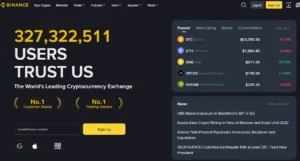
Binance is the heavyweight of this list. It charges 0.10% maker and 0.10% taker on spot at the base level, according to BitDegree’s fee guide. Paying fees in BNB cuts that by 25%.
The VIP ladder runs from level 0 to level 9. Each level depends on your 30-day volume and your BNB balance. At VIP 9, spot fees fall to 0.011% maker and 0.023% taker. That tier needs about $4 billion in monthly volume and 5,500 BNB, so it is a whale club, not a goal for most traders.
Futures look better early. Datawallet’s VIP breakdown lists USD-M futures at 0.02% maker and 0.05% taker for base accounts. At VIP 9, the maker fee reaches 0%, and the taker fee drops to 0.017%.
Liquidity is Binance’s real edge. Deep books mean less slippage when you trade size.
Regulation is the complication. In 2023, Binance pleaded guilty to US charges tied to anti-money-laundering and sanctions failures. The US Department of Justice says Binance agreed to pay $4.3 billion and accept an independent monitor. Since then, Abu Dhabi’s regulator approved Binance’s global platform under ADGM’s framework.
Availability also varies. US residents cannot use the global platform, so check your country first.
Best for: Traders who want deep liquidity and the lowest published top-tier rates.
Watch out for: The legal history and country restrictions.
Read more: Best Crypto Exchanges in UAE (2026)
Kraken Review

Kraken wins on transparency. Its official fee schedule lists every tier, and the top ones are friendly to volume.
At $50 million or more in 30-day spot volume, Kraken Pro 1 charges 0% maker and 0.09% taker. At $500 million or more, Pro 5 charges 0% maker and 0.05% taker.
The entry tier hurts. According to Kraken’s own blog, Tier 1 starts at 0.40% maker and 0.80% taker. The same post explains that Kraken now sets your tier by your best of three measures: spot volume, futures volume, or assets on the platform. That helps traders who hold large balances but trade less often.
Futures are cheaper. Datawallet reports entry-level futures fees of 0.02% maker and 0.05% taker. At the highest tiers, makers earn a 0.006% rebate and takers pay 0.0125%.
Regulation is Kraken’s strongest card. Its EU entity holds a MiCA licence from the Central Bank of Ireland, per Datawallet’s MiCA review.
Best for: Maker-heavy traders who value regulation and a clear fee table.
Watch out for: The high entry-tier fees and a taker rate that stays above Binance’s at mid volume.
Read more: Best Crypto Exchanges for Canada (2026) – Ranked & Reviewed
Bybit Review
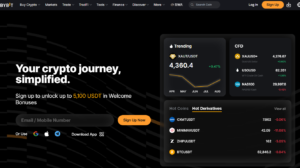
Bybit built its name on derivatives, and its fee ladder shows it. Bybit’s official help centre lists base spot fees of 0.10% maker and 0.10% taker. Perpetual futures start at 0.02% maker and 0.055% taker.
The top of the ladder is where high-volume traders live. Supreme VIP drops spot fees to 0.03% maker and 0.045% taker. Perpetuals fall to 0% maker and 0.03% taker.
The thresholds are reachable. Bybit’s VIP table lists VIP 5 at $50 million in 30-day spot volume and Supreme VIP at $100 million. Bybit’s fee structure page also shows separate, higher rates for special zones such as the Adventure Zone, so read the fine print before trading new tokens.
Now the uncomfortable part. In February 2025, attackers stole about $1.5 billion in crypto from Bybit. The FBI attributed the theft to North Korea’s “TraderTraitor” group. It was the largest crypto exchange theft on record at the time.
That does not make Bybit unusable. It does mean you should never leave idle funds there.
For European users, Bybit EU GmbH holds a MiCA licence from Austria’s financial regulator.
Best for: Derivatives traders chasing low perpetual fees.
Watch out for: The 2025 breach and the special-zone fee schedules.
Read more: Bybit Review After 7 Days of Use (2026) – Fees, Safety & Real Experience
OKX Review
OKX undercuts its rivals at the start. According to OKX’s own fee framework, regular users pay 0.08% maker and 0.10% taker on spot. Regular status covers accounts under $100,000 in assets or $1 million in 30-day volume.
Futures start at 0.02% maker and 0.05% taker, per OKX’s help page.
OKX also lets you cut fees by holding its OKB token. Cryptsy’s fee guide says holding 2,000 OKB lifts you to Lv5 pricing, even if your trading volume never reaches $2 million. The same guide reports that top VIP tiers push the taker fee near 0.015%, with maker rebates at the highest levels.
Traders like OKX for its single account. CryptoSlate’s review highlights a unified account that shares collateral across products, and monthly proof-of-reserves reports.
On regulation, OKX Europe Limited holds a MiCA licence from Malta’s MFSA.
Best for: Active traders who want one margin account across spot, futures and options.
Watch out for: Two separate fee schedules (spot and derivatives) that people often mix up.
Read more: REPLACE WITH YOUR OKX REVIEW TITLE
Bitget Review

Bitget looks great on paper. Bitget’s fee FAQ lists standard spot fees of 0.1% for makers and takers, and futures fees of 0.02% maker and 0.06% taker. Paying with BGB, its native token, reduces the spot fee to 0.08%.
At the top, a third-party review reports VIP 7 reaching 0% maker and 0.03% taker on spot. Bitget is also known for copy trading, and our own review covers it in detail.
Now, the caution. In September 2026, Bitget reported unauthorised transfers from its hot wallets. Its incident update says the team fixed the vulnerability and that user balances were unaffected. The company said its Protection Fund covers the financial impact, and it brought in Mandiant and SlowMist to investigate. The Block reports that withdrawals returned in phases. Yahoo Finance puts the loss at about $387.5 million and the fund at more than $464 million.
Bitget did what a responsible exchange should: it disclosed, paused and covered the loss. Still, a recent incident belongs in your risk calculation. If you use Bitget, keep balances small and watch for the final investigation findings.
Best for: Copy-trading fans who accept the recent incident risk.
Watch out for: The September 2026 breach and the limited coin list compared with some rivals.
Read more: Bitget Review 2026: Honest Pros, Cons & Everything You Need to Know
How We Ranked the Best Crypto Exchange for High-Volume Traders
We scored each exchange on five questions:
- How low do fees fall at volume? We used published fee schedules, not marketing headlines.
- How reachable are the top tiers? A 0.011% fee means little if it needs $4 billion a month.
- What does the security record show? We counted hacks, disclosures and how each exchange responded.
- What is the regulatory standing? We looked at licences, settlements and regional availability.
- Does the product fit active trading? We checked margin, futures, API-style tools and liquidity.
We built this ranking from public records. We did not run live trades on each platform for this piece, and we did not accept any exchange’s claims at face value. For more about the people behind these reviews, see our About page.
Read more: About us – Exchange Review Lab
Fees Comparison for High-Volume Trading Exchanges
Fees decide whether an exchange fits a high-volume strategy. Here is how to read them.
Maker vs Taker: The Fee Split That Matters
A maker order sits on the order book and waits. A taker order fills immediately against an existing order. OKX’s help page explains the split: makers add liquidity and usually pay less.
If your strategy uses limit orders, the maker rate is your real cost. If you chase breakouts with market orders, the taker rate is.
A $50 Million Example
Let’s compare two exchanges with official, volume-based tiers. We assume spot trading only, before any token discounts, and we assume you reach each tier on volume alone.
| 30-Day Spot Volume | Exchange and Tier | All-Maker Cost | All-Taker Cost |
|---|---|---|---|
| $50 million | Kraken Pro 1 (0% / 0.09%) | $0 | $45,000 |
| $50 million | Bybit VIP 5 (0.04% / 0.05%) | $20,000 | $25,000 |
If you trade mostly with limit orders, Kraken wins this round by a mile. If you trade mostly with market orders, Bybit costs about $20,000 less per month.
We left Binance, OKX, and Bitget out of this example. Their tiers mix volume with token holdings or assets, which makes a clean volume-only comparison unfair.
Token Discounts: Free Money With Strings
Binance gives a 25% discount for paying fees in BNB. Bitget offers 0.08% with BGB. OKX rewards OKB holders with lower tiers.
These discounts save real money, but they also tie you to a token whose price can fall. Hold the token only if you would hold it anyway.
Costs Beyond the Trading Fee
Trading fees are not the whole bill. Perpetual futures also charge funding fees. Bitget applies them every eight hours, for example. Withdrawals carry network fees. Spreads matter on any “instant buy” button.
Chasing Even Lower Base Fees?
Our MEXC review lists spot fees of 0% maker and 0.05% taker. Lower fees often come with trade-offs in regulation, so read the full review before you commit.
Read more: MEXC Review for Beginners 2026: Fees, Safety & Features
Coinbase takes the opposite approach. Our review concludes it works best as an easy fiat gateway, not as the lowest-fee choice for high-volume trading.
Read more: Coinbase Review for Beginners 2026: Read before trading
Security & Regulation
Cheap fees mean nothing if your funds vanish. Check both sides before you trade size.
The Security Record
Two of our five exchanges have disclosed major thefts in recent years. Bybit lost about $1.5 billion in 2025, and the FBI blamed North Korean hackers. Bitget reported a hot-wallet breach in September 2026 and says its Protection Fund covers the loss.
Binance has no comparable theft in this list, but it carries a heavy legal record. Kraken and OKX do not appear in these incident reports, though no exchange is risk-free.
Regulation Is a Map, Not a Badge
Licences differ by region. Under the EU’s MiCA rules:
- Kraken holds authorisation from the Central Bank of Ireland.
- Bybit operates in Europe through Bybit EU, authorised in Austria.
- OKX holds authorisation from Malta’s MFSA.
One detail trips up many traders. EU Personal Finance notes that MiCA protections apply only to the authorised EU entity. Your account must sit with that entity, not the global brand.
Binance took a different route. Abu Dhabi’s FSRA authorised its global platform, and the DOJ case record documents the earlier US settlement.
How to Protect Your Capital
- Turn on two-factor authentication. Use an authenticator app, not SMS.
- Set a withdrawal address allowlist. OKX and others support it.
- Keep only trading capital on the exchange. Move the rest to your own wallet.
- Read the proof-of-reserves page. OKX publishes monthly reports, per CryptoSlate.
- Confirm your legal entity. Check which company serves your country.
Frequently Asked Questions
What is the best crypto exchange for high-volume traders?
Binance offers the lowest published top-tier spot fees and deep liquidity. Kraken suits maker-heavy traders who want strong regulation. Your trading style decides the winner.
How much volume counts as high volume?
It depends on the exchange. Bybit’s VIP 1 starts at $1 million in 30-day volume. Kraken’s Pro tiers start at $50 million.
Do maker orders really save money?
Yes. At $50 million in monthly volume, Kraken’s maker fee is 0% and its taker fee is 0.09%. That is a $45,000 difference.
Is it safe to keep large balances on an exchange?
We advise against it. Bybit and Bitget both disclosed large thefts, and protection funds do not guarantee full recovery in every case. Keep trading capital on the exchange and move the rest to self-custody.
Can US traders use these exchanges?
Access varies by country and by product. Binance’s global platform excludes US residents, so check each exchange’s terms for your location before you sign up.
Should I pay fees with the exchange’s token?
Only if you would hold the token anyway. The discount helps, but token price swings can erase the savings.
Final Verdict
There is no single winner for every trader, but there is a smart way to choose.
Pick Binance if you want the deepest liquidity and the lowest published top-tier rates, and you can legally use it. Pick Kraken if you trade mostly with limit orders and value regulation. Pick Bybit if you live in perpetual futures. Pick OKX if you want one account for everything. Treat Bitget as a watch-list candidate until its incident investigation wraps up.
Whatever you choose, do the maths on your own volume before you commit. Then keep your coins somewhere safer than a hot wallet. Your future self, and that smug accountant, will thank you.

