
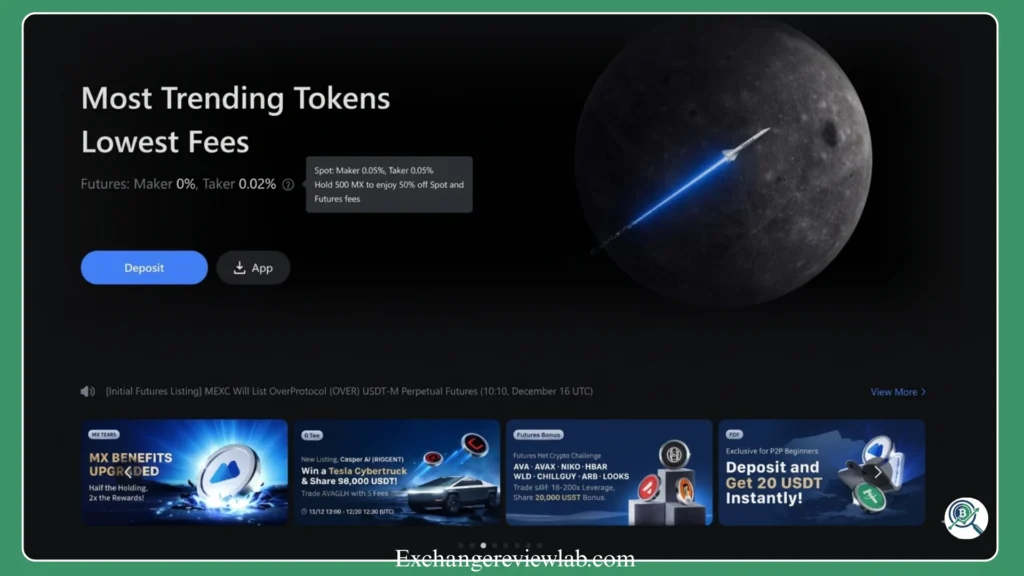
MEXC charges 0% maker and 0.05% taker for spot trading, 0% maker and 0.02% taker for futures, and nothing at all for crypto deposits. You can cut those costs even further with a few smart strategies, and we’ll walk you through all of them.
Why MEXC Fees Actually Matter (More Than You Think)
Here is a scenario most traders have lived through: you make a solid call on a trade, time it well, execute it cleanly and then watch a chunk of your profit disappear quietly into fee deductions. No dramatic market crash. Just fees.
This is why understanding the fee structure of any exchange you use is not optional. It is essential. The difference between a profitable trading strategy and a breakeven one can often be traced back to costs that compound silently in the background.
MEXC has built a reputation for being one of the more fee-friendly exchanges in the market. But is that reputation earned? Let’s look at the actual numbers, understand what you’re paying and when, and find out where you can reduce costs even further.
MEXC Fee Structure at a Glance
Before going into the details, here is a clean summary of what MEXC charges across its main services.
| Service | Maker Fee | Taker Fee |
| Spot Trading | 0.00% | 0.05% |
| Futures (USDT-M & Coin-M) | 0.00% | 0.02% |
| Crypto Deposits | Free | Free |
| Crypto Withdrawals | Varies by asset & network | — |
| P2P Trading | 0.20% | 0.20% |
These numbers are competitive. The industry average for spot taker fees sits around 0.10% to 0.20%, and futures taker fees typically range from 0.04% to 0.06% on major platforms. MEXC comes in well below those benchmarks on both counts.
Understanding the Maker-Taker Model
If you are new to trading, the terms “maker” and “taker” can sound more complicated than they are. Here’s a plain-English explanation.
A maker adds liquidity to the market. When you place a limit order at a price that doesn’t match immediately, your order sits in the order book and waits. You are making liquidity available for others. Exchanges reward this with lower (or zero) fees.
A taker removes liquidity. When you place a market order or a limit order that fills instantly, you are matching with an existing order in the book. You’re taking liquidity out. This typically costs a little more.
On MEXC, makers pay 0% on both spot and futures. Takers pay 0.05% on spot and 0.02% on futures. That 0% maker fee is not a promotional offer — it is the standard rate for most trading pairs on the platform.
MEXC Spot Trading Fees
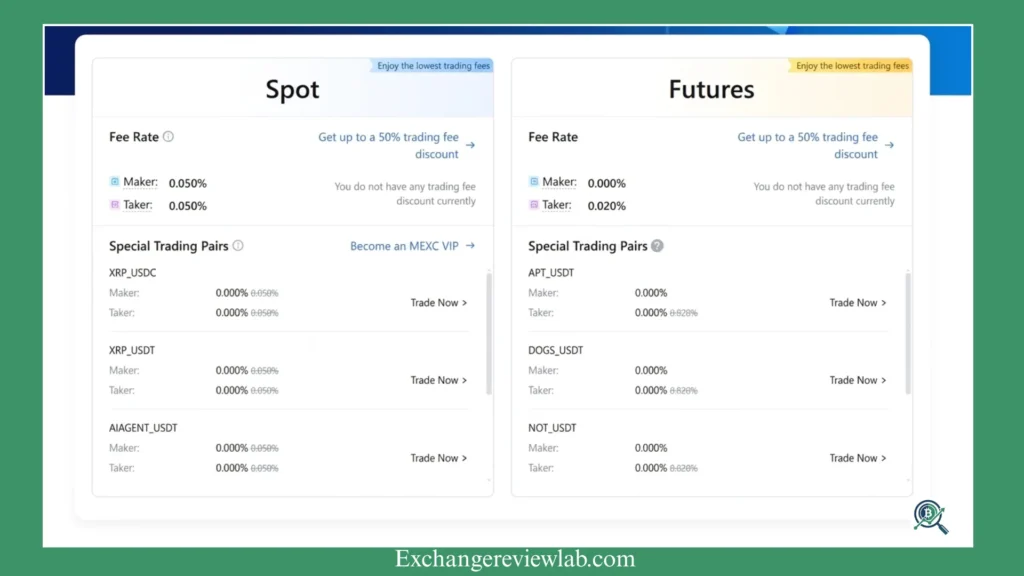
MEXC applies a flat fee structure for spot trading. Whether you’re trading Bitcoin, Ethereum, or a smaller altcoin, the baseline rates remain consistent: 0% for makers and 0.05% for takers.
To put that in perspective: if you’re buying $10,000 worth of BTC as a taker order, the fee comes to $5. That’s it. No tiered complexity, no surprise deductions.
A few important rules about how spot fees work on MEXC:
- Fees are deducted in the currency you receive from the trade. If you buy BTC with USDT, the fee comes out in BTC.
- Unfilled or cancelled orders carry no fees whatsoever. You only pay when a trade actually executes.
- Some trading pairs have special promotional fee rates — we’ll cover those separately.
What Makes the 0% Maker Fee Significant?
The zero maker fee for spot trading is more impactful than it might first appear. Anyone using limit orders to enter or exit positions which includes most active traders with any kind of strategy can execute those trades at literally zero cost. That is not common across the industry.
Platforms like Binance charge 0.10% for makers at the base level. Kraken charges up to 0.25%. Even with volume-based discounts, reaching zero fees on those platforms requires trading volumes that most retail users never hit.
On MEXC, the 0% maker fee is available from day one, to every user.
MEXC Futures Trading Fees
Futures trading is where MEXC’s fee structure becomes genuinely exceptional. The rates here are:
- Maker: 0.000%
- Taker: 0.020%
These apply to both USDT-margined (USDT-M) and Coin-margined (Coin-M) perpetual contracts.
Why 0% Futures Maker Fees Are Rare
Most derivatives platforms charge makers something. Bybit charges up to 0.02% for makers. Binance charges up to 0.02% as well. MEXC charges nothing.
For a futures trader executing at scale, this matters enormously. Futures fees are calculated on the total position value, not your margin. If you open a $100,000 position using 10x leverage with $10,000 in margin, the fee is based on $100,000 — not $10,000.
On a platform charging 0.02% for makers, that same $100,000 position costs $20 to open. On MEXC, it costs $0.
Across 1,000 such trades in a year — a realistic figure for active traders — that’s a $20,000 difference. Not small.
Futures Funding Rates
One cost that new futures traders sometimes overlook is the funding rate. This isn’t a fee charged by MEXC — it’s a payment mechanism between traders that keeps perpetual futures prices aligned with spot prices.
Every 8 hours, long and short position holders either pay or receive a small percentage based on the prevailing funding rate:
- Positive rate: Long positions pay short positions
- Negative rate: Short positions pay long positions
The exchange itself does not collect funding payments. They flow between traders. You can monitor current funding rates directly on the MEXC platform before opening any position. For highly volatile assets, funding rates can occasionally spike during extreme market conditions — worth keeping in mind before holding large leveraged positions overnight.
MEXC Deposit Fees
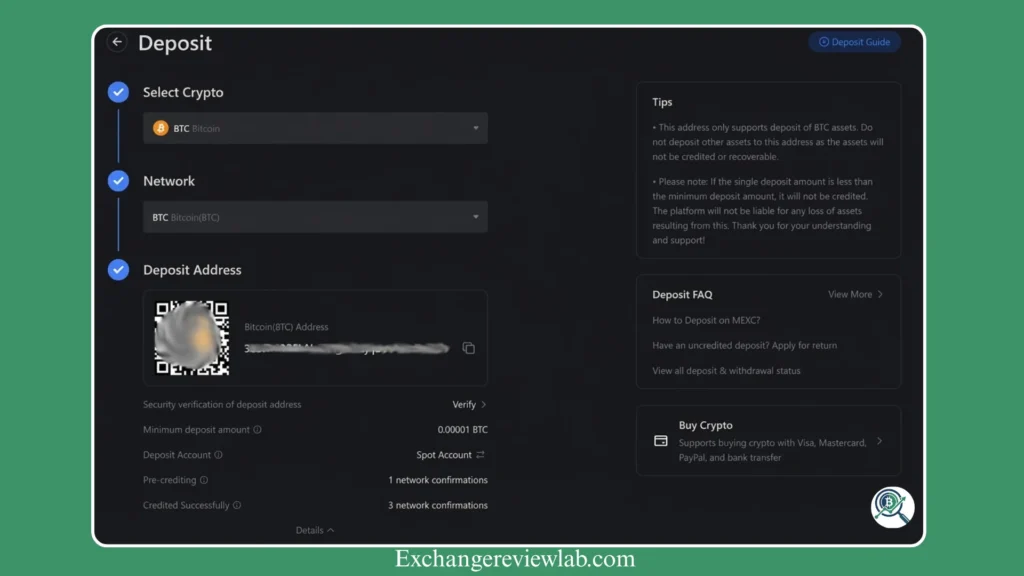
Depositing cryptocurrency into MEXC is completely free. No fees on your end.
That said, there are two things to always verify before sending funds:
1. Network compatibility. MEXC supports multiple blockchain networks for most assets — ERC-20, TRC-20, BEP-20, Solana, and others. Always confirm that the network you select on MEXC matches the network you’re sending from. A mismatch can result in lost funds with no recovery option.
2. Minimum deposit thresholds. Some assets have minimum deposit amounts. If you send below the threshold, the funds will not be credited and cannot be returned. Check the specific minimum for your asset before transferring.
For fiat deposits through third-party gateways like credit cards, fees typically range from 2% to 5%, depending on the provider. P2P (peer-to-peer) deposits carry no platform-side fees, though individual sellers set their own terms.
MEXC Withdrawal Fees
Unlike deposits, crypto withdrawals on MEXC are not free, but they are transparent. Fees vary depending on the asset and the blockchain network you use to withdraw.
This is where network selection becomes genuinely important. The same asset withdrawn over different networks can have dramatically different costs.
Here’s an example using USDT to illustrate:
| Network | Estimated Withdrawal Fee | Speed |
| Ethereum (ERC-20) | ~$5–$10 (network-dependent) | Slower |
| Tron (TRC-20) | ~$1 or less | Fast |
| BNB Smart Chain (BEP-20) | ~$0.30–$1 | Fast |
The lesson here is straightforward: check the fee before withdrawing, not after. The cheapest route can be 5–10 times less expensive than the most expensive one, and the asset you receive is identical.
KYC Verification and Withdrawal Limits
How much you can withdraw per day is directly tied to your KYC (Know Your Customer) verification level. Here’s how the limits stack up:
| KYC Level | Daily Withdrawal Limit (BTC equivalent) |
| No KYC | 10 BTC |
| Primary KYC | 80 BTC |
| Advanced KYC | 200 BTC |
| Institutional KYC | 400 BTC |
For unverified users, MEXC may also apply a combined deposit and withdrawal cap of 1,000 USDT, depending on your country of residence. This is manageable for occasional traders, but anyone moving larger amounts will want to complete at least primary KYC verification.
How to Reduce Your MEXC Trading Fees
Now for the part most traders care about: paying less. MEXC offers several legitimate, clearly documented ways to reduce what you pay in fees.
1. Hold MX Tokens for a 50% Discount
MX is the native token of the MEXC platform. Holding at least 500 MX tokens in your spot wallet for 24 consecutive hours triggers an automatic 50% discount on both spot and futures trading fees.
What does that look like in practice?
- Spot taker fee drops from 0.05% to 0.025%
- Futures taker fee drops from 0.02% to 0.01%
- Maker fees stay at 0% (already zero)
The platform takes balance snapshots multiple times per day. Your lowest recorded balance across those snapshots determines eligibility. As long as you maintain the 500 MX threshold, the discount applies automatically ,no manual activation needed.
The MX holding discount doesn’t extend to all pairs. BTC/USDT Perpetual and BTC/USD Perpetual are excluded from futures discounts. A list of excluded spot pairs is available on the MEXC fee schedule.
2. Use MX Token Deduction for a 20% Discount
An alternative to the holding discount is the MX Deduction feature. When enabled, MX tokens are used directly to pay your trading fees, and you receive a 20% discount on spot trading as a result.
For futures, you’ll need to transfer MX tokens from your spot wallet to your futures wallet. Once there, they’ll automatically offset futures trading fees with the same 20% reduction.
One important note: these two MX discounts cannot be stacked. The platform applies whichever is larger typically the 50% holding discount if you qualify.
3. Use the VIP Program
MEXC’s VIP program is designed for higher-volume traders and offers reduced fee rates alongside a set of premium perks. There are three tiers, each requiring you to maintain a minimum asset balance on the platform:
| VIP Tier | Minimum Assets Required |
| Gold VIP | 300,000 USDT |
| Diamond VIP | 1,000,000 USDT |
| Premium VIP | 2,000,000 USDT |
Each tier locks in your VIP status for a retention period (20 days for Gold, 40 for Diamond, 60 for Premium) so your benefits aren’t lost during short-term balance fluctuations.
Benefits across all tiers include reduced trading fees, a personal VIP service group, industry analysis reports, and priority customer support. Diamond and Premium members gain access to express withdrawal channels, higher withdrawal limits, and invitations to exclusive events. Premium members additionally get access to beta testing, VIP seminars, and high-quality project subscriptions.
For traders who are already VIP members on another major exchange, MEXC offers a VIP Experience Card. If you can provide proof of at least $10 million in combined spot and futures trading volume on other platforms within the past month, MEXC will grant 30 days of VIP-equivalent benefits. During that period, futures fees can drop to 0% maker and 0.01% taker, with spot trading at 0.025%.
4. Trade Zero-Fee Pairs During Promotions
MEXC regularly runs promotional events where specific trading pairs carry zero fees for both makers and takers. These are listed on the platform’s official events page and rotate periodically.
Over 140 trading pairs on MEXC currently offer zero fees for both makers and takers, significantly cutting trading costs. Staying on top of which pairs are included in active promotions is one of the easiest ways to reduce trading costs, especially for traders who have flexibility in which assets they focus on.
MEXC Fees Compared to Other Exchanges
Numbers only mean something in context. Here’s how MEXC fee structures stack up against three of the biggest names in crypto trading.
MEXC vs Binance
Binance uses a maker-taker model with a tiered VIP system. At the base level:
| Exchange | Spot Maker | Spot Taker | Futures Maker | Futures Taker |
| MEXC | 0.00% | 0.05% | 0.00% | 0.02% |
| Binance | 0.10% | 0.10% | 0.02% | 0.05% |
MEXC’s base rates are lower for both spot and futures. Binance’s VIP tiers do allow high-volume traders to bring rates down substantially, but reaching those tiers requires significant trading volume — and holding BNB tokens.
For most everyday traders, MEXC’s base fees are more favorable.
MEXC vs Bybit
Bybit is a strong competitor in the derivatives space. Its base rates are:
| Exchange | Spot Maker | Spot Taker | Futures Maker | Futures Taker |
| MEXC | 0.00% | 0.05% | 0.00% | 0.02% |
| Bybit | 0.10% | 0.10% | 0.02% | 0.055% |
MEXC wins on futures maker fees clearly (0% vs 0.02%). The gap narrows for high-volume Bybit users who move up its VIP tiers. But at the base level, MEXC’s futures fees are lower.
MEXC vs Kraken
Kraken is well-regarded for security and regulatory compliance. Its fee structure is volume-tiered, but base rates are among the highest of the major platforms:
Kraken’s fees drop significantly for high-volume traders, but at standard volumes, MEXC’s rates are considerably lower.
Read more: KuCoin Fees Review (2026) – Hidden Costs & Fees
KuCoin Review After 7 Days of Use
Practical Tips for Managing Your MEXC Fees
A few habits that can meaningfully reduce what you pay over time:
Prefer limit orders over market orders. Market orders always execute as taker orders. Limit orders that don’t fill immediately are maker orders — and on MEXC, those are free. This alone can bring your effective trading cost to zero on most transactions.
Choose the right withdrawal network. The same USDT sent over TRC-20 costs a fraction of what ERC-20 charges. Always check before withdrawing, not after.
Hold 500 MX if you trade regularly. The 50% fee discount from holding MX tokens activates automatically once you meet the threshold. At most price points, the savings from the discount quickly outweigh the cost of holding the tokens.
Check the events page before trading new assets. If an asset you’re considering is part of a zero-fee promotional period, trading timing around that window costs nothing.
Complete KYC verification. Higher verification levels unlock larger withdrawal limits and remove caps that can otherwise become inconvenient at key moments.
Is MEXC’s Fee Structure Genuinely Competitive?
The honest answer is yes, particularly for futures traders and those who use limit orders.
The 0% maker fee across both spot and futures is a real structural advantage over most competitors. The 0.05% spot taker fee and 0.02% futures taker fee are below industry averages. And the MX token holding discount makes it possible to cut the taker fees in half without needing to qualify for any special program.
Where MEXC is less distinctive is in its withdrawal infrastructure — fees vary by network just like every other exchange, and the cheapest options require some attention to which network you choose.
The platform serves over 40 million users across more than 170 countries, with more than 3,500 spot trading pairs and nearly 800 futures markets. That scale suggests the fee efficiency is working for traders, not against them.
Summary: MEXC Fee Quick Reference
| Fee Type | Rate | Notes |
| Spot Maker | 0.00% | Standard, all users |
| Spot Taker | 0.05% | Reducible to 0.025% with MX |
| Futures Maker | 0.00% | Standard, all pairs |
| Futures Taker | 0.02% | Reducible to 0.01% with MX |
| Crypto Deposits | Free | All networks |
| Crypto Withdrawals | Network-dependent | Check MEXC fee page |
| P2P Trading | 0.20% both sides | Platform fee |
| Fiat via card (third-party) | 2–5% | Varies by provider |
Final Thoughts
Fees are not the only thing that matters when choosing a crypto exchange, but they are one of the things that matters every single time you trade. They’re consistent, compounding, and entirely within your control to understand.
MEXC’s fee structure is one of the more transparent and competitive in the market. The base rates are low, the 0% maker fee is a genuine benefit, and there are multiple legitimate paths to reducing costs further without jumping through excessive hoops.
If you’re evaluating where to trade or wondering whether your current exchange is costing you more than it should, MEXC’s numbers are worth looking at. The math tends to speak for itself.
