
Here’s something most beginners discover the hard way: the crypto exchange you pick doesn’t just affect what you can trade; it directly affects how much of your money you actually keep.
Uphold has been around since 2015 and has carved out a fairly unique space for itself. It’s not just a crypto exchange; you can trade precious metals like gold, silver, platinum, and palladium, buy and sell foreign currencies, and do all of it from one unified account without juggling multiple platforms. That convenience sounds great on paper.
But convenience usually comes with a cost, and Uphold’s fee structure is genuinely different from what most traders are used to. There’s no maker-taker model. There are no volume-based VIP tiers. Instead, Uphold uses flat, percentage-based trading fees divided by asset category.
This guide covers everything: Uphold deposit fees, Uphold withdrawal fees and limits, Uphold trading fees, Uphold Card fees, step-by-step withdrawal instructions, TRX and USDT-specific fees, and a direct comparison with Binance, Coinbase, Kraken, Bybit, Robinhood, eToro, and Crypto.com.
No fluff. No outdated numbers. Let’s get into it.
A Quick Note on How This Guide Was Put Together
Every fee figure in this article comes from Uphold’s official fee page, Uphold’s official help center, or independently verified third-party reviews from recognized financial publications. Nothing here is estimated or fabricated. Where fees are approximate, particularly network fees that fluctuate with blockchain congestion, that’s clearly stated.
Uphold updates its fee structure periodically, so for the most current numbers, always cross-check directly with Uphold’s official resources before confirming a large transaction. Links are included throughout this guide for easy access.
What Makes Uphold’s Fee Model Different
Most major crypto exchanges, such as Binance, Bybit, and Kraken, use a maker-taker fee model: if you add liquidity (a limit order that doesn’t fill immediately), you’re the “maker” and pay a lower fee; if you take liquidity (a market order that fills instantly), you’re the “taker” and pay slightly more. Active traders who generate high monthly volume often unlock further discounts through tiered VIP programs. If you want the full picture on how a maker-taker exchange prices trades, our Coinbase fees breakdown walks through a comparable model in detail.
Uphold doesn’t do any of that.
Instead, it applies fixed percentage-based fees based on the type of asset you’re trading, not your trading volume, not your order type. The fee is built into the spread (the gap between the mid-market price and the price you actually get). You won’t see a separate “trading fee” line item on your confirmation screen; the cost is already factored in.
On the plus side, this is transparent in a specific way: what you see in the trade preview is what you pay. Uphold states on its official website that its pricing model is all-inclusive; there are no hidden charges added between the “Preview Trade” and “Confirm Trade” stages.
On the downside, those flat rates are higher than what you’d get from tiered-fee platforms if you trade in meaningful volume. More on that in the comparison section.
Understanding the Spread: What You’re Actually Paying
The spread is easy to misunderstand, so it’s worth explaining clearly.
When you buy Bitcoin on Uphold, you don’t pay the mid-market price – the price platforms like CoinGecko or CoinMarketCap display. You pay the “ask” price, slightly above mid-market. When you sell, you receive the “bid” price, slightly below. The difference between those two prices is the spread, and that’s where Uphold’s revenue comes from on trades.
For example, if Bitcoin’s mid-market price is $100,000 and Uphold’s spread for BTC is 1.5%, you’d buy at roughly $101,500 and sell at roughly $98,500. That 3% total round-trip cost might seem steep next to a 0.2% maker fee on Binance, and mathematically, it is.
But there’s no ambiguity in Uphold’s model. The spread is front and center in the trade preview window; you see your effective buying price before you confirm. If it doesn’t work for you, you walk away.
Does Uphold Have a Native Token or Loyalty Discount?
Short answer: no. Uphold doesn’t have a platform token and doesn’t offer loyalty discounts tied to holdings or trading history; there’s no equivalent of Binance’s BNB discount or Bybit’s tiered reward system.
The only way to reduce your effective Uphold fees is to choose lower-fee payment methods, trade higher-fee assets less frequently, and keep individual trade sizes above the $500 threshold to avoid the small-trade surcharge.
Uphold Deposit Fees: A Full Breakdown by Region
Crypto deposits on Uphold are free, full stop, no fee, no minimum, no strings. That’s standard across the industry, and Uphold matches it.
Fiat deposits are where things get region-specific. Uphold divides its fiat deposit fee structure into four geographic categories: the United States, the United Kingdom, the European Economic Area (EEA), and everywhere else.
United States
| Deposit Method | Fee | Daily Limit |
| ACH (Plaid) | Free | Up to $15,000 |
| ACH (Microdeposits) | Free | Up to $2,000 |
| Debit Card / Apple Pay / Google Pay | 3.99% | Up to $15,000 |
| Credit Card | 3.99% | Up to $15,000 |
| Wire Transfer (below $2,000) | $10 flat | Unlimited |
| Wire Transfer (above $2,000) | Free | Unlimited |
The 3.99% card fee is on the higher end for card deposits, though not out of line with industry norms for instant payment methods. If you want to avoid it, stick to ACH.
Limit reset detail: daily limits reset at 00:00 UTC every day, weekly limits reset every Monday at 00:00 UTC, and monthly limits reset on the first of each calendar month at 00:00 UTC. A monthly reset doesn’t override the weekly cap — you still operate within weekly limits after the month refreshes.
United Kingdom
| Deposit Method | Fee | Daily Limit |
| FPS | Free | Unlimited |
| SEPA | Free | Unlimited |
| Debit / Credit Card, Apple Pay, Google Pay | Free | Up to £15,000 |
Source: Uphold official fee page
European Economic Area (EEA)
| Deposit Method | Fee | Daily Limit |
| SEPA | Free | Unlimited |
| Debit / Credit Card, Apple Pay, Google Pay | Free | Up to €15,000 |
Source: Uphold official fee page
Other Countries
| Deposit Method | Fee | Daily Limit |
| Debit Card / Credit Card | 3.99% | Up to $15,000 |
| Apple Pay / Google Pay | 3.99% | Up to $15,000 |
Users outside the US, UK, and EEA can only fund accounts through card or Apple/Google Pay — there’s no direct fiat deposit option, so you must use these methods to purchase crypto simultaneously.
Source: Uphold official fee page
Uphold Withdrawal Fees: Fiat
Once you’re ready to take money out, Uphold again splits its fee structure by region – this time across five categories: the US, UK, EEA, Canada, and other countries.
United States
| Withdrawal Method | Fee | Daily Limit |
| ACH (Microdeposits) | Free | Up to $25,000 |
| ACH (Plaid) — Standard | Free | Up to $25,000 |
| ACH (Plaid) — Instant | 1.75% (min $1) | Up to $25,000 |
| Debit Card / Apple Pay | 1.75% (min $1) | Up to $25,000 |
Source: Uphold official help center, support.uphold.com
United Kingdom
| Withdrawal Method | Fee | Daily Limit |
| FPS | Free | Up to £25,000 |
| SEPA | Free | Up to £25,000 |
| Debit Card / Apple Pay | 1.75% (min £1) | Up to £25,000 |
Google Pay is not available for withdrawals in any region – only for deposits.
EEA
| Withdrawal Method | Fee | Daily Limit |
| SEPA | Free | Up to €25,000 |
| Debit Card / Apple Pay | 1.75% (min €1) | Up to €25,000 |
Canada
| Withdrawal Method | Fee | Per-Transaction Limit |
| Interac | Free | Up to $10,000 CAD |
Interac is Canada’s only withdrawal option — free, but no alternative if it doesn’t work for your situation.
Other Countries
| Withdrawal Method | Fee | Daily Limit |
| Debit Card | 2.75% (min $1) | Up to $25,000 |
| Apple Pay | 2.75% (min $1) | Up to $25,000 |
That’s notably higher than the 1.75% charged in the US, UK, and EEA.
Uphold Withdrawal Limits: Daily, Weekly & Monthly
This is one of the most-searched questions about Uphold, so here it is in one place instead of scattered across the guide.
| Limit Type | Resets | Notes |
| Daily limit | 00:00 UTC every day | Applies per payment method (see tables above) |
| Weekly limit | Monday 00:00 UTC | A monthly reset does not override this |
| Monthly limit | 1st of each calendar month, 00:00 UTC | Highest-tier ceiling; still bound by weekly caps |
A few practical points:
- Limits are per method, not universal. Your ACH limit and your card limit are tracked separately, so hitting one doesn’t block the other.
- Verification level affects your ceiling. Higher-tier identity verification (providing a proof of address or additional documentation) typically unlocks higher daily and monthly caps — Uphold doesn’t publish exact tier thresholds, so check your account’s “Limits” page for your personal figures.
- Crypto withdrawal limits are generally more generous than fiat, since blockchain transactions aren’t subject to the same banking-rail caps, but Uphold can still apply account-level limits for security.
- If you consistently hit your monthly limit, contacting Uphold support to request a review is usually faster than waiting for gradual auto-increases.
How to Withdraw Money From Uphold (Step-by-Step)
If this is your first fiat withdrawal, here’s the process:
- Log in and go to your Uphold dashboard.
- Select the fiat balance you want to withdraw from (e.g., USD, GBP, EUR).
- Click “Withdraw” (sometimes labeled “Cash Out” depending on region).
- Choose your withdrawal method – ACH, wire, FPS, SEPA, Interac, or card, depending on your country.
- Enter the amount. Uphold will show the fee (if any) and the exact amount you’ll receive before you confirm.
- Confirm your linked bank account or payment method. If it’s your first withdrawal to a new account, Uphold may require a small verification step.
- Review the preview screen carefully – this is where the fee is disclosed in full, with no surprises later.
- Confirm the withdrawal.
Processing times: standard ACH typically takes 1–3 business days; SEPA and FPS are usually same-day or next-day; instant ACH and debit card withdrawals (at the 1.75% fee) typically land within minutes to a few hours.
Tip: if you’re not in a hurry, always choose the free standard method (ACH, SEPA, FPS, Interac) over the instant/card option; the fee difference is significant relative to the time saved.
Uphold Crypto Withdrawal Fees (Including TRX & USDT)
Crypto withdrawal fees don’t vary by region; they’re the same regardless of where you live. Two types of charges apply:
1. Blockchain Network Fees – paid to the blockchain’s validators, not to Uphold. They vary by asset, network, and congestion. Uphold passes these through at cost.
2. Uphold’s Flat $0.99 Fee – applies to withdrawals on networks that don’t generate enough trading volume on Uphold to cover operational costs.
According to Uphold’s official documentation, the $0.99 flat fee applies to all crypto network withdrawals except BTC, XRP, and HBAR. This is a notable recent update compared to the older, more asset-specific list. TRX is not on the exemption list, so a standard TRX withdrawal carries both the network cost and the $0.99 flat fee.
Typical Network Fees by Asset
| Network | Asset | Approximate Network Fee |
| Bitcoin | BTC | ~0.00004 BTC |
| Ethereum (Arbitrum) | ETH | ~0.0001 ETH |
| Solana | SOL | ~0.0006 SOL |
| Cardano | ADA | ~0.5 ADA |
| Dogecoin | DOGE | ~1 DOGE |
| Litecoin | LTC | ~0.0008 LTC |
| TRON | TRX | ~1 TRX |
| Polygon | USDT/USDC | ~0.25 USDT/USDC |
These figures are approximate and subject to change based on network conditions. Always verify the current fee on your withdrawal confirmation screen before sending.
Uphold TRX Withdrawal Fee: What You’ll Actually Pay
TRX withdrawals combine two costs: the small network fee (roughly 1 TRX, which is typically a few cents depending on TRX’s current price) plus Uphold’s $0.99 flat fee, since TRX isn’t on the BTC/XRP/HBAR exemption list. On a small withdrawal, that $0.99 is the dominant cost – which is why it’s worth consolidating TRX withdrawals into fewer, larger transactions rather than sending small amounts repeatedly.
Separately, if you’re trading TRX (buying or selling it on Uphold rather than withdrawing it), TRX falls into Uphold’s altcoin fee category, meaning the trading spread is 2.5% to 2.95%
Uphold USDT Withdrawal Fee: Which Network Should You Use?
USDT withdrawals are a bit different because USDT exists on multiple blockchains, and the network you pick changes your cost dramatically:
- TRC-20 (Tron network) is generally the cheapest way to move USDT on-chain, with network costs typically under a dollar.
- ERC-20 (Ethereum network) can cost significantly more — sometimes several dollars — especially when the Ethereum network is congested.
- Solana and Polygon are lower-cost alternatives increasingly used for stablecoin transfers.
Uphold’s available withdrawal networks can change over time and aren’t identical for every user, so the network options (including whether TRC-20 is offered) will show on your withdrawal screen – check there for the current list and fee before confirming. Regardless of which network you choose, the same $0.99 flat fee noted above applies unless the network is on Uphold’s exempt list.
Bottom line for TRX/USDT withdrawals: check the withdrawal screen for the live network fee, expect the $0.99 flat charge on top (for TRX and most USDT networks), and consolidate smaller withdrawals into one larger transaction whenever practical.
A Note on Internal Swaps and Network Fees
If you’re converting one asset to another inside your Uphold account (for example, swapping BTC for USDT without withdrawing), that’s a trade, not a withdrawal — it goes through the spread-based trading fee, not a blockchain network fee, since no on-chain transaction occurs. Network fees only apply when you actually move an asset off Uphold to an external wallet.
Read more
- Uphold Exchange Review 2026 — Fees, Pros & Cons
- Is Uphold Safe in 2026? Read This Before You Start Trading
How to Withdraw Crypto From Uphold (Step-by-Step)
- Log in and open the crypto balance you want to withdraw (e.g., BTC, TRX, USDT).
- Click “Withdraw” and select “Send to external wallet.”
- Choose the network carefully. For assets like USDT that exist on multiple chains, select the network that matches your destination wallet exactly (e.g., TRC-20, ERC-20, Solana). Sending on the wrong network can result in permanently lost funds.
- Paste (don’t manually type) the destination wallet address to avoid transcription errors.
- Enter the amount. Uphold will display the network fee and, if applicable, the $0.99 flat fee before you confirm.
- Double-check the address and network one more time — this step cannot be undone once submitted.
- Confirm the withdrawal and wait for blockchain confirmation (times vary by network; Bitcoin can take longer than Solana or Tron, for example).
Safety tip: always send a small test amount first when withdrawing to a new address for the first time, especially for larger sums.
Uphold Trading Fees: How the Spread Model Works
This is the most important section for anyone planning to actively trade on Uphold.
Rather than charging a separate line-item commission, Uphold builds its fee into the spread. Rates vary by asset type:
| Asset Category | Typical Fee Rate |
| Bitcoin (BTC) and Ethereum (ETH) | 1.4% to 1.6% |
| Stablecoins (USDT, USDC, etc.) | ~0.2% (or 1:1 parity for first $20,000/month) |
| Altcoins (including TRX) | 2.5% to 2.95% |
| Major Market FX | ~0.3% |
| Precious Metals | 1.9% to 2.95% |
There’s one additional charge to flag: a flat $0.99 fee applies to any crypto trade (excluding stablecoins) where the trade value falls below $500, using any order type other than a Trailing Stop or Take Profit order. If you’re testing the waters with small trades — including small TRX trades — this adds up fast.
How Uphold’s Stablecoin Trading Fee Works
For US, UK, and European users, conversions between USD and major USD-based stablecoins (like USDT and USDC) get 1:1 parity pricing for the first $20,000 in monthly volume, provided market parity stays within 0.2%. Trades above that threshold revert to the standard spread for the portion above the cap. That’s a genuinely competitive rate for stablecoin traders.
Rules That Affect Your Actual Trading Fee
- Cross-asset trades use the higher fee. Trading TRX (or any altcoin) for a stablecoin means you pay the altcoin rate (2.5%–2.95%), not the stablecoin rate.
- Higher-volume trades cost more. Uphold’s stated rates apply to “typical” trade sizes; larger transactions can scale fees upward, though Uphold doesn’t specify an exact threshold.
- Altcoin fees depend on liquidity. Newly listed tokens and low-cap assets tend to have wider spreads.
- Market volatility widens spreads. Uphold holds each price open for 18 seconds and shows an in-app notification when market spreads exceed 4%, letting you decide whether to proceed.
- Regional variation exists. Fees can differ slightly based on local market conditions or regulatory requirements.
The single biggest advantage of Uphold’s model: you always know the exact price before you confirm — no hidden charges inserted between the preview screen and execution.
Uphold Card Fees: The UK Debit Card Explained
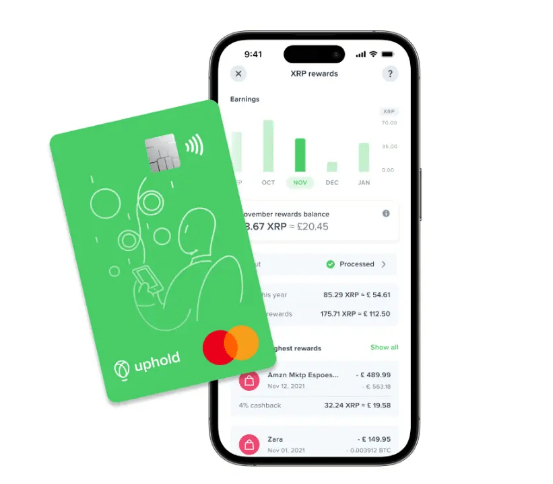
Uphold offers a debit card for UK customers, the Optimus card, issued as a Mastercard. You can spend your digital assets anywhere Mastercard is accepted, and the card draws from your Uphold balance in the background, handling asset conversion automatically.
| Fee Type | Amount |
| Annual Fee | £0 (none) |
| Foreign Transaction Fee | 0% |
| Physical Card Delivery / Replacement | £9.95 |
| ATM Withdrawal (UK) | £2.50 |
| ATM Withdrawal (Foreign) | £3.50 |
| Virtual Card | Free |
Source: Uphold official website and multiple independent reviews
The zero foreign transaction fee is a genuine standout; most traditional credit and debit cards charge 1.5%–3% on foreign purchases. For frequent travelers, the Uphold Card saves real money.
| Transaction Type | Per Transaction | Daily Maximum |
| ATM Withdrawal | Up to £500 | £1,000 (max 2 daily) |
| Retail Purchase | Up to £10,000 | £10,000 (max 50 daily) |
The two-transaction daily ATM limit is tight – if you regularly pull cash in multiple small withdrawals, you’ll hit that ceiling fast. Retail spending limits are generous.
Uphold also relaunched a US debit card in October 2025 with an XRP rewards focus. US users who hold XRP can now earn rewards on purchases, spending from a balance across 300+ supported assets.
Uphold vs. Other Major Exchanges: Fee Comparison
Now for the part many readers care about most: how do Uphold fees stack up against the competition? The honest answer: in most fee categories, Uphold is more expensive than its major rivals. Here’s a fair breakdown.
Uphold vs. Binance
Binance is the largest centralized crypto exchange in the world by trading volume and user count. Its tiered maker-taker fee structure starts at 0.1% for both makers and takers — roughly 10x cheaper than Uphold’s stablecoin rate and 15–25x cheaper than Uphold’s BTC/ETH rates. Binance also runs a VIP program with 9 tiers based on 30-day trading volume and BNB holdings, with BNB holders getting an additional 25% discount.
The trade-off: Binance is complex, and the sheer number of features can overwhelm newcomers. Uphold’s simplicity has real value for users who don’t want to navigate futures, margin, and derivatives settings just to buy Bitcoin.
Bottom line: for trading fees, Binance wins decisively. For simplicity and multi-asset access, Uphold offers something different.
Uphold vs. Coinbase
Coinbase is one of the most recognizable exchanges in the US, and it’s a common comparison point for beginners choosing between the two platforms. Coinbase’s standard “simple” interface pricing has historically run higher than its Advanced Trade tier, which uses a maker-taker model starting around 0.1%–0.6% depending on volume. That means Coinbase can be either notably cheaper or roughly comparable to Uphold’s spread, depending entirely on which Coinbase interface you use — a nuance that trips up a lot of new users. We break this down asset-by-asset in our Coinbase fees review.
Where Uphold pulls ahead of Coinbase: multi-asset access (precious metals, FX) that Coinbase doesn’t offer, and a debit card with 0% foreign transaction fees. Where Coinbase pulls ahead: a larger asset selection for trading and, via Advanced Trade, potentially lower costs for active traders.
Bottom line: casual users comparing the default apps will find the two fairly close; active traders should use Coinbase’s Advanced Trade tier to beat Uphold’s flat spread.
Uphold vs. Kraken
Kraken operates in 190+ countries and supports over 420 cryptocurrencies. Its maker-taker fee structure starts at 0.25% for takers and 0.2% for makers on crypto pairs. For stablecoin pairs, both maker and taker fees sit at 0.2% — comparable to Uphold’s stablecoin rate.
Where Kraken genuinely edges out Uphold is through Kraken+, a subscription tier offering zero trading fees up to $10,000/month for $4.99/month. Kraken’s fiat deposit and withdrawal infrastructure is also more developed for non-US users.
Bottom line: for serious traders, Kraken is more affordable. Uphold’s flat-fee, no-subscription model is more predictable for casual users.
Uphold vs. Bybit
Bybit serves over 60 million users and supports nearly 2,000 cryptocurrencies. Its spot trading fees are 0.1% for both makers and takers — half the cost of Uphold’s cheapest trading tier. Bybit also runs a tiered VIP system with 6 tiers plus 6 Pro tiers, including maker fee rebates at the highest levels. For a full walkthrough of getting started, see our Bybit review for beginners.
Bottom line: Bybit’s trading fees are consistently lower than Uphold’s. If you trade frequently, the difference compounds quickly.
Uphold vs. Robinhood
Robinhood’s crypto trading is commission-free in the sense that there’s no separate trading fee line item – similar to Uphold, the cost is embedded in the spread. In practice, Robinhood’s crypto spreads have historically run tighter than Uphold’s altcoin and BTC/ETH rates, making Robinhood typically cheaper for straightforward buy-and-hold crypto trades. However, Robinhood’s asset selection is narrower (no precious metals, no FX, no dedicated debit card with Uphold’s foreign-fee structure), and it’s primarily built around the US market.
Bottom line: for pure crypto cost, Robinhood tends to be cheaper; for multi-asset access and international availability, Uphold is the broader platform.
Uphold vs. eToro
eToro is best known for social/copy trading and a broad multi-asset offering (stocks, crypto, commodities) that somewhat overlaps with Uphold’s multi-asset pitch. eToro’s crypto fees are also spread-based rather than a visible commission, and rates vary by asset — generally in a similar ballpark to Uphold’s, though eToro adds a separate withdrawal fee structure that differs by region. eToro’s copy-trading and stock-investing features go beyond what Uphold offers, while Uphold’s precious metals and FX access go beyond what eToro’s crypto-first pricing typically emphasizes.
Bottom line: the two platforms serve different core use cases — eToro for social/stock investing with crypto included, Uphold for multi-asset simplicity with a crypto-first structure.
Uphold vs. Crypto.com
Crypto.com combines an exchange with its own CRO token ecosystem, offering fee discounts and card cashback tied to CRO staking — something Uphold has no equivalent for, since Uphold has no native token. Crypto.com’s base exchange trading fees can be competitive (often below Uphold’s flat spreads) for users willing to stake CRO, but without staking, the discount disappears, and the gap narrows.
Bottom line: Crypto.com can be cheaper if you’re willing to hold and stake its token; Uphold’s flat, no-token model is simpler but doesn’t reward loyalty the same way.
Fee Comparison Table
| Exchange | Spot Trading (BTC) | Stablecoins | Maker-Taker Model | VIP Tiers |
| Uphold | 1.4%–1.6% | ~0.2% | No | No |
| Binance | 0.1% / 0.1% | 0.1% / 0.1% | Yes | Yes (9 tiers) |
| Coinbase (Advanced) | ~0.1%–0.6% | ~0.1%–0.6% | Yes | Yes (volume-based) |
| Kraken | 0.2% / 0.25% | 0.2% / 0.2% | Yes | Yes |
| Bybit | 0.1% / 0.1% | 0.1% / 0.1% | Yes | Yes (12 tiers) |
| Robinhood | Spread-based, typically tighter than Uphold | N/A | No (spread) | No |
| eToro | Spread-based, comparable to Uphold | Varies | No (spread) | No |
| Crypto.com | Competitive with CRO staking | Competitive with CRO staking | Yes | Yes (CRO tiers) |
Fee figures based on publicly available fee schedules and are subject to change. BTC rates on Uphold, Robinhood, and eToro represent spread-based fees rather than a stated commission. Verify current rates directly with each platform.
How to Reduce Your Uphold Fees: Practical Tips
Uphold doesn’t offer a formal fee discount program, but there are smart ways to reduce your costs within the platform’s rules.
- Use free deposit methods. US users should default to ACH. UK and EEA users get free card deposits too. Avoid cards outside the UK/EEA — that 3.99% adds up before you’ve even traded.
- Use free withdrawal methods. SEPA, FPS, and standard ACH withdrawals are free. Skip the debit card withdrawal unless you’re in a hurry.
- Keep trades above $500. The $0.99 small-trade surcharge applies below $500 — consolidate multiple small trades into one larger transaction where possible.
- Trade stablecoins when possible. The stablecoin rate (~0.2%) is Uphold’s lowest.
- Avoid small cross-asset altcoin trades, including TRX-to-stablecoin swaps — these get charged at the altcoin rate (2.5%–2.95%).
- Watch for spread notifications. When Uphold flags a 4% spread alert, take it seriously; waiting even 30 minutes can make a difference.
- Time your crypto withdrawals, including TRX and USDT, for off-peak hours (typically early morning UTC) to reduce network-fee costs.
- Use lower-cost blockchain networks for stablecoins. For USDT/USDC, TRC-20 or Polygon typically costs less than Ethereum mainnet — confirm your destination wallet supports the chosen network first.
- Consolidate TRX withdrawals. Since the $0.99 flat fee applies per withdrawal regardless of size, one larger TRX withdrawal is far cheaper than several small ones.
Real-World Cost Scenarios
Scenario 1: US user deposits $1,000 via debit card and buys Bitcoin
- Deposit fee: 3.99% = $39.90
- Trading fee (BTC at ~1.5% spread): $15.00
- Total cost to enter the position: ~$54.90 (≈5.49% of deposit)
Same scenario with ACH deposit:
- Deposit fee: Free
- Trading fee: $15.00
- Total cost: ~$15.00 (≈1.5% of deposit)
That dramatic difference is driven entirely by the deposit method. The lesson: always use ACH if you’re a US user.
Scenario 2: US user deposits $1,000 via ACH and buys TRX (an altcoin)
- Deposit fee: Free
- Trading fee (TRX at ~2.95% altcoin spread): $29.50
- Small-trade surcharge (if under $500): $0.99
- Total cost: ~$29.50 (or $30.49 if under a $500 trade)
Altcoin trading — including TRX — is expensive on Uphold relative to major alternatives. Frequent altcoin traders should factor this in.
Is Uphold Transparent About Its Fees?
This is one area where Uphold deserves credit. The platform maintains a detailed public fee page, and its help center breaks down deposit and withdrawal costs by payment method and region. The all-inclusive spread model means you see the complete cost before you confirm – no fees added at the last second.
From a fee-transparency standpoint, Uphold does better than many platforms that bury spread information in footnotes or adjust rates quietly between the preview and confirmation screens.
Security and Regulation: Why It Matters Alongside Fees
Fees don’t exist in a vacuum. A platform with lower fees but poor security or weak regulation is a bad trade.
Uphold holds licenses in several key jurisdictions:
- United States – Registered with FinCEN as a Money Services Business, plus state-level Money Transmitter licenses
- United Kingdom – Regulated by the Financial Conduct Authority (FCA)
- Canada – Registered with FINTRAC
- Lithuania – Supervised by the Ministry of the Interior
Uphold also operates a bug bounty program and has not experienced a platform-level hack.
Uphold’s Reserve Transparency
Uphold reportedly holds over 90% of user funds in cold storage and publishes its proof-of-reserves status every 30 seconds, aiming to demonstrate that every dollar, crypto unit, and precious metal holding in user accounts is backed 1:1 by real assets. This kind of real-time transparency matters, especially after high-profile exchange collapses — like FTX in 2022 – where an exchange’s apparent assets didn’t match its actual liabilities.
User Ratings and Real Feedback
On Trustpilot, Uphold holds a 4.5-out-of-5 rating, suggesting most users report a positive experience (Source: Webopedia Uphold Review). The most frequent praise centers on ease of use, reliable transaction processing, and multi-asset flexibility. The most common complaints involve account verification holds and slower customer support response times — issues common across the crypto exchange industry, not unique to Uphold.
Reddit communities echo a similar pattern: users who don’t hit account issues are generally satisfied, while those who hit verification friction find resolution slow. Worth keeping in mind if you plan large or unusual transactions.
Who Is Uphold Best Suited For?
Uphold isn’t the cheapest platform for high-frequency traders — that’s just a fact. If you’re executing dozens of trades a week and want the lowest possible cost per trade, Binance or Bybit will serve you better on fees alone.
But Uphold makes sense for:
- Casual and beginner investors who want a straightforward interface without complex order books or derivatives dashboards
- Multi-asset investors who want crypto, precious metals, and foreign currencies from one account
- UK users who want a no-annual-fee debit card with 0% foreign transaction fees
- US users who want free ACH deposits and simple onboarding
- XRP holders in the US who want to earn rewards on everyday card spending
- Users who prioritize fee transparency over fee minimization
- Long-term buy-and-hold investors who deposit infrequently and don’t mind a higher spread on occasional trades
When You Should Probably Look Elsewhere
- You trade altcoins (including TRX) frequently. A 2.5%–2.95% fee per trade is expensive. Five altcoin trades a week at $1,000 each costs $125–$147.50 weekly — over $6,500 annually. The same activity on Bybit at 0.1% costs roughly $26 per week.
- You want futures or margin trading. Uphold doesn’t offer either.
- You trade in large volumes. Uphold has no volume-based discounts — you pay the same rate whether trading $500 or $500,000.
- You’re based outside the US, UK, EEA, and Canada. The “other countries” fee structure (3.99% deposits, 2.75% withdrawals) is noticeably less favorable.
Common Questions About Uphold Fees
Are Uphold’s Fees Higher Than Industry Average?
For trading, yes – particularly altcoins (2.5%–2.95%, which includes TRX) and BTC/ETH (1.4%–1.6%). Most major exchanges charge 0.1%–0.25% for spot trading. Uphold’s stablecoin rate (~0.2%) is more competitive, and the 1:1 parity deal for the first $20,000/month is genuinely attractive for stablecoin traders.
Does Uphold Charge Hidden Fees?
No. Uphold’s official position, supported by its platform design, is that the price shown in the trade preview includes everything. The spread-based model embeds the fee in the rate itself rather than adding a separate line after the fact.
Does Uphold Have Volume Discounts?
No. The same rates apply whether you trade $100 or $100,000 per month — a genuine disadvantage compared to Binance, Kraken, and Bybit.
How Much Does Uphold Charge Per Transaction?
It depends on the transaction type: crypto deposits and most standard fiat withdrawals (ACH, SEPA, FPS, Interac) are free; card-based deposits/withdrawals run 1.75%–3.99% depending on region; trading carries the asset-specific spread (0.2%–2.95%); and crypto withdrawals combine a network fee plus, in most cases, Uphold’s flat $0.99 charge.
What Are Uphold’s Wallet Fees?
Uphold doesn’t charge a separate fee just for holding assets in your wallet. The costs you’ll encounter are the same ones covered throughout this guide: network fees and the $0.99 flat fee when you withdraw crypto to an external wallet, and the spread when you trade.
Does Uphold Charge a Fee for Internal Swaps or Conversions?
Converting one asset to another inside your Uphold account (without withdrawing) is priced through the trading spread, not a network fee, since no blockchain transaction takes place. See the trading fees section for exact rates by asset category.
What Does “Uphold Trade” Mean?
“Uphold Trade” simply refers to buying, selling, or converting an asset within your Uphold account – as opposed to depositing or withdrawing. Every trade is priced via the spread model described above rather than a separate commission line.
Can I Deposit Crypto to Uphold for Free?
Yes. Crypto deposits are free across all regions. You only pay blockchain network fees on the sending side, charged by the network itself, not by Uphold.
Does Uphold Charge for Staking?
Uphold offers staking for more than 15 digital assets, with potential rewards up to 14% APY depending on the asset. Staking is available in the US, and Uphold reinstated staking for UK users in February 2025 following regulatory changes under the Financial Services and Markets Act 2000. Uphold doesn’t publicly charge a separate staking fee — the platform takes a cut from the gross staking yield before passing rewards to users, standard practice across the industry.
Is Uphold a Legitimate Crypto Exchange?
Yes. Uphold is a regulated platform registered with FinCEN in the US, the FCA in the UK, and FINTRAC in Canada, among other jurisdictions. It has operated since 2015, publishes real-time proof-of-reserves data, and has not experienced a platform-level hack. That doesn’t mean it’s risk-free – no exchange is, but it is a legitimate, licensed platform rather than an unregulated operation.
What Happened to Uphold’s US Debit Card?
Uphold paused its US card program in March 2023 and relaunched it in October 2025 with a new focus on XRP rewards. US users can now earn XRP on everyday purchases, spending from any of the 300+ assets supported in their Uphold account.
Final Verdict: Are Uphold Fees Worth It?
Uphold fees are not the lowest in the industry. For most trading categories, including TRX and other altcoins, you’ll pay more per trade than you would on Binance, Bybit, or Kraken. That’s the truth, and glossing over it wouldn’t help you make a good decision.
What Uphold does offer is a clean, transparent, multi-asset platform with a predictable fee structure — no complex VIP tiers, no token discounts to track, and no surprises between the preview screen and your actual trade execution. For users who value simplicity and want to hold crypto, precious metals, and foreign currencies in one account, that’s a reasonable trade-off.
The zero-fee ACH deposits for US users, free fiat deposits for UK and EEA users, and the no-annual-fee debit card for UK users are genuinely competitive features. The stablecoin parity deal for the first $20,000 in monthly volume is also worth noting for users who move frequently between USD and stablecoins.
If you’re a cost-conscious, high-frequency trader, Uphold probably isn’t your first choice. But if you’re a casual investor who wants a reliable, regulated, multi-asset platform with clear pricing, Uphold is a solid contender.
This article is for informational purposes only and does not constitute financial or investment advice. Always verify current fee schedules directly with Uphold before making trading decisions, as fees are subject to change.
