
f you have been thinking about buying crypto but keep staring at your wallet, wondering if there is even enough in there to get started, you are not alone. Most people assume crypto investing is for people with hundreds or thousands of dollars to throw around. The reality is quite different, and Uphold is one of those platforms built specifically to challenge that assumption.
This is a full, honest Uphold review written for low-budget users: beginners, students, freelancers, and anyone who wants to dip their toes into crypto without risking the rent money. We cover the fees, features, security, pros, cons, and the big question is Uphold actually worth it for someone with a tight budget?
No fluff. No fake data. Just the stuff you actually need to know.
What Is Uphold? A Quick Introduction
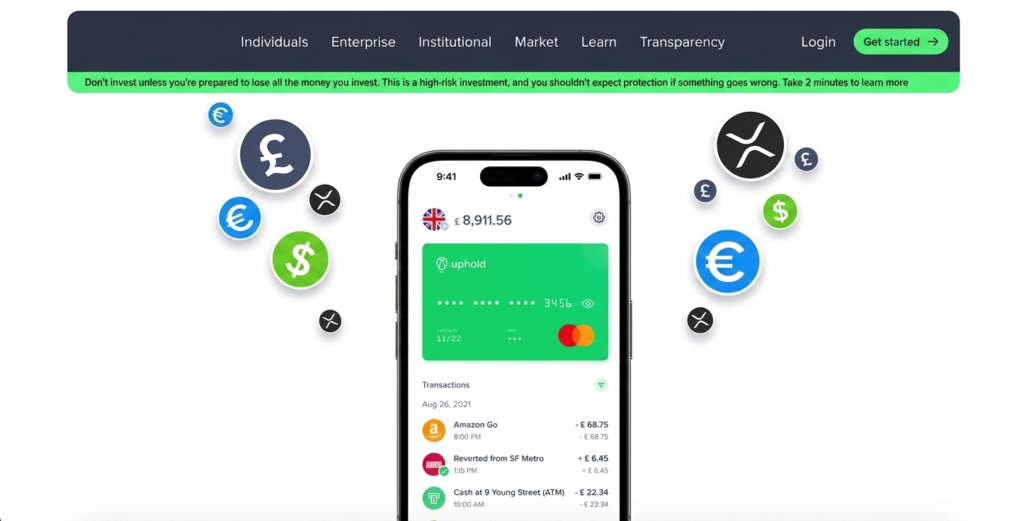
Uphold is a US-based multi-asset digital trading platform that was founded in 2014 and launched publicly in 2015. It operates with what it calls an “anything-to-anything” trading model, which basically means you can swap directly between crypto, fiat currencies, and precious metals in a single transaction, without needing to convert to cash first.
Think of it like a one-stop financial shop where you can buy Bitcoin, immediately swap it for gold, and then convert that gold into euros, all inside the same app, without touching a second platform. That level of flexibility is genuinely rare.
The platform serves users across more than 140 countries and supports over 300 assets, including cryptocurrencies, 27 fiat currencies, and precious metals like gold, silver, platinum, and palladium. It has registered users across North America, Europe, Latin America, Asia-Pacific, and parts of Africa.
For beginners with limited capital, the most important thing to note is this: you can start investing on Uphold with as little as $10. That is the minimum deposit for card payments. Some deposit methods, like crypto transfers, have no minimum at all.
Who Is Uphold Actually Built For?
Before going deep on the features and fees, it is worth being honest about who this platform serves best, and who it does not.
Uphold is a good fit if you are:
- A first-time crypto investor who wants a clean, easy interface
- Someone who wants to diversify across crypto, currencies, and metals in one place
- A long-term “buy and hold” type who does not trade every day
- Someone with a small budget who needs low minimum deposits
- A user who values transparency and regulated platforms over maximum profit
Uphold is probably not the best fit if you are:
- An active day trader chasing the lowest possible fees
- Someone who needs advanced charting tools or technical analysis features
- A user in certain restricted countries (more on that below)
With that context in mind, let us go through everything that matters for a low-budget user.
Getting Started: How Easy Is the Sign-Up Process?
Setting up an Uphold account is genuinely straightforward. You download the app (available on iOS and Android), enter your basic details, and go through identity verification, known as KYC (Know Your Customer). This is a standard legal requirement for any regulated financial platform.
The KYC process involves uploading a government-issued ID and sometimes a selfie. In most cases, it completes within minutes, though first-time users occasionally experience slightly longer wait times for initial checks.
One thing worth knowing: Uphold makes it easy to create an account, but the KYC process does not kick in until after sign-up. Some users have reported frustration when funds get held up during verification. The lesson here is simple: complete your KYC before you deposit money. Get verified first, fund second.
Once verified, the interface is clean and intuitive. There are no confusing dashboards full of trading widgets. Assets are clearly listed, prices update in real time, and executing a trade is genuinely just a few taps.
Uphold Fees Explained: What Does It Actually Cost You?
This is probably the most important section of any platform review for low-budget users. Fees eat into small investments fast, so let us be precise.
How Uphold Charges You (Spread-Based Model)
Uphold does not charge traditional maker or taker fees like most exchanges. Instead, it uses a spread-based pricing model; the difference between the market price and the price you actually pay is where Uphold makes its money.
According to Uphold’s official fee page, the spread typically ranges depending on the asset and market conditions. For major coins like Bitcoin, spreads sit on the lower end. For smaller, less liquid tokens, spreads can widen. Uphold displays the all-in price before you confirm a trade, so there are no hidden surprises between “preview” and “confirm”; the price you see is the price you pay. That transparency is genuinely appreciated.
For context, independent analysis found that Uphold’s spreads sit around 0.80% to 1.20% for major assets, compared to the industry average spot trading fee of roughly 0.18% to 0.23%. So yes, Uphold is not the cheapest option for frequent traders.
However, for someone who buys a small amount of Bitcoin once a week and holds it, the difference in real money terms is small. A 1% spread on a $20 trade is 20 cents. That is a coffee, not a crisis.
Deposit Fees
Here is what matters most for users just getting started:
- Bank transfer (ACH, US users): Free. No deposit fee.
- Bank wire (under $5,000): Free.
- Debit or credit card: 3.99% fee. This is the most expensive method and is worth avoiding for regular deposits.
- Crypto deposits from external wallets: Free.
- Google Pay / Apple Pay: Instant, but carries the same card-level fee.
The clear takeaway for budget users: use a bank transfer whenever possible. The 3.99% card fee on a $50 deposit costs you $2. That adds up quickly if you are depositing small amounts regularly.
Withdrawal Fees
- Bank withdrawal (ACH, US): Free.
- Debit card instant withdrawal: 1.75% fee, minimum $1.
- Crypto withdrawal to external wallet: Network fee (paid to the blockchain, not Uphold) plus a flat $0.99 Uphold fee for most networks. Bitcoin, XRP, and HBAR are exceptions, with no flat Uphold fee on those.
A flat $0.99 withdrawal fee on a $15 crypto transfer is proportionally high. For low-budget users who plan to withdraw small crypto amounts frequently, this is something to factor in. If you are holding long-term on the platform, it is a non-issue.
The $0.99 Small Trade Fee
Uphold also applies a $0.99 transaction fee on all trades under $100. This is an important one for very small investors. If you are consistently making $10 or $15 trades, a $0.99 fee represents roughly 6–10% of your transaction. That hurts.
The workaround is simple: save up slightly and trade in $100+ increments when possible. Even $100 trades eliminate this additional charge.
No Monthly Fee, No Account Fee
There is no monthly subscription, no account maintenance fee, and no inactivity fee. You can create an account, deposit $20, and leave it there for six months without being charged anything extra. That is a meaningful benefit for users who want to start small and grow slowly.
Read more : Uphold Exchange Review 2026: Fees, Pros & Cons
Asset Selection: What Can You Actually Buy?
Uphold supports over 300 cryptocurrencies, 27 fiat currencies, and four precious metals (gold, silver, platinum, palladium). For a beginner, 300 cryptocurrencies sounds like more than you will ever need , and it probably is.
For everyday low-budget investors, the relevant assets are the majors: Bitcoin (BTC), Ethereum (ETH), Solana (SOL), Cardano (ADA), XRP, and stablecoins like USDT and USDC. Uphold has all of these, and the “anything-to-anything” model means you can swap between them directly without routing through a third asset.
The platform also lists newer tokens ahead of many competitors. That can be useful if you want early access to emerging projects, but it also carries more risk, and for beginners, the focus should be on established assets first.
The Anything-to-Anything Feature: Why It Matters for Small Investors
Most exchanges require you to sell your crypto for USD first, then use that USD to buy a different asset. On Uphold, you skip that step entirely. You can go directly from Bitcoin to Ethereum, or from Ethereum to gold, in one transaction.
For a low-budget user, this matters because every extra transaction step costs you another spread. Reducing the number of steps reduces your total cost. If you want to reallocate from one coin to another, one trade instead of two means you pay one spread instead of two.
It is a small thing that compounds meaningfully over time.
Dollar-Cost Averaging: The Best Strategy for Low-Budget Users
Uphold supports recurring buy orders. You can set up automatic purchases of any asset on a daily, weekly, or monthly schedule. This is the backbone of a strategy called dollar-cost averaging (DCA), where instead of trying to time the market, you invest a fixed amount regularly.
For example: invest $10 in Bitcoin every week, regardless of price. Some weeks you buy when it is high, some weeks when it is low. Over time, your average entry price smooths out, and you avoid the emotional mistake of “waiting for the right moment” (which, spoiler alert, never comes at a convenient time).
For low-budget users, automated recurring buys are one of the most powerful tools available on Uphold. Set it once, forget about it, and let time do the heavy lifting.
Uphold Staking: Earning While You Hold
Staking is one of the most relevant features for budget-conscious investors who want their holdings to generate returns without actively trading.
In March 2025, Uphold relaunched its staking service for US customers, following the SEC’s dropping multiple staking-related lawsuits. The UK saw a stakeholder return in February 2025 following a UK Treasury amendment to the Financial Services and Markets Act. This regulatory clarity opened the door for Uphold to bring back a feature it had paused due to regulatory uncertainty.
Uphold currently supports staking on 19 crypto assets, including Ethereum (ETH), Solana (SOL), Polkadot (DOT), Cardano (ADA), Cosmos (ATOM), and others. Staking rewards are paid out weekly, in the same cryptocurrency you staked.
Minimum staking amounts are low, typically between $1 and $10, depending on the asset, making this accessible to small investors. Uphold takes a commission on staking rewards ranging from 3% to 34%, depending on the crypto, so effective yields vary. For assets like ETH and SOL, this is still a meaningful passive income source for long-term holders.
Note: Staking availability varies by region due to local regulations. Always check the current availability for your country before making decisions based on this feature.
The USD Interest Account (US Users)
For US-based users, Uphold offers a USD Interest Account that allows you to earn up to 4.50% APY on US dollar balances. Balances of $1,000 or more earn the higher rate, while balances under $1,000 earn 2% APY.
There are no lock-up periods, no minimum deposit requirements, and no monthly fees. Most significantly, funds are held at FDIC-insured partner banks, meaning they are insured up to $2.5 million. This is a meaningful safety net that most pure crypto platforms cannot offer for fiat balances.
For a low-budget user who wants to keep some “dry powder” in cash while earning a return, this is a genuinely useful feature. It functions essentially like a high-yield savings account built into your crypto platform.
Security: Is Uphold Safe?
Security is non-negotiable, especially when you are starting, and every dollar counts. So let us look at what Uphold actually does and what its track record looks like.
Regulatory Status
Uphold holds regulatory registrations across multiple major jurisdictions:
- United States: Registered with FinCEN (Financial Crimes Enforcement Network) and compliant with state-level money transmission regulations.
- United Kingdom: Authorized by the FCA (Financial Conduct Authority) as a crypto-asset firm.
- Canada: Registered with FINTRAC (Financial Transactions and Reports Analysis Centre of Canada).
- Europe: Registered with the Financial Crime Investigation Service under the Ministry of the Interior of Lithuania.
This level of multi-jurisdictional licensing is not something a shady or negligent platform maintains. It requires ongoing compliance costs, audits, and reporting obligations.
Security Certifications
Uphold holds SOC 2 Type 2, ISO 27001, and PCI DSS certifications. These are widely recognized standards covering information security management, operational controls, and secure payment processing. Independent audits are required to maintain these certifications; they cannot be self-declared.
Transparency: Real-Time Proof of Reserves
One of Uphold’s most distinctive features is its real-time proof of reserves. The platform publishes its assets and liabilities every 30 seconds on a publicly accessible transparency page. This means any user, or anyone else, can verify at any time that Uphold holds enough assets to cover all customer funds.
Uphold also has a strict policy of never lending out customer assets. In the aftermath of high-profile exchange collapses, this “100% reserved” model is a significant trust signal.
Security Track Record
Uphold has never suffered a major platform hack or loss of customer funds. Its mail service was compromised once in November 2018, but no customer funds were affected. According to analysis from Chainalysis, an estimated $3.4 billion in crypto was lost to hackers across the industry in 2025; Uphold was not among the victims.
Wallet Security Options
Uphold offers three wallet types, which is more than most entry-level platforms:
Standard Custodial Wallet: Uphold holds your keys. It is the simplest option and is fine for most beginners.
Vault Wallet: Adds a time delay (up to 48 hours) on withdrawals. If someone compromises your account and tries to send funds out, you have time to catch it and cancel before the money leaves. This is an underrated feature for people who worry about account security.
UpHODL Wallet (Non-Custodial): Uphold’s Web3 wallet that gives you full control of your private keys. It supports BTC, ETH, XRP, ERC-20 tokens, and NFTs, and connects to dApps via WalletConnect. This is more suited to experienced users.
Two-factor authentication (2FA) is available and strongly recommended. The platform also supports biometric login and device authorization.
App Experience: What Is It Like Day to Day?
The Uphold mobile app rates 4.7 out of 5 on the iOS App Store (based on over 3,800 reviews) and 4.5 out of 5 on the Google Play Store (based on over 66,000 reviews). Those numbers reflect real user sentiment at scale.
The interface is clean and uncluttered. When you tap on an asset, you see a price chart, 24-hour trading volume, market cap, circulating supply, all-time high price, recent news headlines, and a brief explanation of what the asset is. It is exactly what a beginner needs, not too little, not overwhelming.
You will not find TradingView candlestick charts or order book depth here. For a seasoned trader, that is a dealbreaker. For a beginner or casual investor, it is actually a feature with less noise and less temptation to over-trade.
Recurring buy orders, asset swaps, staking, and interest accounts are all accessible with minimal friction. It is one of the more polished apps in the crypto space.
Uphold Pros and Cons for Low Budget Users
What Works in Your Favor
Low entry barrier. The $10 minimum deposit via card and no minimum for crypto deposits make Uphold genuinely accessible. You do not need hundreds of dollars to get started.
No account fees. No monthly charge, no inactivity fee. Your money sits there without being slowly drained.
Transparent pricing. The price you see before confirming a trade is the price you pay. No slippage surprises between preview and execution.
Recurring buys for DCA. Automated weekly or monthly investments make building a portfolio habit-forming in the best possible way.
Multi-asset access in one place. Crypto, gold, fiat currencies, all under one roof, with direct swaps between them.
Strong regulatory standing. Registered with FinCEN, FCA, FINTRAC, and European regulators. Your money is on a compliant, audited platform.
Real-time proof of reserves. You can verify the platform’s solvency yourself at any time. That level of transparency is rare.
Staking and interest accounts. Passive income options for holders who are not actively trading.
Clean mobile app. High user ratings across both major app stores back this up.
Where It Falls Short
Spreads are higher than average. For frequent traders, Uphold’s 0.80–1.20% spread on major assets costs more than specialist exchanges charging 0.10–0.20% trading fees. This is the clearest trade-off: you pay for convenience.
3.99% card deposit fee. Funding via debit or credit card is expensive. ACH bank transfers are free, but that requires a linked bank account and a few days to settle.
$0.99 fee on trades under $100. This is the most painful point for micro-investors. A $0.99 fee on a $10 trade is effectively a 10% surcharge. Batch your trades to avoid this.
$0.99 flat withdrawal fee. For small crypto withdrawal amounts, this fee is proportionally high.
Limited customer support. Uphold offers email support and a digital assistant. There is no live chat and no phone support. If something urgent goes wrong, response times can be frustrating. NerdWallet specifically noted this as an area needing improvement in their review.
No advanced charting. Not an issue for beginners, but worth noting if your needs grow over time.
Country restrictions. Uphold is not available in all countries. New user sign-ups are currently not supported in Germany, the Netherlands, India, Indonesia, Nigeria, Pakistan, and Vietnam, among others. If you are in one of these countries, verify availability before proceeding.
Uphold vs. Competitors: A Fair Comparison for Budget Users
It would be misleading to review Uphold without briefly acknowledging how it sits among alternatives.
Coinbase is the most recognized name in crypto and offers strong regulatory standing, but its fees for small purchases are also on the higher side. Coinbase does not offer the same cross-asset diversity (no precious metals, fewer fiat pairs) that Uphold provides.
Crypto.com charges 0% on credit card orders and has a broader debit card rewards program, but requires holding its native CRO token to access the best rates. That introduces a layer of complexity and risk that Uphold does not impose.
Robinhood charges a spread but no set trading fee, and offers commission-free stock trading alongside crypto. However, it does not offer direct crypto withdrawals to external wallets in all situations, which limits your control over your assets.
For a beginner with a small budget who values simplicity, regulatory transparency, and multi-asset access in one place, Uphold holds its own. The higher spreads are a real cost, but they come packaged with features and transparency standards that lower-cost platforms do not always match.
Practical Tips for Getting the Most Out of Uphold on a Small Budget
Getting the most out of any platform when capital is limited comes down to smart habits. Here are the ones that matter most for Uphold users:
Use bank transfers, not cards. ACH deposits are free. The 3.99% card fee is avoidable and adds up painfully on small amounts. Set up your bank connection during onboarding.
Trade in $100+ increments. The $0.99 small-trade fee disappears above $100. If you are making multiple small weekly contributions, consider saving up to $100 before placing a single trade.
Set up recurring buys. Dollar-cost averaging through automated weekly purchases removes emotional decision-making and takes advantage of market dips automatically.
Use the Vault for long-term holdings. If you are planning to hold crypto for months or years, the Vault’s withdrawal delay adds meaningful security without costing anything.
Enable 2FA immediately. This takes two minutes and meaningfully reduces your account’s vulnerability. Do it before funding the account.
Use ACH withdrawals. If you need to cash out, bank transfers are free. Avoid instant debit card withdrawals to dodge the 1.75% fee unless speed is genuinely urgent.
Consider staking if you hold PoS coins. If you own ETH, SOL, ADA, or DOT and plan to hold them long-term, staking earns passive weekly rewards at no additional cost to hold.
Check country availability before depositing. If you are outside the US, UK, or major European countries, confirm that your country is currently supported before moving money in.
Who Should Use Uphold and Who Should Look Elsewhere?
Uphold makes the most sense for you if:
You are new to crypto and want a clean, regulated platform where you can start with as little as $10. You value simplicity and transparency over the lowest possible fees. You want to diversify across crypto, fiat, and precious metals without juggling multiple apps. You are a long-term holder who plans to set up recurring buys and largely leave your portfolio alone.
You should consider alternatives if:
You plan to trade frequently or actively, in which case the spread costs will accumulate. You need advanced charting or order book access for technical analysis. You are in a country where Uphold does not currently accept new users. You need responsive customer support available around the clock.
Final Verdict: Uphold Review for Low Budget Users
Uphold is a legitimate, regulated, and genuinely beginner-friendly platform. It is not perfect, and nothing in crypto is, but for a first-time investor working with limited capital, it does a lot of things right.
The $10 minimum deposit, zero account fees, transparent pricing, recurring buy feature, real-time proof of reserves, and strong regulatory credentials make it one of the more trustworthy entry points into crypto. The multi-asset access is a genuine differentiator; being able to hold Bitcoin, gold, and euros in one app without paying separate platform fees for each is a meaningful convenience.
The costs to be aware of are the 3.99% card deposit fee (avoid by using bank transfer), the $0.99 small-trade surcharge (avoid by trading in $100+ increments), and the spread-based pricing model, which is higher than specialist exchanges. None of these are dealbreakers for a careful beginner, but they need to be understood up front.
If you go in with clear eyes, use the right deposit method, trade sensibly, and let dollar-cost averaging do its work over time, Uphold is a solid home for your first crypto investment.
Start small. Learn the platform. Build the habit. The rest follows.
Frequently Asked Questions
Is Uphold safe for beginners? Yes. Uphold is registered with FinCEN, FCA, FINTRAC, and European regulators. It holds SOC 2 Type 2, ISO 27001, and PCI DSS certifications and publishes real-time proof of reserves every 30 seconds. It has never suffered a major hack or loss of customer funds.
What is the minimum deposit on Uphold? The minimum deposit via debit or credit card is $10. Bank transfers and crypto deposits have no stated minimum, though practical transaction limits apply. This makes Uphold accessible to users with very small starting capital.
Does Uphold charge trading fees? Uphold does not charge separate commission fees on trades. Instead, it earns through a spread embedded in the trade price, typically ranging between 0.80% and 1.20% for major assets. An additional $0.99 fee applies to trades under $100 in value.
Can I withdraw my crypto from Uphold? Yes. You can withdraw crypto to an external wallet at any time. A blockchain network fee applies, plus a flat $0.99 Uphold fee for most network withdrawals (BTC, XRP, and HBAR are exceptions to the flat fee).
Does Uphold offer staking? Yes. As of early 2025, Uphold relaunched staking for US and UK users. It currently supports staking on 19 assets, including ETH, SOL, DOT, and ADA. Rewards are paid weekly in the same cryptocurrency staked. Availability varies by region.
Is Uphold available in my country? Uphold operates in over 140 countries. However, some countries are currently restricted or not accepting new users, including Germany, the Netherlands, India, Indonesia, Nigeria, Pakistan, and Vietnam. Check Uphold’s official restriction list before signing up.
What is the “anything-to-anything” feature? It means you can swap directly between any two supported assets, for example, from Bitcoin to gold, or from Ethereum to US dollars , in a single transaction, without converting through a third asset first. This reduces the number of individual trades and associated spread costs.
Crypto markets are volatile. This article is for informational purposes only and does not constitute financial advice. Always assess your own risk tolerance before investing. Fees and features quoted reflect publicly available information at the time of writing and are subject to change. Verify current details directly with Uphold before making financial decisions.
