
Table of Contents
If you have ever sat in front of your screen at 2 AM watching crypto prices move, heart racing, coffee going cold, you already know the problem with manual trading. It is exhausting. And honestly, the market does not care about your sleep schedule.
Crypto markets run twenty-four hours a day, seven days a week, three hundred and sixty-five days a year. There are no opening bells, no closing bells, no lunch breaks. While you sleep, Bitcoin can move 8%. While you are stuck in a meeting, Ethereum can bounce off support three times and set a new local high. Manual trading against an always-on market is a losing game of endurance for almost everyone.
That is exactly where the KuCoin trading bot steps in.
KuCoin is one of the largest cryptocurrency exchanges in the world by trading volume, and it has built a suite of native automated trading tools directly into its platform. No third-party apps. No complicated API setups. Just open your account, pick a strategy, and let the bot run.
The appeal is real, but so are the risks. A poorly configured bot in a trending market is not a passive income machine. It is an automated way to place bad trades faster than you could manually. That distinction matters.
But is it actually good? That is what this KuCoin trading bot review is here to find out.
We will walk through every major bot strategy, break down how each one works, talk about the real advantages and genuine limitations, and give you a step-by-step guide to getting started. No fluff, no fake numbers, and definitely no promises of overnight riches.
What Is the KuCoin Trading Bot?
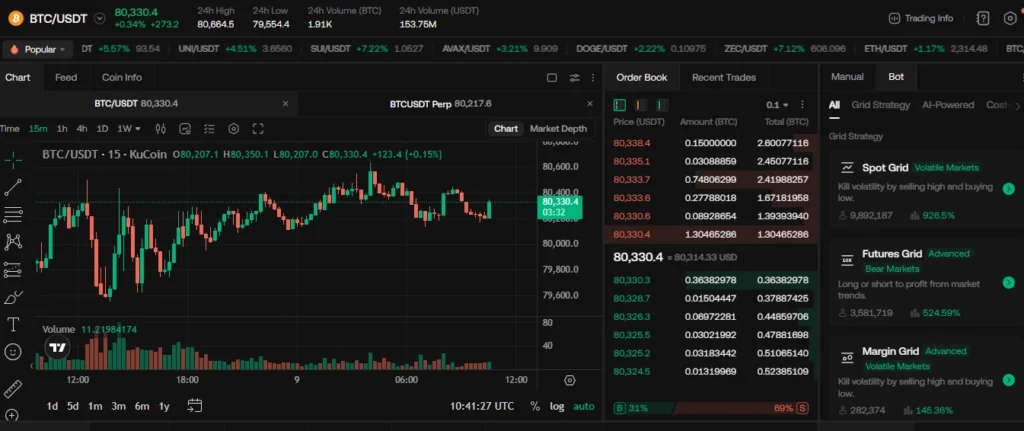
The KuCoin trading bot is a native, built-in automation tool on the KuCoin exchange. It allows users to execute cryptocurrency trading strategies automatically, based on rules they set in advance or rules the platform’s AI suggests.
Unlike many third-party crypto bots that require you to connect via API keys and pay monthly subscription fees, KuCoin’s bots live inside the exchange itself. That is a meaningful difference. You do not need to keep a browser tab open, run a server, or trust a separate company with access to your funds.
KuCoin’s native bots integrate seamlessly with the exchange and carry zero subscription fees; only standard trading fees apply. That alone makes it an attractive starting point for traders who want automation without added cost complexity.
The platform currently offers the following bot strategies:
- Spot Grid
- Futures Grid
- Spot Martingale
- Smart Rebalance
- Infinity Grid
- DCA (Dollar-Cost Averaging)
- AI Spot Trend
Each strategy serves a different market condition. That variety matters more than most people realize because what works in a sideways, choppy market is completely different from what works during a trending bull run.
KuCoin trading bots are particularly favored for their ease of use and effectiveness in diverse market conditions, catering to diverse trading strategies and risk management objectives.
How Does the KuCoin Trading Bot Actually Work?
Before diving into each individual strategy, it helps to understand the basic mechanics behind all of them.
At its core, a trading bot follows a set of pre-defined rules to place buy and sell orders automatically. You define the parameters price range, investment amount, number of orders, risk levels and the bot executes without requiring your constant attention.
KuCoin bots run entirely in the cloud. You do not need to keep the mobile app open or leave a computer running. The bot keeps working as long as you have not paused or stopped it manually.
When you set up a bot, you have two main configuration paths:
Auto Mode: The platform uses historical data and its AI engine to suggest parameters. Great for beginners who want to start quickly without knowing the technical details.
Custom Mode: You manually define every parameter, price range, grid spacing, leverage, stop-loss, and take-profit. This gives experienced traders full control.
Both modes sit within the same interface. You pick your trading pair (say, BTC/USDT), choose your strategy, input your capital, and hit create. The bot then takes over.
KuCoin Trading Bot Strategies: A Full Breakdown
1. Spot Grid Bot — The Classic Workhorse
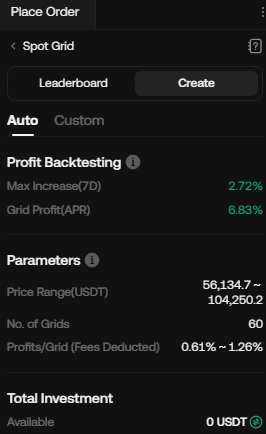
The Spot Grid bot is the most popular strategy on KuCoin, and for good reason.
Grid trading is a strategy built around a simple idea: prices tend to oscillate up and down within a range. Instead of trying to predict direction, you place multiple buy orders below the current price and multiple sell orders above it. As the price bounces back and forth, the bot collects profit on each movement.
A grid trading bot places a grid of buy and sell orders of the same size at predetermined levels between the top and bottom of the range. As soon as the price climbs above one of the grid lines, the bot places a sell order, and vice versa, when the price drops, the bot automatically places a buy order.
Here is a real-world example of how this plays out:
Imagine you set up a Spot Grid bot on BTC/USDT with a lower price limit of $80,000 and an upper limit of $100,000. You add 10 grid levels. The bot places buy orders every $2,000 below the current price and sell orders every $2,000 above it. Every time Bitcoin dips to the next grid line and rebounds, the bot pockets the spread.
The Spot Grid bot performs best in sideways or mildly volatile markets, the kind where prices move around without going clearly up or clearly down. In a flat market, most traders stare at charts feeling helpless. The grid bot quietly keeps collecting small profits from every swing.
Where does it struggle? During strong directional trends. If Bitcoin decides to fall from $90,000 to $60,000 in a straight line, the bot keeps buying on the way down. It will accumulate a lot of BTC, but it may not find the sell orders it needs to close profitable trades. Setting a proper stop-loss before you launch the bot is essential for this reason.
The Spot Grid Trading Bot is among the most profitable KuCoin bot trading strategies, especially in volatile markets.
2. Futures Grid Bot — Grid Trading With Leverage
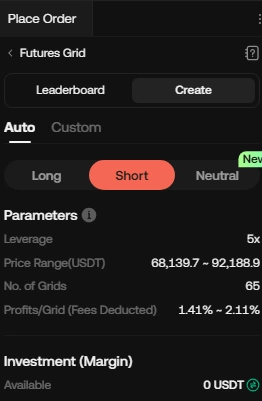
The Futures Grid bot works on the same core grid logic as its spot counterpart, but it adds two important dimensions: leverage and the ability to profit from both rising and falling prices.
In spot trading, you can only profit when the price goes up (buy low, sell high). Futures trading lets you go “long” (betting on price increases) or “short” (betting on price drops). The Futures Grid bot automates this across a grid structure.
With the KuCoin futures trading bot, you can leverage your profit potential up to 100x, using either Isolated or Cross Margin with the KuCoin Grid bot, KuCoin DCA Bot, or Infinity Trail.
Let that number sink in: 100x leverage. That means a 1% price movement creates a 100% swing in your position. It also means a 1% move in the wrong direction wipes out your position entirely.
This is not a bot for casual experimentation. Futures trading amplifies both gains and losses, and the Futures Grid bot is best suited for experienced traders who understand margin, liquidation, and risk management deeply.
That said, when used responsibly with low leverage, tight stop-losses, and appropriate position sizing, the Futures Grid bot is a genuinely powerful tool for active traders who want to extract value from both market directions.
Use Isolated Margin when you want to limit your maximum loss to only the capital allocated to that specific position. This prevents a single losing trade from affecting the rest of your portfolio.
3. DCA Bot — The Long-Term Investor’s Best Friend
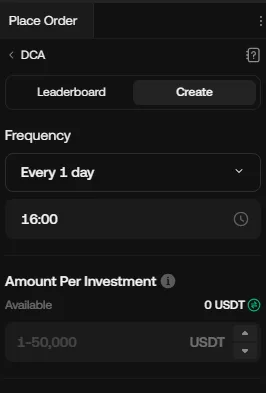
The DCA (Dollar-Cost Averaging) bot is the most philosophically sound strategy for long-term crypto investors, and arguably the least stressful to run.
Dollar-cost averaging means buying a fixed amount of an asset at regular intervals, regardless of its price. Buy $100 of Ethereum every week, whether it is at $2,000 or $2,500 or $1,800. Over time, your average purchase price smooths out the volatility, and you accumulate the asset without ever needing to “time the market.”
This idea is well-supported in financial research. DCA strategies are suitable for long-term investors who trust in the value of the target asset and want to avoid the impact of market fluctuations. The bot buys the target asset at fixed intervals, regardless of price.
KuCoin’s DCA bot automates the entire process. You set a trading pair, pick your investment amount and interval (daily, weekly, etc.), and the bot does the rest. It removes the emotional component entirely; you are not watching charts and second-guessing yourself. The bot buys, the portfolio grows, and you get on with your life.
For long-term accumulation, DCA is the simplest way to automate periodic buys without staring at charts.
The DCA bot is especially useful for traders who believe in the long-term value of an asset but feel anxious about picking the perfect entry point. Here is the liberating truth: with DCA, there is no perfect entry point. You buy consistently, and time does the heavy lifting.
4. Spot Martingale Bot — High Risk, High Reward
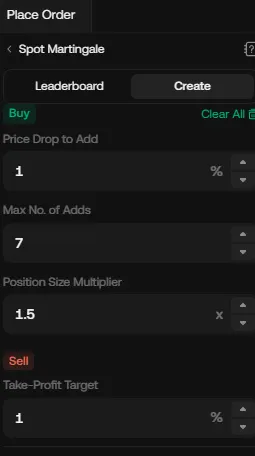
The Spot Martingale bot is the most aggressive strategy on KuCoin’s platform, and it comes with a fascinating history.
The Martingale strategy did not start in finance. Martingale was initially created as a casino-centric strategy that lets a gambler double their stakes after every loss, so that the first win would recover all previous losses and win a profit equal to the original stake.
In crypto trading, the logic gets adapted: instead of doubling your bet after a loss, you increase your position size as the price falls. The idea is that if an asset is fundamentally sound, it will eventually recover — and when it does, your larger accumulated position yields a profit that covers all previous “losing” entries.
The Spot Martingale bot buys in batches and sells all at once, while the grid trading bot buys and sells in batches. Since Spot Martingale buys larger quantities during a downturn, the assets held at the first opening are less, whereas grid trading holds more assets at opening, usually about half of the initial investment.
Here is a concrete example of how the Martingale mechanism escalates:
If you start with 1 unit and the price drops 1%, the bot buys 2 units. Another 1% drop triggers a 4-unit purchase. Another drop adds 8 units. By the time the price has fallen 4%, you hold 31 units total at an average-down cost. When the price recovers to your profit target, the bot sells everything and starts again.
The compounding nature of this approach means it can generate meaningful returns in sideways and mildly bearish markets. For arbitrage in oscillating markets, the Spot Martingale strategy yields higher returns with lower risks.
But here is the honest warning: if the price of an asset keeps falling without recovery, think a token heading to zero, the Martingale strategy accelerates losses rather than capping them. This strategy should mostly be used on large cryptocurrencies during stagnating markets or market pullbacks, and you should avoid using it during strong upswings or downswings on high volume.
In other words: use the Martingale bot on Bitcoin, Ethereum, or other established assets. Never use it on highly speculative tokens with a real risk of complete failure.
5. Smart Rebalance Bot — Portfolio Management on Autopilot
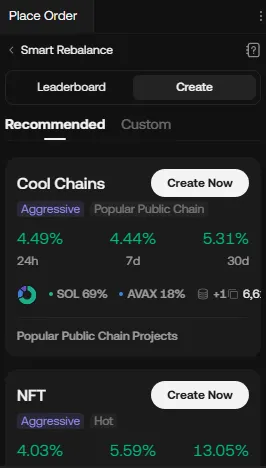
The Smart Rebalance bot approaches trading differently than the others. Instead of focusing on individual price movements, it focuses on maintaining the right mix of assets in your portfolio.
Here is the problem it solves: say you build a portfolio with 50% Bitcoin, 30% Ethereum, and 20% Solana. Bitcoin rallies hard and now makes up 70% of your portfolio. You are technically richer, but you are also now heavily concentrated in a single asset, which means higher risk.
The Smart Rebalance bot automatically sells some of the over-performing assets and buys more of the under-performing ones to restore your original allocation. This “buy low, sell high” happens automatically across your entire portfolio, not just one trading pair.
The bot operates in two modes:
Threshold Rebalancing: The bot rebalances whenever an asset’s allocation drifts beyond a set percentage. For example, if any holding moves more than 5% from its target, the bot corrects it.
Periodic Rebalancing: The bot rebalances on a fixed schedule every hour, day, or week, regardless of whether any significant deviation has occurred.
Both modes serve the same goal: keeping your portfolio intentional and aligned with your strategy. This is the kind of disciplined portfolio management that professional fund managers execute manually, and the KuCoin Smart Rebalance bot does it automatically for retail traders.
6. Infinity Grid Bot — Built for Trending Markets
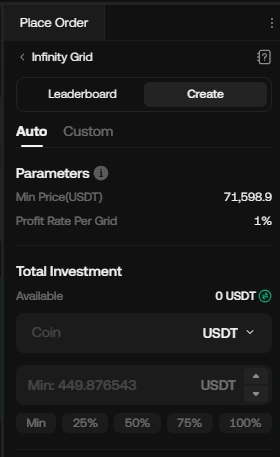
The Infinity Grid bot is a more sophisticated variant of the standard grid strategy. Where the regular Spot Grid bot requires you to define fixed upper and lower price limits, the Infinity Grid has no upper price ceiling.
This makes it particularly well-suited for assets in a long-term uptrend. Instead of getting “stuck” when price breaks above the upper grid limit (and the regular bot would stop trading), the Infinity Grid continues placing buy orders and selling at progressively higher prices.
KuCoin offers the Infinity Grid for trending moves. The structure automatically adjusts as the market moves upward, letting you ride a sustained bull trend without manually reconfiguring the bot every time the price breaks new levels.
The trade-off is that Infinity Grid bots are slightly more complex to tune, and they can be less efficient in choppy sideways markets where a standard Spot Grid would typically outperform.
Read more: Is KuCoin a scam or safe in 2026
KuCoin Review After 7 Days of Use
Key Features That Make KuCoin Bots Stand Out
No Extra Subscription Cost
This is worth repeating because it genuinely matters.
Most third-party trading bots, 3Commas, Bitsgap, and Cryptohopper, charge monthly subscription fees ranging from $15 to $100+ per month. Those costs can quietly erode trading profits, especially for smaller accounts.
KuCoin trading bots carry zero subscription fees; only standard trading fees apply. The only cost you incur is the regular trading fee KuCoin charges on each executed order, which is the same fee you would pay on any manual trade.
To give you a sense of scale: at KuCoin’s standard taker rate of 0.1%, a Spot Grid running 10 cycles per day on a 150 USDT allocation generates roughly $0.15 in daily fees — around $4.50 per month. That is transparent and predictable.
Desktop Pro Interface With TradingView Integration
KuCoin offers an advanced desktop interface for trading bot management, which is a meaningful upgrade over the standard mobile view.
The desktop version integrates directly with TradingView charts, giving you a visual overlay of your grid lines on the price chart. Instead of just reading numbers, you can literally see where your buy and sell orders sit relative to price action. For serious traders, this kind of visual clarity is invaluable.
For seasoned crypto traders seeking a more comprehensive visual insight into their trading bot’s operation, KuCoin caters to your needs with the Trading Bot Pro version on PC, which allows you the flexibility to scrutinize all your grids via a TradingView chart.
The desktop interface also gives access to advanced risk management settings, stop-loss, take-profit, leverage adjustment in a layout that is simply easier to navigate on a larger screen.
AI-Assisted Setup
For users who do not know where to start, KuCoin’s AI-powered auto-configuration takes the guesswork out of parameter setting.
When you select “Auto” mode, the platform analyzes historical price data for your chosen trading pair and suggests a price range, number of grids, and investment amount. You do not need to know what a “grid interval” is or how to calculate optimal spacing.
The user-friendly interface makes these bots accessible to both novice and experienced traders. Beginners can launch with AI-suggested settings, learn how the bot behaves in real conditions, and gradually customize settings as their confidence grows.
Risk Management Tools Built In
Every KuCoin bot strategy includes built-in risk controls that help you define your maximum acceptable loss before launching.
Stop-Loss: If the asset price falls below a level you define, the bot automatically stops and sells your position. This prevents a bad trade from becoming a catastrophic loss.
Take-Profit: Conversely, if your position reaches a profit target you set, the bot closes out and locks in gains. This prevents greed from turning a winning position into a breakeven (or losing) one.
These tools are not unique to KuCoin, but having them native to the bot setup process rather than requiring separate configuration in a third-party tool makes them far more likely to be used correctly.
KuCoin Trading Bot: Honest Pros and Cons
Pros
Built directly into the exchange. No API key setup, no third-party trust required, no separate account to manage.
No monthly subscription fee. You only pay standard trading fees, the same as any manual trade.
Multiple strategies for different market conditions. Six distinct bot types cover sideways markets, trending markets, long-term accumulation, and portfolio management.
AI auto-configuration for beginners. Beginners can get started in minutes without advanced knowledge.
TradingView integration on desktop. Visual grid overlay on live charts makes strategy management cleaner.
Cloud-based operation. The bot runs 24/7 without needing your device to stay on.
Risk management tools included. Stop-loss and take-profit are built into the setup process.
Cons
Not available for US residents. This is the biggest limitation for American traders. KuCoin is a venue best suited for traders who want to run simple Spot Grid or DCA bots with minimal setup, but US users face restrictions. The reason is that regulatory KuCoin has chosen not to register under the strict requirements set by US financial regulators, meaning access is blocked for users in the United States.
No API control for native bots. Native bots are UI-only, with no API control. This is a significant limitation for developers or traders who want to integrate bot behavior with custom code, external signals, or their own trading systems.
Futures leverage carries serious risk. The Futures Grid bot’s leverage goes up to 100x. For inexperienced users, this is genuinely dangerous, and the platform’s setup interface does not always make this risk loud enough.
The Martingale strategy requires strong conviction. The Spot Martingale bot can accelerate losses in a sustained downtrend. It requires careful asset selection and a realistic assessment of downside risk.
No cross-exchange functionality. KuCoin bots only work within KuCoin. Traders who hold funds on multiple exchanges need separate tools for each platform.
read
How to Set Up the KuCoin Spot Grid Bot: Step-by-Step
Let us walk through the most common starting point: creating a Spot Grid bot.
Step 1 — Log In and Find the Trading Bot Section
Log in to your KuCoin account. From the top navigation menu, hover over “Trade” and select “Trading Bot” from the dropdown. This takes you to the bot hub, where all strategies live.
Step 2 — Select Spot Grid
Click on the “Spot Grid” tab. You will see options to choose a trading pair.
Step 3 — Choose Your Trading Pair
Select the cryptocurrency pair you want the bot to trade. BTC/USDT is the most popular choice for beginners, given Bitcoin’s liquidity and relatively predictable range behavior.
Step 4 — Set Your Parameters
Here you choose between Auto and Custom:
- Auto: Let KuCoin’s AI suggest the price range, grid count, and investment amount based on historical data.
- Custom: Manually enter your upper price limit, lower price limit, number of grids, and total investment.
If you are new to this, start with Auto. Watch how the bot behaves over a week before adjusting to custom settings.
Step 5 — Configure Risk Controls
Add a Stop-Loss price and, optionally, a Take-Profit target. These are not optional niceties; they are essential safeguards. A grid bot running without a stop-loss can theoretically keep buying a falling asset until your entire balance is consumed.
Step 6 — Review and Launch
Check every parameter. Confirm the investment amount, price range, grid count, and risk settings. Then click “Create” to launch your bot.
Once running, the bot dashboard shows you the number of completed grid trades, total profit, and current status in real time. You can pause or stop the bot at any time from this same screen.
How to Set Up the DCA Bot: Step-by-Step
Setting up a DCA bot is even simpler.
Step 1 — Navigate to Trading Bot > DCA
Same path as before: Trade → Trading Bot → DCA.
Step 2 — Choose Your Asset
Pick the cryptocurrency you want to accumulate. For DCA to make sense, choose an asset you genuinely believe in for the long term.
Step 3 — Set Investment Amount and Interval
Decide how much you want to invest per purchase (e.g., $50) and how frequently (daily, every 3 days, weekly). This is the core of DCA — consistency over time.
Step 4 — Set a Take-Profit Target (Optional)
You can configure the bot to automatically close out the full position when your profit reaches a certain percentage. Or you can let it accumulate indefinitely until you manually stop it.
Step 5 — Launch
Review and click Create. The bot will execute the first purchase immediately and schedule the next one according to your chosen interval.
Is the KuCoin Trading Bot Safe?
Safety in this context covers two things: security of funds and safety of the trading strategy itself.
On fund security: Because KuCoin’s bots are native to the exchange, your funds never leave your KuCoin account. There are no third-party API connections, no external wallets, and no additional services with access to your assets. The security of your funds depends on the security of your KuCoin account itself strong password, two-factor authentication, and anti-phishing codes are all available and should be enabled.
KuCoin has implemented several account-level security features, including Google Authenticator support, trading password protection, and device management controls. Enabling all of these is basic hygiene before launching any bot with real capital.
On trading strategy safety: No bot guarantees profits. Every strategy carries risk in different market conditions. Crypto bots are not infallible and may fail to execute orders due to technical glitches, network lags, or exchange limitations.
Grid bots can accumulate losing positions during strong downtrends. Martingale bots can amplify losses on assets that do not recover. Futures bots with high leverage can liquidate positions rapidly.
There is also the question of market risk that no bot can eliminate. A grid bot running on a trading pair where the asset loses 60% of its value is not going to generate meaningful profit, regardless of how well it is configured. Bots execute your strategy mechanically. They do not predict price direction.
This is why the strategy you choose matters as much as the tool itself. Matching the right bot to the right market condition is the real skill — and it is something you develop through experience, not just reading guides.
The safest approach is to start with a small capital allocation, use conservative settings, always configure a stop-loss, and treat the first few weeks as a learning period rather than an income strategy.
Who Should Use the KuCoin Trading Bot?
Best for:
Traders who are already on KuCoin and want to automate simple strategies without paying for external tools. The zero-subscription model makes it cost-effective even for smaller accounts.
Long-term investors who want to automate DCA purchases and stop thinking about entry timing altogether.
Intermediate traders who understand grid logic and want a straightforward way to run systematic, rules-based trading in sideways markets.
Not ideal for:
US residents are blocked from accessing KuCoin entirely due to regulatory restrictions.
Developers who want API-level control over bot behavior. KuCoin’s native bots do not expose API control for automation.
Traders managing large, complex portfolios across multiple exchanges. KuCoin bots only work within KuCoin.
Complete beginners with no understanding of market mechanics. The bots are user-friendly, but they cannot substitute for a basic understanding of how cryptocurrency markets work. Launching a Martingale or Futures Grid bot without that foundation is genuinely risky.
KuCoin Trading Bot vs. Third-Party Alternatives
It is worth briefly comparing KuCoin’s native bots against dedicated third-party trading bot platforms.
3Commas offers more advanced features — cross-exchange support, API integration, DCA long/short, social trading — but charges monthly subscription fees starting around $37. It is more powerful but costs more.
Pionex is a competing exchange with 16+ built-in free bots, similar to KuCoin’s native model. Pionex integrates 16+ free trading bots directly within its exchange, with low or zero maker trading fees and a simple user interface suited for those new to automated trading. Pionex is worth considering for beginners as a direct alternative.
Bitsgap focuses on its COMBO bot, combining grid and DCA techniques, with additional backtesting features, but again with subscription pricing.
Where KuCoin’s bots win clearly: zero additional cost, native integration, and no trust required in a third party. Where they fall short: no API control, no cross-exchange capability, and limited advanced customization compared to dedicated platforms.
For most users who are already on KuCoin and want to start automating without additional complexity, the native bots are the right starting point. You can always graduate to third-party tools once you understand what additional features you actually need.
Practical Tips for Getting the Most Out of KuCoin Bots
Start small. Before committing significant capital, run the bot with a small amount for a week or two. Understand how it behaves in real market conditions before scaling up.
Match strategy to market conditions. Grid bots work best in sideways markets. DCA works in any market but shines during bear markets. Infinity Grid suits strong uptrends. Do not force the wrong tool onto the wrong market environment.
Set stop losses every time. This is not optional for responsible trading. Define the worst-case scenario before you launch, not after.
Do not over-leverage. The Futures Grid bot’s 100x leverage ceiling exists, but using it is extremely high risk. Conservative traders should use little to no leverage, especially when learning.
Review bot performance weekly. Bots are not truly “set and forget.” Market conditions change, and a strategy that worked last month may need adjustment today. Check your bot dashboards regularly.
Avoid the Martingale bot on small-cap or low-liquidity tokens. The Martingale strategy relies on the assumption that the asset will recover. Speculative tokens sometimes do not. Stick to established, high-liquidity cryptocurrencies for this strategy.
Common Mistakes Traders Make With KuCoin Bots
Understanding the strategies is one thing. But knowing what goes wrong in practice is arguably more valuable. Here are the most common mistakes traders make when using KuCoin trading bots and how to avoid them.
Running a grid bot without a stop-loss.
This is the single most common and costly mistake. A Spot Grid bot without a stop-loss will keep buying an asset as its price falls indefinitely. If you set up a BTC/USDT grid between $80,000 and $100,000, and Bitcoin drops to $60,000, the bot has deployed all your capital into a falling asset with no exit mechanism. Always define your worst-case exit before clicking “Create.”
Using the Martingale bot on low-liquidity tokens.
The Martingale strategy works on the assumption that the asset will eventually recover. That assumption breaks down completely with low-quality tokens that can lose 90% of their value and never recover. Only use the Martingale bot on high-liquidity, established cryptocurrencies.
Setting too many grids with too little capital.
If you spread $100 across 50 grid levels, each individual order is so small that trading fees eat a significant portion of each profit. There is a practical minimum per grid — typically several dollars below which the math stops working in your favor. Fewer grids, bigger per-grid capital, and lower fees are the more profitable configuration for small accounts.
Confusing “bot running” with “bot profitable.”
An active bot and a profitable bot are two completely different things. Users sometimes check their bot dashboard, see lots of activity, and assume everything is going well. It is not until they compare the total profit/loss to simply holding the asset that they realize the bot has underperformed. Regularly audit your bot’s actual performance against the benchmark of simply doing nothing.
Not adjusting parameters when market conditions change.
A grid bot configured for a tight sideways range will perform poorly when the market enters a strong trend. Parameters that worked perfectly in February may need adjustment in March. Bots require periodic human oversight — they are not truly passive.
Over-leveraging on the Futures Grid bot.
The temptation to use higher leverage is understandable it amplifies gains. But it amplifies losses equally. A 10x leverage position gets liquidated on a 10% adverse move. On volatile crypto assets, 10% moves happen within hours. Unless you actively manage leveraged positions and understand liquidation mechanics thoroughly, keep leverage low or use the spot bots instead.
Understanding KuCoin Trading Fees in the Context of Bots
Before launching any KuCoin trading bot, it is worth understanding how fees work because they have a meaningful compounding effect on bot performance.
KuCoin charges standard maker and taker fees on every executed order. As of the time of this writing, the standard taker fee on KuCoin is 0.1%. For high-frequency bots that execute many trades per day, this accumulates.
To put it in concrete terms: at KuCoin’s standard taker rate of 0.1%, a Spot Grid running 10 cycles per day on a 150 USDT allocation generates roughly $0.15 in daily fees — around $4.50 per month. On a 150 USDT investment, that is 3% of your capital going to fees monthly before any market risk is factored in.
This does not mean fees make bots unprofitable. A well-configured grid bot in a volatile market can generate far more than 3% monthly in spread profits. But it does mean you need to account for fees when evaluating whether a bot strategy is working.
KuCoin offers fee discounts for holders of its native KCS token and for users with higher trading volumes. If you plan to run bots long-term with meaningful capital, reviewing KuCoin’s fee tier structure is worth the time.
After going through every strategy, feature, advantage, and limitation, here is the honest summary:
The KuCoin trading bot is genuinely useful — particularly for traders who want a simple, cost-free way to automate systematic strategies within the KuCoin ecosystem.
The Spot Grid bot is a solid, well-designed tool for sideways market conditions. The DCA bot is one of the most sensible investment automation tools available on any exchange. The Smart Rebalance bot solves a real problem for multi-asset portfolio holders. And the zero-subscription pricing model makes all of it accessible without eating into your trading profits before you even start.
The limitations are real, though. US residents cannot use it. Power users who want API integration will find it restrictive. And the Futures Grid and Martingale bots carry meaningful risks that casual users should approach with serious caution.
If you are a KuCoin user outside the US who wants to dip your toes into automated trading, this is one of the most accessible entry points available especially at no additional cost. Start with the Spot Grid or DCA bot, use conservative settings, and treat the first month as education.
Done correctly, the KuCoin trading bot does exactly what it promises: it takes the exhausting, emotional, sleep-disrupting work of manual trading and replaces it with disciplined, rule-based automation.
Your 2 AM self will thank you.
Frequently Asked Questions
Does the KuCoin trading bot cost money?
KuCoin’s native trading bots carry no subscription fee. You only pay the standard KuCoin trading fee on each order the bot executes the same fee you would pay on any manual trade.
Can US residents use the KuCoin trading bot?
No. KuCoin and its trading bot tools are not available to US residents due to regulatory restrictions.
Which KuCoin bot strategy is best for beginners?
The DCA bot is the simplest and most beginner-friendly strategy. The Spot Grid bot with Auto settings is also a solid starting point. Both carry a lower risk than the Martingale or Futures Grid strategies.
Is the KuCoin trading bot profitable?
No bot guarantees profit. KuCoin bots can be profitable when the strategy matches market conditions, parameters are configured thoughtfully, and risk controls are in place. Past performance of any bot strategy does not guarantee future results.
Can I run multiple KuCoin bots at the same time?
Yes. KuCoin allows users to run multiple bots simultaneously across different trading pairs and strategies.
Does the KuCoin bot work 24/7?
Yes. KuCoin bots are cloud-based and run continuously without requiring your device to stay active.
Final Verdict: Is the KuCoin Trading Bot Worth It?
After going through every strategy, feature, advantage, and limitation, here is the honest summary:
This article is for informational purposes only and does not constitute financial or investment advice. Cryptocurrency trading involves significant risk, including the potential loss of principal. Always conduct your own research before making any investment decisions.
