
MEXC is one of the lowest-fee crypto exchanges on the planet, with over 3,000 listed coins, a powerful trading engine, and a feature set that genuinely rivals Binance. It is not the most regulated platform in the room, and that matters depending on where you live. But if low fees, massive coin selection, and advanced trading tools are your priorities, MEXC is hard to ignore in 2026.
Mexc Review for Beginners : MEXC Key Facts
| Detail | Information |
| Founded | 2018 (as MXC Exchange) |
| Rebranded | 2021 (MEXC Global) |
| Headquarters | Victoria, Seychelles |
| CEO | John Chen |
| Website | www.mexc.com |
| Total Users | 40+ million across 170+ countries |
| Supported Cryptocurrencies | 3,000+ |
| Spot Trading Pairs | 2,052+ |
| Futures Pairs | 1,500+ USDT-M contracts |
| Trading Engine Speed | 1.4 million transactions per second |
| Daily Trading Volume | ~$5 billion |
| Global Ranking | Top 10 spot, Top 5 futures |
| Native Token | MX |
| Customer Support Email | support@mexc.com |
MEXC Scorecard
| Category | Score | Verdict |
| Fees | ⭐⭐⭐⭐⭐ 5/5 | Industry-leading. Hard to beat. |
| Coin Selection | ⭐⭐⭐⭐⭐ 5/5 | More altcoins than virtually anyone. |
| Trading Features | ⭐⭐⭐⭐ 4/5 | Deep and growing — includes stock futures. |
| Security | ⭐⭐⭐⭐ 4/5 | Solid, but custodial risk is always real. |
| Ease of Use | ⭐⭐⭐⭐ 4/5 | Learnable for beginners, built for traders. |
| Regulation & Trust | ⭐⭐⭐ 3/5 | Weakest area. Multiple regulator warnings. |
| Customer Support | ⭐⭐⭐ 3/5 | Fast for small issues, slow for big ones. |
| Overall | ⭐⭐⭐⭐ 4.3/5 | Strong choice — with caveats worth knowing. |
Best for: Active traders, altcoin hunters, futures traders, and fee-conscious users outside the US.
Not ideal for: US residents (blocked), complete beginners who want hand-holding, users prioritizing strict regulatory oversight.
What Is MEXC? The Full Background
MEXC started in 2018 under the name MXC Exchange. The founding team — led by CEO John Chen, a Singaporean businessman — built the platform around a simple bet: list new tokens faster than anyone else, charge less than everyone else, and let speed and access do the marketing. That bet paid off. By 2021 the platform rebranded to MEXC Global, and by 2026, it had grown into one of the ten largest spot exchanges on earth.
The name MEXC is actually an acronym — Most trending tokens, Everyday airdrops, Xtremely low fees, Comprehensive liquidity. Whether that fully describes the experience is debatable. The fees part, though, is not debatable at all.
The exchange is headquartered in Victoria, Seychelles — a jurisdiction chosen deliberately for its crypto-friendly tax environment (zero corporate tax, no capital gains, no VAT on crypto transactions) and its ability to serve 170+ countries from a single operating entity. It is a practical setup for a global exchange, even if it does not inspire the same confidence as, say, a New York or London registration. More on that in the regulation section.
MEXC is not a simple “buy Bitcoin and hold” platform. It is built around active trading. Spot markets, perpetual futures, stock-linked derivatives, copy trading, staking, launchpad access, crypto loans, and a demo account — it is more trading hub than digital piggy bank. That distinction matters if you are a beginner trying to decide whether the complexity is worth it.
Is MEXC Safe? Security Features in Detail
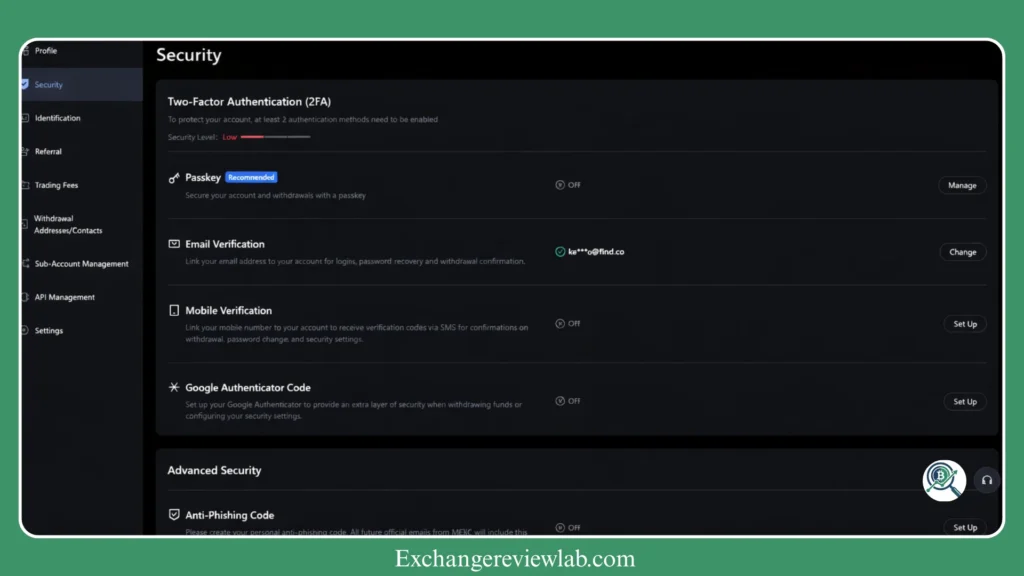
This is the question everyone searches first. Let us answer it properly instead of just saying “yes, it is safe” and moving on.
What MEXC Does to Protect Your Account
Two-Factor Authentication (2FA): Available via authenticator app. Mandatory recommendation for every user before depositing a single dollar.
Anti-Phishing Code: You set a personal code, and every real MEXC email includes it. If an email claiming to be from MEXC does not have your code, it is fake. Simple and genuinely useful.
Withdrawal Whitelist: You can restrict withdrawals to pre-approved wallet addresses only. Even if someone steals your password, they cannot send funds to a random wallet without first disabling the whitelist — which triggers a 24-hour hold. That is a real deterrent.
Cold Storage: MEXC keeps 95% of user assets in offline cold storage with multi-signature wallets and hardware security modules. The remaining 5% stays in hot wallets for day-to-day withdrawals, protected by distributed key management.
Proof of Reserves: MEXC publishes bi-monthly reserve reports audited by third-party security firm Hacken. As of March 2026, the numbers were: BTC reserve ratio 270%, ETH 112%, USDT 114%. Those ratios mean MEXC holds significantly more BTC than user balances require — which is a strong on-chain trust signal.
$100 Million Guardian Fund: A dedicated insurance reserve built to compensate users in the event of a security breach. This is MEXC’s equivalent of what Binance calls its SAFU fund.
Bug Bounty Program: MEXC runs a public bug bounty via BugRap, offering up to 20,000 USDC to security researchers who responsibly disclose vulnerabilities. Exchanges that invite public scrutiny of their code tend to be more secure than those that do not.
Automated Risk Detection: An AI-powered system that flags unusual activity patterns in real time. This is a double-edged sword — more on that in the user feedback section.
The Real-World Security Threat You Need to Know About
In January 2026, The Hacker News reported on a malicious Chrome browser extension specifically designed to steal MEXC API keys, enable unauthorized withdrawals, and send user credentials to attackers. This was not a MEXC infrastructure hack — MEXC itself was not breached. The attack came through compromised user devices. Still, the lesson is important: do not install random browser extensions, do not grant withdrawal permissions to API keys unless absolutely necessary, and treat your browser environment as part of your security stack.
Has MEXC Been Hacked?
No major confirmed exchange-level hack as of 2026. That is a meaningful track record in an industry where billions of dollars have disappeared through exchange breaches since 2014. It does not guarantee the future, but it is worth noting honestly.
MEXC Regulation: The Honest Picture
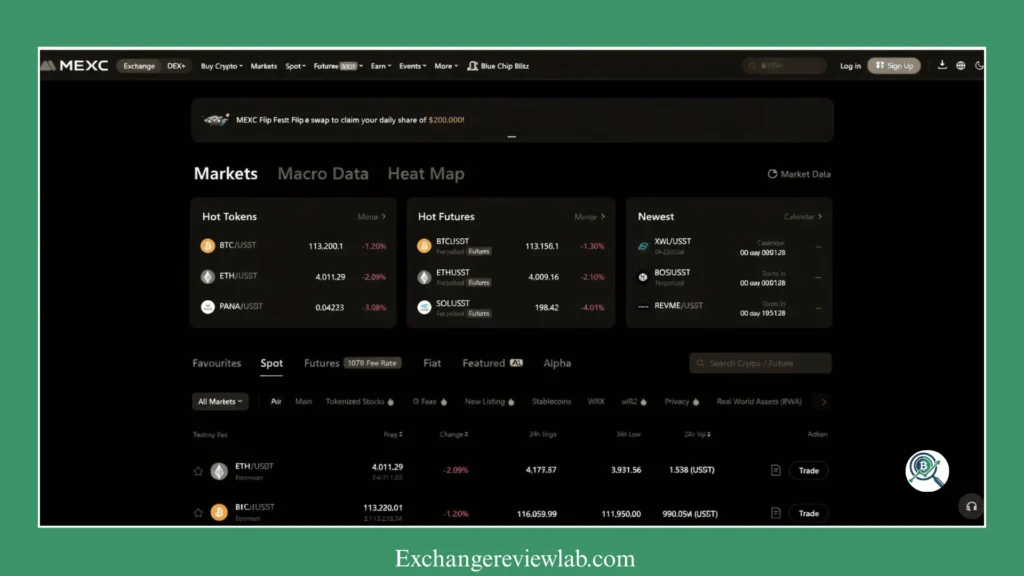
Here is where the conversation gets more complicated — and where some MEXC competitors will try to scare you without giving you the full context.
MEXC holds an MSB (Money Services Business) license in the US, an AUSTRAC license in Australia, and previously held an MTR license in Estonia (revoked in November 2023). In 2025, the exchange received FCA registration in the United Kingdom, expanding its European footprint. In India, MEXC is registered with the Financial Intelligence Unit (FIU-IND), making it one of the more compliant international exchanges available to Indian users.
That said, MEXC has also received regulatory warnings from Germany’s BaFin, the British Columbia Securities Commission (BCSC) in Canada, and has appeared on Hong Kong’s SFC alert list. It does not currently serve US residents, Canadians, mainland Chinese users, or users in several other restricted jurisdictions.
What does all this mean practically? MEXC is a real, large-scale, functioning exchange not a scam. But its regulatory profile is not as clean or comprehensive as Kraken (US-regulated, been operating since 2011) or Coinbase (publicly listed on Nasdaq). If maximum regulatory protection matters most to you, those are stronger options. If low fees and coin access matter more, and you are not in a restricted country, MEXC makes a strong case.
MEXC Fees: The Complete Breakdown
Fees are MEXC’s single clearest advantage. Here is every fee type you need to understand.
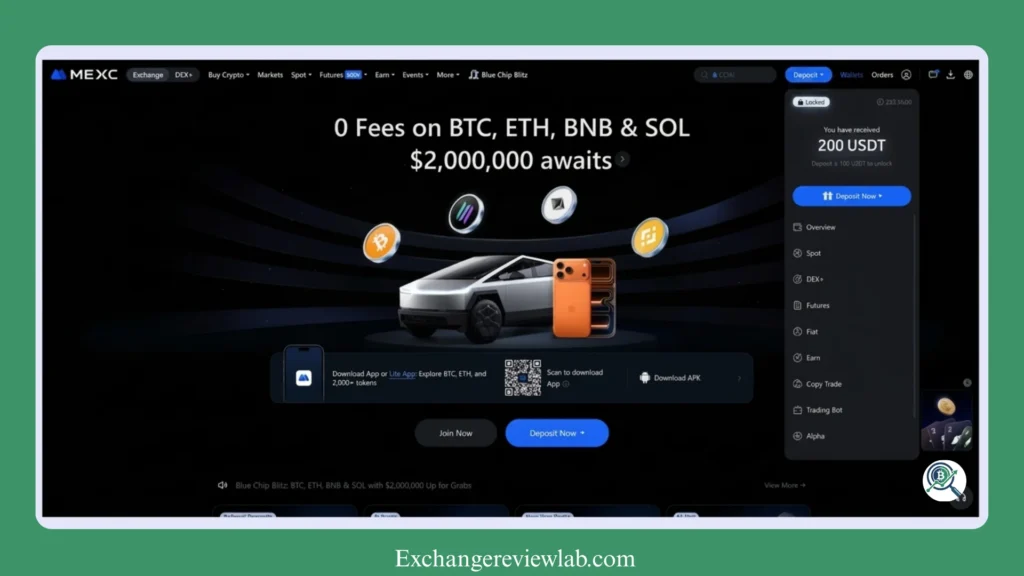
Spot Trading Fees
| Fee Type | Rate |
| Spot Maker | 0.00% |
| Spot Taker | 0.05% |
A maker order adds liquidity to the order book (a limit order you place and wait for). A taker order removes liquidity immediately (a market order). MEXC charges zero for makers and 0.05% for takers on standard spot trades. On popular pairs like BTC/USDT, MEXC periodically runs 0% taker promotions as well — check the live fee page before trading.
Real-world example: If you trade $1,000 on MEXC using a limit order, you pay $0. On Binance with 0.10% standard fees, you pay $1. On Coinbase with 0.60% fees, you pay $6. Over a year of active trading, that difference compounds considerably.
Futures Trading Fees
| Fee Type | Rate |
| Futures Maker | 0.00% |
| Futures Taker | 0.02% |
These are among the lowest perpetual contract fees of any major exchange. Bybit and Binance both charge 0.02% maker and 0.05% taker on futures. MEXC’s maker fee is zero, and its taker fee beats both.
Important: Futures also carry funding rate payments — periodic charges paid between long and short position holders to keep perpetual contracts aligned with the spot price. These are not listed under “fees” but can easily cost more than the commission itself if you hold a position overnight or across several days. Always factor funding rates into your futures cost calculation.
Deposit Fees
| Deposit Method | Fee |
| Crypto Transfer | Free (blockchain network fee applies) |
| P2P Trading | Free |
| Bank Transfer | Free in most regions |
| Credit/Debit Card | Up to 4% (charged by third-party providers: Banxa, MoonPay, Mercuryo) |
Crypto deposits are free on MEXC’s side. You only pay the standard blockchain network fee (set by the network, not MEXC). Worth knowing: Bitcoin deposits require 2 block confirmations before crediting, Ethereum requires 10, and USDT on the ERC-20 network requires 96 confirmations. If you are moving USDT via ERC-20 and wondering where your funds went — they are waiting on confirmations. Use TRC-20 (Tron network) for faster, cheaper USDT transfers.
Withdrawal Fees
Withdrawal fees vary by coin and network. As a general guide: USDT on TRC-20 costs around 1–2 USDT. Withdrawing ETH on mainnet depends on current gas prices. Binance and MEXC are broadly similar here — there is no universal winner because fees move with network congestion.
Fiat withdrawals to a bank account are not a direct native feature on MEXC. The platform routes these through third-party off-ramp providers, which carry their own fees and requirements. It is not impossible, but it is less streamlined than exchanges with integrated banking (like Kraken or Coinbase).
MX Token Discounts
Holding MEXC’s native MX token unlocks up to 50% off trading fees. The more MX you hold, the deeper the discount. High-volume traders who plan to use MEXC consistently should factor this in — the fee savings can be significant over months of active trading.
No Inactivity Fees
MEXC charges nothing for dormant accounts. There are no monthly fees either. It will not drain your balance just for sitting there.
Fee Comparison: MEXC vs Binance, Kraken, Coinbase, Bybit, OKX
| Exchange | Spot Maker | Spot Taker | Futures Maker | Futures Taker | Cryptos Listed |
| MEXC | 0.00% | 0.05% | 0.00% | 0.02% | 3,000+ |
| Binance | 0.10% | 0.10% | 0.02% | 0.05% | 500+ |
| OKX | 0.08% | 0.10% | 0.02% | 0.05% | 500+ |
| Bybit | 0.10% | 0.10% | 0.02% | 0.055% | 600+ |
| Kraken | 0.16% | 0.26% | 0.02% | 0.05% | 200+ |
| Coinbase | 0.40% | 0.60% | N/A | N/A | 200+ |
| KuCoin | 0.10% | 0.10% | 0.02% | 0.06% | 1,000+ |
MEXC is the cheapest option across both spot and futures trading among all major exchanges in 2026. The only close rival on spot fees is OKX at 0.08% maker. On coin selection, no one comes close to MEXC’s 3,000+ listings.
The trade-off: Kraken and Coinbase have stronger regulatory profiles. Binance has deeper liquidity on major pairs. OKX has a more polished ecosystem. MEXC wins on fees and coin access, and it wins convincingly.
MEXC Features: What You Can Actually Do
MEXC is not just a buy-and-sell platform. Here is what the full feature set looks like.
Spot Trading
The core trading experience on MEXC is fast and feature-rich. TradingView charts are integrated directly into the platform, so you get professional-grade charting without needing a separate subscription. Order types include market, limit, stop-limit, and OCO (One Cancels the Other) orders. The interface is more trader-focused than beginner-friendly — if you have never seen a candlestick chart before, there will be a brief learning curve. If you have, everything feels familiar within a few minutes.
Perpetual Futures Trading
MEXC’s futures market is one of its biggest draws. Over 1,500 USDT-M perpetual contracts are available, covering BTC, ETH, major altcoins, and a long list of smaller tokens. Leverage goes up to 200x on major pairs and up to 500x on select contracts — numbers that should be approached with genuine caution, especially by beginners.
You can choose between isolated margin (your risk is capped at the amount you put in the specific trade) and cross margin (your entire account balance backs the position). Isolated margin is safer for beginners because losses on any single trade are limited to that trade’s allocation.
Stock-Based Perpetual Futures — MEXC’s Most Unique Feature
This one does not get enough attention. In January 2026, MEXC launched stock index futures, including NAS100, US30, and SP500 as USDT-M perpetual contracts. By March 2026, SP500 and NAS100 were upgraded to 24/7 trading with up to 20x leverage.
MEXC also offers individual stock futures tied to NVDA, AAPL, TSLA, AMZN, GOOGL, META, COIN, and others. Before you get excited — these are not real stock purchases. You do not own any Nvidia shares. These are leveraged derivative contracts tied to stock prices. They are speculative instruments, not investments. US stock futures on MEXC currently support isolated margin only.
What makes this genuinely interesting is the access angle. Crypto traders outside the US who want exposure to US equity markets can now do so directly from their MEXC account, without opening a separate brokerage. No other major crypto exchange offers this at the same scale in 2026.
Copy Trading
MEXC’s copy trading feature lets you automatically mirror the positions of experienced traders. You can view a lead trader’s full performance history — win rate, return on investment, maximum drawdown, number of followers — before deciding whether to copy them. When they open a trade, the system replicates it proportionally in your account.
This is one of the genuinely useful features for beginners. Instead of flying blind in the futures market, you can attach your capital to someone who actually knows what they are doing. The key caveat: past performance does not guarantee future results. Even top-performing traders have losing months.
Demo Trading
MEXC gives every account access to a $50,000 virtual balance for futures demo trading. This is one of the most underused beginner tools in the entire crypto space. You can practice opening futures positions, test leverage mechanics, experience liquidation without losing real money, and understand how funding rates work — all before committing a single dollar of actual capital. If you are new to futures, use the demo account. There is no excuse not to.
Earn Products: Passive Income on Idle Crypto
Not everyone wants to trade. For holders, MEXC’s Earn section lets you generate passive income on assets that would otherwise just sit in your wallet.
Flexible Savings: Deposit crypto and earn daily interest. You can withdraw anytime. Returns vary by asset and market conditions but provide a simple way to put idle funds to work.
Fixed-Term Staking: Lock assets for a fixed period (7 days, 30 days, 90 days) in exchange for higher yields. Higher reward, less flexibility.
New Token Mining: Stake MX or other supported tokens to earn newly listed project tokens before they hit the market. High-risk, high-reward.
Yields can reach up to 100% APY on certain promotional products, though the average stablecoin return is considerably more modest. Always check whether a yield is promotional (time-limited) or structural (ongoing).
Launchpad and Kickstarter
MEXC’s Launchpad gives users early access to token sales for new projects before they list publicly on the exchange. The Kickstarter system lets MX token holders vote on which new coins get listed — and rewarded with token allocations for participating early.
Important: as of 2026, Advanced KYC is required to participate in Kickstarter events and airdrops. This is partly a compliance measure linked to CARF (Crypto-Asset Reporting Framework) protocols that MEXC implemented from January 1, 2026.
Crypto-Backed Loans
MEXC allows users to borrow stablecoins or other cryptocurrencies by using their existing crypto holdings as collateral. You keep your Bitcoin or Ethereum, borrow against it, and repay the loan with interest. Useful for users who want liquidity without selling their holdings and triggering a taxable event — though borrowing to trade is a risk management decision that deserves careful thought.
DEX+ Hybrid Platform
MEXC’s DEX+ system connects centralized execution speed with decentralized exchange liquidity, giving traders access to over 10,000 token pairs — including tokens that have not yet made it onto the main MEXC exchange. This is particularly useful for users hunting newly launched tokens across DeFi ecosystems. No gas fees, no external wallet required — it runs from your standard MEXC account.
MEXC Alpha
MEXC Alpha is the platform’s early-access token section. It gives users direct exposure to newly launched tokens immediately after launch, often before broader market awareness catches up. The upside is obvious — early movers have historically captured outsized returns on trending narratives. The downside is equally obvious — many new tokens do not survive. MEXC Alpha is for users comfortable with high-risk, speculative positions.
How to Set Up a MEXC Account: Step-by-Step
Getting started on MEXC is faster than opening a bank account. Here is exactly how it works.
Step 1 — Create Your Account
Go to www.mexc.com and click Sign Up in the top-right corner. You can register via email address, phone number, Google account, Apple ID, MetaMask wallet, or Telegram. Email registration is the most common and gives you the most account control.
Enter your email and create a strong password. Use a password manager if you do not already reusing passwords across crypto accounts is one of the most common causes of account compromise.
Step 2 — Verify Email or Phone
MEXC sends a 6-digit verification code immediately. Enter it to confirm your registration. If it does not arrive within two minutes, check your spam folder. Some users report occasional delays with the code, particularly on less common email providers.
Step 3 — Enable Two-Factor Authentication Immediately
Before you do anything else — before you deposit, before you look at prices — go to Account → Security → Two-Factor Authentication and enable an authenticator app. Google Authenticator and Authy both work. This single step makes your account dramatically more resistant to unauthorized access.
While you are in the security settings, also set an anti-phishing code and configure a withdrawal whitelist if you have a primary wallet address.
Step 4 — Complete KYC Verification
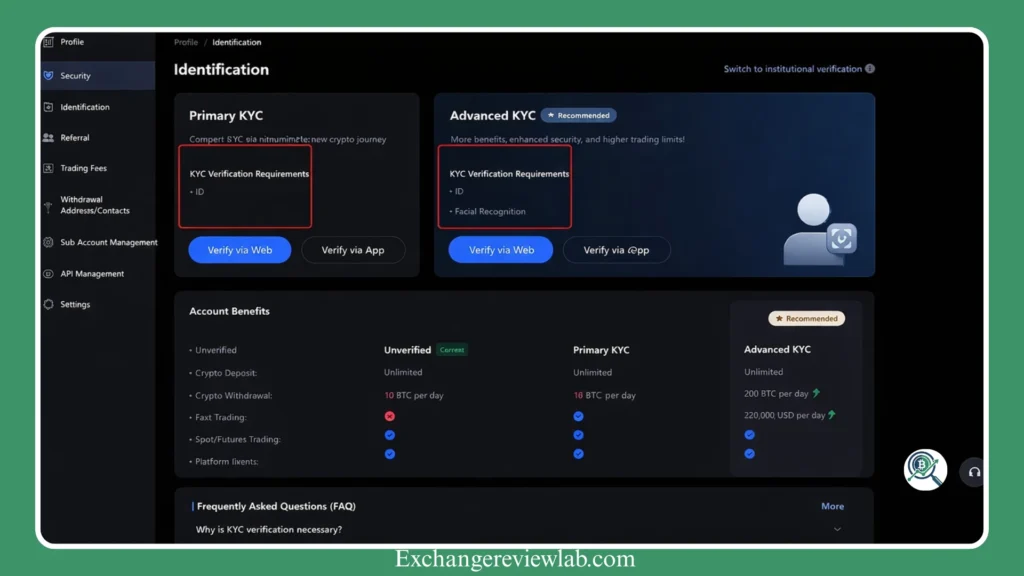
Basic account registration does not require identity verification on MEXC. You can deposit crypto and start trading with just an email address. However, KYC is required for:
- Daily withdrawals exceeding 1,000 USDT equivalent
- Fiat on-ramps via card or bank transfer
- Participation in Kickstarter, Launchpad, and airdrop events
- Full access under 2026 CARF compliance rules (requires a Tax Identification Number)
To complete KYC, navigate to the Verification section and submit a government-issued photo ID and a selfie. Standard verification completes in 1–2 business days. Advanced KYC for higher limits may take slightly longer.
Step 5 — Fund Your Account
Three main routes:
Crypto Deposit (Recommended for speed and cost): Navigate to Assets → Deposit, select your cryptocurrency and preferred network, copy the deposit address, and send from your external wallet. Free on MEXC’s side — you only pay the blockchain network fee. Use TRC-20 for USDT to minimize transfer costs.
P2P Trading (Recommended for fiat without a card fee): Buy crypto directly from other users using local bank transfer, UPI, or other regional payment methods. No third-party card fees. Available in most countries including India, where P2P is often the most practical route.
Buy with Card: Instant but more expensive. Third-party providers (Banxa, MoonPay, Mercuryo) handle card transactions and typically charge up to 4%. Convenient if you need to fund the account quickly and the premium is acceptable.
Step 6 — Start with Demo Trading First
If you are new to futures or unfamiliar with how leverage and liquidation work, activate the demo account before trading with real funds. You get a $50,000 virtual balance, access to the full futures interface, and the ability to make every possible mistake without any financial consequence. Most beginners skip this. Do not be most beginners.
Step 7 — Make Your First Trade
For your first spot trade, navigate to Spot Markets, search for the trading pair you want (e.g., BTC/USDT), and place a limit order at the price you want to buy. Using limit orders means you pay 0% maker fee. Using market orders means you pay 0.05% taker fee. For a beginner making one or two trades, the difference is small. For active traders, using limit orders consistently saves meaningful money over time.
Supported Currencies and Countries
Cryptocurrencies
MEXC supports 3,000+ cryptocurrencies. This includes all major assets (BTC, ETH, SOL, BNB, XRP, ADA, DOGE, SHIB, USDT, USDC) and thousands of altcoins, meme coins, DeFi tokens, and newly launched projects. The breadth is genuinely unmatched among major exchanges — Binance lists around 500 assets, Kraken around 200, and Coinbase around 200. If a token is generating buzz on Crypto Twitter, MEXC typically lists it within days of launch.
Fiat Currencies for Purchase
MEXC supports purchases in USD, EUR, GBP, INR, AED, BRL, NGN, PHP, TRY, VND, and dozens of other fiat currencies through third-party providers. Availability depends on your country and chosen payment method.
Countries
MEXC serves users in 170+ countries. It does not serve users in:
- United States (all 50 states and territories)
- Canada
- Mainland China
- Singapore
- Cuba, Iran, North Korea, Sudan
- Certain Russian-controlled regions of Ukraine
Users in the United Kingdom can access spot trading; derivatives and futures are restricted under FCA regulations. Japan has limited trading pairs due to FSA licensing requirements. India is well-served — MEXC is registered with FIU-IND, and P2P trading provides a practical fiat on-ramp.
What Real Users Actually Say
No platform review is complete without actual user voices. Here is the balanced picture from Trustpilot, Reddit, and crypto forums in 2026.
What Users Praise
The most consistent praise centers on coin selection and fees. Traders who hunt newly listed altcoins, meme coins, and early-stage tokens consistently rate MEXC as the best exchange for that specific use case. Copy trading gets positive mentions from users who benefited from mirroring profitable lead traders. The mobile app holds a 4.7/5 rating on both the Google Play Store and the App Store — genuinely strong numbers for a trading platform.
One Trustpilot user summarized a widely shared sentiment: “Not the best exchange, but it gets the job done for me. Buying and selling has no issues, but withdrawing can be a problem sometimes as it takes time to process.”
Where Users Have Problems
Three issues come up repeatedly:
Account Freezes: MEXC’s automated risk detection system sometimes flags legitimate user accounts. One verified Trustpilot user described trading with higher funds, becoming profitable, and then having their withdrawal held for five days with no clear reason provided. The funds were eventually released, but the experience was described as highly stressful. MEXC’s position is that the system catches fraud; users on the receiving end of false positives experience it very differently.
KYC Timing: Multiple users signed up under the impression that KYC is optional, made deposits, started trading successfully, and then found their withdrawals blocked until they completed full identity verification. The honest answer is that MEXC’s KYC rules have tightened significantly in 2026 due to industry-wide CARF compliance requirements. This is not unique to MEXC — it affects every major exchange — but the communication could be clearer.
Customer Support on Complex Issues: For routine questions, MEXC’s support generally responds quickly. For complex cases — account investigations, large withdrawal delays, Kickstarter eligibility disputes — support responses can be slow and generic. This is the most consistent complaint across every major review platform.
Trustpilot Score in Context
MEXC scores 1.8/5 on Trustpilot. That sounds alarming until you check the competition: Binance scores 1.4/5, and Coinbase scores 1.4/5.
Trustpilot scores for crypto exchanges are systematically skewed because dissatisfied users are far more likely to leave reviews than satisfied ones.
MEXC responds to 82% of negative reviews within one week — a genuine signal that the company actively monitors feedback.
The real picture is mixed: most users trade without incident, problems are real but not universal, and high-value withdrawals carry more friction than small ones.
Who Should Use MEXC and Who Should Avoid It
MEXC Makes Sense For:
Users who want access to the widest possible range of altcoins and newly launched tokens. Traders for whom low fees are a genuine priority — especially those placing large or frequent orders where fee differences have real financial impact. Futures traders who want low-cost access to leveraged crypto markets. Users in Asia, Africa, Latin America, and the Middle East where many US-regulated exchanges have limited availability. Anyone who wants to trade US stock index futures (NAS100, SP500) directly from a crypto account. Beginners willing to use the demo account to learn the platform mechanics before risking real money.
MEXC Is Not the Right Choice For:
US residents — they are blocked outright. Users in Canada, Mainland China, Singapore, and other restricted regions. Users who prioritize maximum regulatory protection and would pay more in fees for stronger legal oversight. People who want a simple, minimal interface for buying and holding Bitcoin or Ethereum — platforms like Kraken, Coinbase, or even Binance are more streamlined for that use case. Anyone needing reliable, fast-resolving customer support for complex issues.
MEXC vs. The Competition: When to Choose What
| If you want… | Best choice |
| Lowest fees + most coins | MEXC |
| US regulatory compliance | Kraken or Coinbase |
| Best overall liquidity | Binance |
| Cleanest beginner experience | Coinbase |
| Strong futures + moderate fees | Bybit or OKX |
| US stock futures via crypto | MEXC (unique offering) |
| Strongest audit trail + proof of reserves | MEXC or Kraken |
Frequently Asked Questions
What is MEXC, and when was it founded?
MEXC is a global centralized cryptocurrency exchange founded in 2018 under the name MXC Exchange. It rebranded to MEXC Global in 2021 and now serves 40+ million users across 170+ countries.
Is MEXC safe to use in 2026?
MEXC is a legitimate, large-scale exchange with solid security infrastructure. It keeps 95% of assets in cold storage, maintains a $100 million Guardian Fund, and publishes bi-monthly Proof of Reserves audited by Hacken. No major exchange-level hack has been confirmed as of 2026. Standard precautions — enabling 2FA, using withdrawal whitelists, avoiding suspicious browser extensions — apply as they do on any exchange.
Is MEXC available in the United States?
No. MEXC blocks US residents from registration, trading, and all services due to SEC and CFTC regulatory restrictions. US users should consider Coinbase, Kraken, or Gemini.
What are MEXC’s trading fees?
Spot trading: 0% maker, 0.05% taker. Futures trading: 0% maker, 0.02% taker. These are among the lowest in the industry. Holding MEXC’s native MX token unlocks further discounts of up to 50%. Fiat card purchases carry additional fees charged by third-party payment providers (up to 4%).
Does MEXC require KYC verification?
Basic crypto trading does not require KYC. However, KYC is required for daily withdrawals above 1,000 USDT, fiat on-ramps, participation in Kickstarter and airdrop events, and full access under 2026 CARF compliance rules (which also require a Tax Identification Number).
How many cryptocurrencies does MEXC support?
3,000+ cryptocurrencies and 2,052+ spot trading pairs. This is significantly more than Binance (~500), Kraken (~200), or Coinbase (~200).
What deposit methods does MEXC accept?
Crypto deposits (free), P2P trading with local bank transfers (free), and card purchases via Banxa, MoonPay, or Mercuryo (up to 4% fee). Direct bank wire deposits are limited and region-dependent.
Does MEXC offer stock trading?
Not in the traditional sense. MEXC offers perpetual futures contracts linked to the prices of US stocks and indices including NVDA, AAPL, TSLA, AMZN, NAS100, US30, and SP500. These are leveraged derivative instruments — not actual stock ownership.
What is MEXC’s customer support like?
Support is available 24/7 via live chat and email (support@mexc.com). Simple account questions resolve quickly. Complex cases involving withdrawals, account freezes, or large transactions take significantly longer and are the most common complaint across user review platforms.
Is MEXC a good exchange for beginners?
Yes — with one strong piece of advice. Use the demo trading account before touching the futures market with real money. The spot trading side is accessible for beginners, the copy trading feature removes the need to develop your own strategy from scratch, and the fee structure is forgiving for small traders. The interface is more trader-focused than beginner-focused, but it is learnable.
Read more : KuCoin Fees Review (2026) – Hidden Costs & Fees
Uphold Exchange Review 2026: Fees, Pros & Cons
Final Verdict: Is MEXC Worth Using in 2026?
MEXC is one of the most feature-rich and cost-efficient crypto exchanges available in 2026. Its zero maker fee on spot and futures is not a promotional stunt — it is the platform’s standard pricing. Its 3,000+ coin listings put every competitor to shame on breadth. And its expansion into stock-linked perpetual futures in 2026 gives traders a genuinely unique capability that no comparable exchange offers at the same scale.
The honest trade-off is regulation. MEXC does not have the same clean regulatory standing as Kraken or the brand trust of Coinbase. Its automated risk system can lock legitimate accounts. Its customer support struggles with complex issues. These are real limitations, not marketing noise.
The conclusion is straightforward: if you are outside the US and the restricted country list, want the lowest fees in the market, need access to the widest possible range of crypto assets, and are willing to treat MEXC as an active trading venue rather than a long-term crypto vault, it belongs near the top of your shortlist.
Just do three things before you fund the account: enable 2FA, set a withdrawal whitelist, and spend one hour with the demo account. Crypto trading rewards preparation, and so does MEXC.
